



Electric vehicles charge while driving
 Published2024.08.19 10:31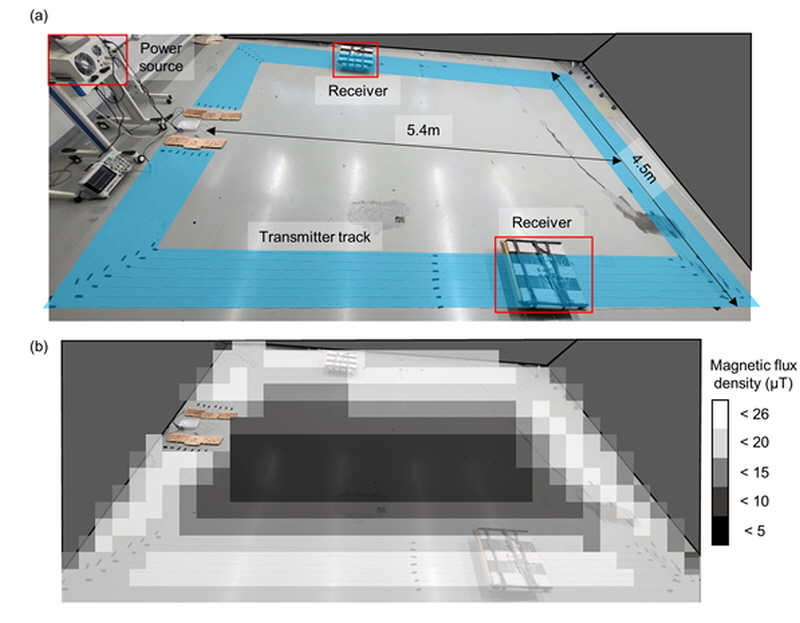
▲ Wireless power transmission experiment for two robots
With the development of technology to wirelessly supply power to moving vehicles, expectations are growing that electric vehicles will be able to charge while driving in the future.
A team led by Professor Young-Jae Byun of the Department of Electrical and Electronic Engineering at UNIST (President Jong-Rae Park) announced on the 16th that they have developed a 'wireless power supply track' that supplies power to moving vehicles without interruption.
By forming a wide and strong magnetic field composed of wires, flexible vehicle movement is possible in all directions without the need for expensive ferromagnetic magnets.
When current flows through an electromagnetic wave generator, a circular magnetic field is generated. As the range of the magnetic field expands through multiple wires, power is efficiently transmitted. Electric vehicles can drive flexibly on the power supply track formed by this wide magnetic field.
We also developed an algorithm to optimize the structure of the power supply track and power receiver. We increased the electric vehicle power transmission efficiency to up to 90%. Existing technology attempted to increase efficiency by using ferromagnetic materials, but it was difficult to apply in practice due to high costs and poor durability.
To enable the application of wireless power supply technology in real life, the research team has also completed verification of human safety, including certifications from the Institute of Electrical and Electronics Engineers (IEEE) and the International Commission on Non-Ionizing Radiation Protection (ICNIRP).
Professor Byun Young-jae explained, “Transportation vehicles, including electric cars, must be able to drive flexibly not only in parallel but also in vertical directions, but existing dynamic wireless charging technology has failed to realize this.”
"If this technology is applied to electric vehicles, it can solve the problems of long charging times and short driving ranges," said first author Cho Hyun-kyung. "Reducing the battery capacity can also reduce pollution caused by the extraction of resources such as lithium, enabling the sustainable use of natural resources."
The research results were published online in the international journal Applied Energy on August 12. The research was conducted with support from the Institute of Information and Communication Technology Planning and Evaluation (IITP) under the Ministry of Science and ICT and the National Research Foundation of Korea (NRF).

Comments
Related news
Biosensor that rapidly detects minute amounts of protein using light
A joint research team led by Professor Lee Jong-won from the Department of Electrical and Electronic Engineering at UNIST (President Park Jong-rae) and Dr. Jung Joo-yeon from the Nanolithography Research Center at Korea Institute of Machinery and Materials (Director Ryu Seok-hyun) has developed a novel biosensor that dramatically improves protein detection sensitivity.
2024.07.11by 배종인 기자
Success in core technology of ultra-fast quantum computer
A joint research team led by Professor Son Chang-hee from the Department of Physics at UNIST (President Park Jong-rae) and Professor Kim Heung-sik from the Department of Semiconductor Physics at Kangwon National University (President Jung Jae-yeon) has successfully increased quantum fluctuations in cobalt-based honeycomb-structured oxides. This marks the world's first confirmation of the feasibility of implementing a quantum spin liquid.
2024.07.18by 배종인 기자
Low-cost green hydrogen production using platinum-free catalysts
A research team led by Professor Lee Seung-geol from the Department of Materials Science and Engineering at UNIST (President Park Jong-rae) has presented a novel anion exchange membrane water electrolysis technology utilizing low-cost non-platinum metal catalysts, and has elucidated the mechanism to prevent ionomer degradation and oxidation phenomena that occur in hydrogen production using the anion exchange membrane method.
2024.07.24by 배종인 기자
.jpg)
Perovskite solar cell stability solved with cheap tin chloride
Commercialization of perovskite solar cells is expected to be accelerated through the use of inexpensive tin chloride. UNIST (President Park Jong-rae) announced that a joint research team led by Professor Kim Dong-seok of the Carbon Neutral Graduate School and Dr. Cho Im-hyun of the Korea Institute of Energy Research improved the stability of solar cells by reacting inexpensive tin(IV) chloride on tin oxide.
2024.08.02by 배종인 기자
Powering Wearable Devices Wirelessly
Professor Jimin Kwon and Doctor Yongwoo Lee from the Department of Electrical and Electronic Engineering at UNIST (President Jong-Rae Park) have developed a technology to maintain long-term stability in polymer Schottky diodes together with Professor Seongjun Jung from the Department of Advanced Materials Science and Engineering at POSTECH (President Sung-Geun Kim). This overcomes the existing problem of diode performance degradation caused by moisture and oxygen.
2024.08.08by 배종인 기자











