



Artificial Intelligence Threatens Even Expert Fields
 Published2024.08.27 15:48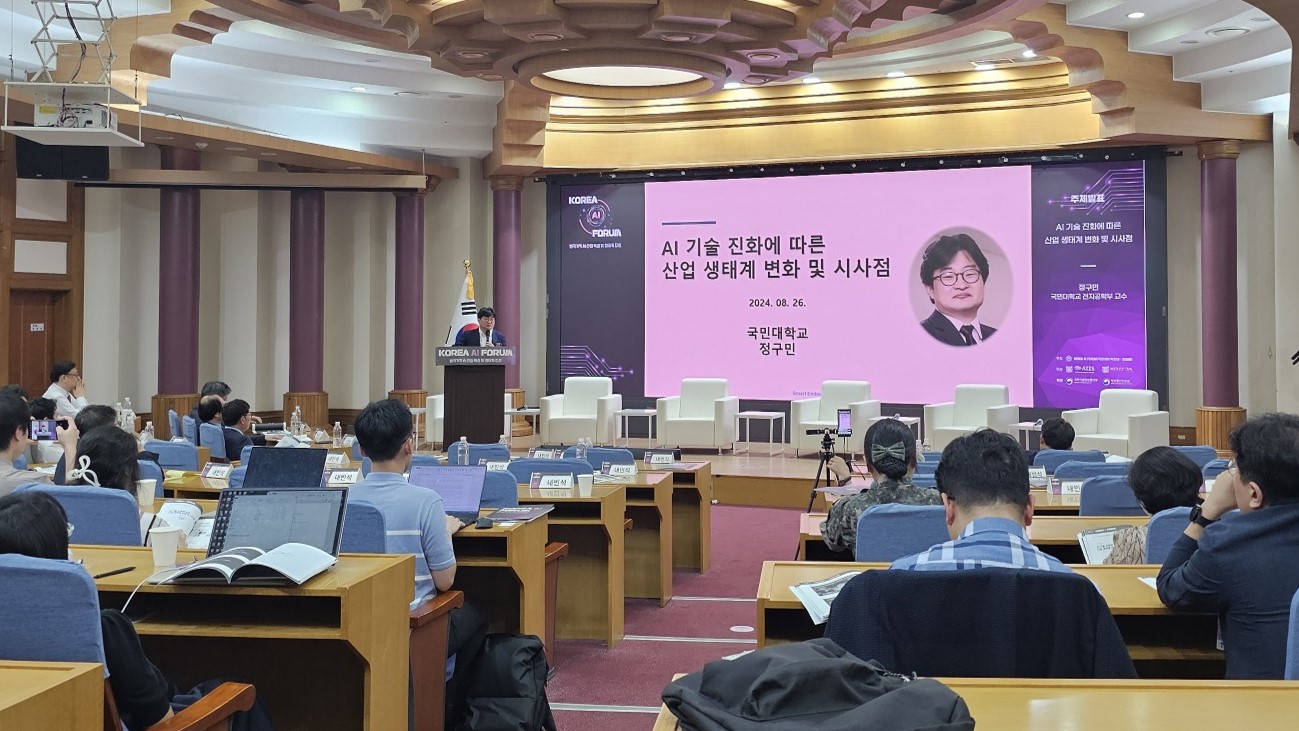
▲ Korea AI Forum
Building AI infrastructure such as data centers and semiconductors is essential
AI technology is exerting influence across all industries and driving change. In response, an AI policy forum was held to urge a swift national and bipartisan response, bringing together experts from various fields for a heated discussion.
The Korea AI Forum was held at the National Assembly Members' Office Building in Yeouido, Seoul on the 26th. AI experts from industry, academia, and research institutes gathered to discuss the event, which was held to find common ground on regulatory improvements and the creation of an AI ecosystem to foster the AI industry and promote technology.
In his opening remarks, Kim Seok-ho, Director of the Korean Social Science Archives at Seoul National University and a co-steering committee member of the forum, stated, “The purpose of this forum is to ensure the smooth implementation of the Framework Act on AI.” He added, “We are planning to hold a special AI exhibition, formulate a national strategic policy proposal containing short-, medium-, and long-term roadmaps synthesizing research results, and publish a comprehensive white paper.”
At the forum, three research presentations were presented: a science and technology part researching strategies for developing core AI technologies, an industrial promotion part establishing corporate support policies, and a legal and institutional part organizing related governance and systems.
Professor Jeong Gu-min of the Department of Electronic Engineering at Kookmin University gave a presentation on "Changes in the Industrial Ecosystem and Implications Following the Evolution of AI Technology." He predicted the impact of the emergence and development of AI technology on industry, as well as issues regarding employment.
Professor Jeong predicted that 'compression time' would become a major issue due to generative AI. This refers to situations where devices can easily operate numerous functions based on generative AI services derived from voice recognition, without any physical manipulation of the device.
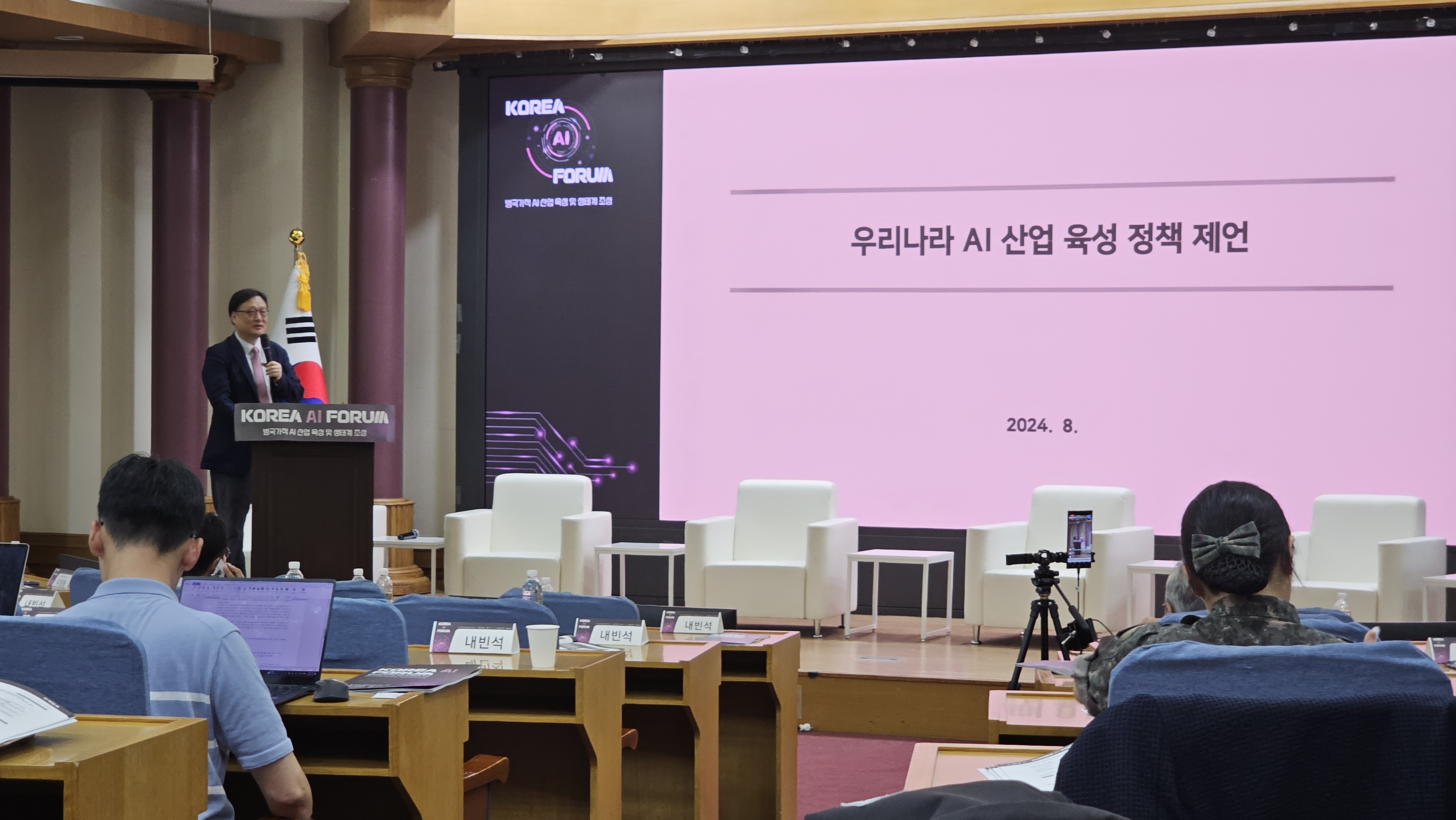
Professor Han Soon-gu of the Department of Economics at Yonsei University presenting policy recommendations.
In addition, it was explained that the expansion of generative AI by big tech companies within the industry's value chain leads to increased investment in AI infrastructure, which in turn leads to expanded investment in data centers and increased revenue for AI semiconductor companies such as Nvidia. Furthermore, amidst the expanding AI ecosystem, the importance of the energy industry is gradually increasing due to power supply shortages.
Professor Jeong expressed concern regarding the areas of AI and jobs, stating, “Even the professional sector is affected by the threat of artificial intelligence,” and noting that “the unemployment rate at U.S. tech companies last March was 2% higher than that of general companies.” This suggests that work processes enhanced by AI learning could lead to a reduction in the fixed workforce employment rate at big tech companies.
Professor Han Soon-goo of the Department of Economics at Yonsei University suggested, through policy recommendations, the expansion of AI data centers and the inducement of domestic investment, the nurturing of AI talent and startups through increased accessibility to AI infrastructure and the development of AI hub cities, and the establishment of an AI regulatory framework to promote AI innovation and the widespread use of AI.
Comments
Related news
Review of large-scale R&D to foster AI semiconductors
The Ministry of Trade, Industry and Energy announced on the 14th that First Vice Minister Park Sung-taek visited Furiosa AI as his first field visit since taking office, and held a roundtable discussion with domestic AI semiconductor supply companies including fabless, design house, and software firms, as well as demand companies such as Hyundai Motor, LG Electronics, and Hanwha Systems that are promoting AI adoption in major industries, to strengthen competitiveness in AI semiconductors.
2024.08.19by 배종인 기자
LG Electronics to Full-scale Attack on AI Data Center Cooling Market
LG Electronics held an "Investor Forum" on the 21st at LG Science Park in Magok, inviting domestic and foreign institutional investors and securities analysts. CEO Cho Joo-wan presented the progress and direction of business portfolio innovation that has been pursued over the past year since announcing the 2030 future vision. In addition to CEO Cho Joo-wan, top executives including CFO Kim Chang-tae (Senior Vice President), CSO Lee Sam-soo (Senior Vice President), and executives in charge of fostering key businesses such as HVAC (heating, ventilation and air conditioning), webOS content/services, and subscriptions attended the event.
2024.08.21by 배종인 기자

US Perplexity Joins Hands with SKT, Leading AI Search Engine Market
Perplexity, which has garnered attention as a Google alternative, will formally introduce an advertising system to its AI-based search platform by the end of this year. Perplexity is reshaping the conversational AI search engine market based on large language models (LLM) by attracting massive investments from Nvidia, Amazon, SKT, and other major players.
2024.08.23by 김예지 기자
.jpg)
Samsung Electronics AI Home Appliances, Voice Control Gets Easier
Samsung Electronics' 'Bespoke AI Appliances' feature an upgraded artificial intelligence (AI) voice assistant 'Bixby' that enables easier control of appliances through natural language-based voice commands that understand context.
2024.08.26by 배종인 기자

[e4ds Tech Day 2026 ⑨] Sim Sang-gyu, Autocrypt CTO: "In the Physical AI Era, Automotive Security Must Extend Beyond the Vehicle"
At e4ds Tech Day 2026, Sim Sang-gyu, CTO of Autocrypt, explained automotive cybersecurity strategies in the era of Physical AI and SDV (Software-Defined Vehicle). Automobiles are evolving as part of an ecosystem connected to AI, cloud, chargers, IoT, and robots, and he emphasized that the scope of security must expand beyond the vehicle interior to the entire connected environment. In particular, AI model tampering, adversarial attacks, OTA updates, and EV charger hacking were identified as major threats. He explained that response measures require zero trust, AI model integrity protection, intrusion detection, Security by Design and Default, and full lifecycle security management, and that proactive security system establishment beyond regulatory compliance is critical for securing future mobility competitiveness.
2026.10.12by 배종인 기자











