



Electronics students avoid soldering, professors struggling with hardware education
 Published2025.02.14 11:45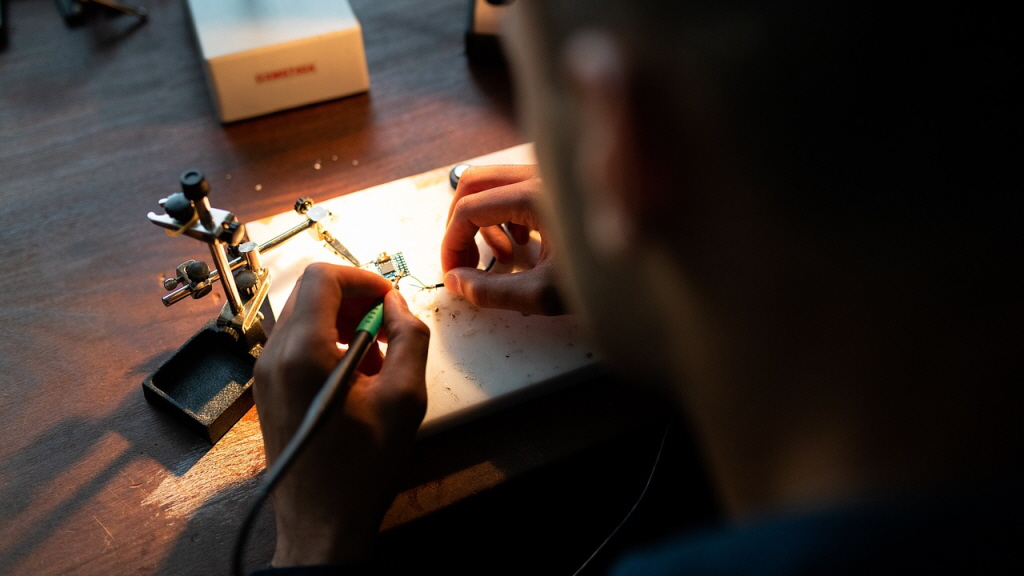
Office of Education operates practical training, providing educational support such as ventilation and health checkups
To handle hardware such as power design with ease, start with soldering.
As students' aversion to soldering intensifies in the school curriculum, hardware education is being replaced with blueprints or simulations; however, as a result, students graduate and become developers, feel a lack of proficiency, and end up going to private academies to learn soldering again. It is an unfortunate reality that the educational environment is better at schools.
Recent reporting by this publication regarding hardware education in the Department of Electronic Engineering at the College of Engineering revealed that students' soldering education is facing difficulties.
A professor interviewed by this publication reported that, in order to provide proper hardware education, he has students implement actual circuits by soldering on PCBs and intentionally break the resulting products to find errors and fix the problems by soldering, but student participation is gradually decreasing.
This means that while the problem-solving process is difficult, students also dislike soldering.
According to the professor, students tend to avoid practical classes, such as soldering, because their primary goal is to earn good grades.
The professor mentioned that class participation is low because he does not give grades for soldering, and that he is receiving complaints from students in the course evaluations. Rather, professors who try to provide proper education to students are being shunned by them.
It is said that some professors often substitute soldering with blueprint or simulation training, and there are even rumors circulating among professors that soldering training is prohibited.
Accordingly, this newspaper directly inquired with the Career and Vocational Education Division of the Seoul Metropolitan Office of Education, and the results showed that there were absolutely no issues with the soldering education.
On the contrary, in the case of specialized high schools, it was found that soldering education was implemented in 18 schools within Seoul in 2024, in accordance with the school-specific curriculum and practical training operation plans under the 'Elementary and Secondary Education Act' and the Ministry of Education notification.
In addition, it was found that to ensure student safety during practical training, relevant guidelines under the Industrial Safety and Health Act, the Act on Prevention and Compensation of School Safety Accidents, the School Health Act, and the Framework Act on Student Safety are applied, making safety education, including safety rules within laboratories and practice rooms, mandatory during soldering practice.
In addition, it was stated that through the Office of Education's health management support program, workplace environment measurements are being conducted for all laboratories where exposure to hazardous substances is a concern, including the soldering lab in the electronics department, and special health examinations are being carried out annually for students and teachers in the relevant laboratories.
Therefore, it is clear that soldering education at specialized high schools and universities is a legally permitted curriculum.
In conjunction with this phenomenon, it has been found that entry-level hardware developers who graduated from electrical engineering are attending private academies to improve their problem-solving skills, which are often lacking during the development process, and are actually participating more actively in training that involves practical soldering.
Rather, in terms of competent faculty and safety aspects such as ventilation, the schoolAlthough the school is superior, proper education is not being provided due to misinformation and students' avoidance.
Of course, lead is a heavy metal that can have serious effects on the human body, so it is a substance that requires safety management.
Accordingly, they stated that they are ensuring safety and conducting education through mask-wearing and the installation of ventilation systems, and that the Seoul Metropolitan Office of Education, along with other city and provincial offices of education, are frequently inspecting the safety management status of the practice rooms.
Despite these risks, the reason we must proceed with soldering training is that it is an essential course for accurately understanding hardware, including electronic circuits and electronic products.
In particular, for hardware, solving various problems such as EMI (electromagnetic interference) and power supply design requires the ability to directly assemble, disassemble, and modify electronic components like ICs, capacitors, and resistors on an actual PCB; however, if one cannot solder, one cannot even begin.
Professors in electrical engineering unanimously agree that since years of experience are required for hardware development and troubleshooting, while it is important for students to handle simulation tools, they must also become familiar with the most basic soldering techniques to enable them to freely modify circuits on actual PCBs.

Comments
Related news
.jpg)
System semiconductor industry seeks to resolve labor shortage through in-house training
System semiconductor companies, facing industry survival threats due to developer shortages, are seeking to resolve labor shortages through in-house training programs.
2021.12.09by 배종인 기자
.jpg)
Embedded Development 'No People'
As demand for developers in semiconductors, artificial intelligence (AI), and autonomous vehicles is exploding, the shortage of embedded developers capable of designing and developing chips and products used in these fields is raising concerns that not only small and medium enterprises, but also mid-sized and large corporations will face developer shortages in the future, potentially falling behind in advanced technology development.
2022.10.11by 배종인 기자
.jpg)
“Domestic chip market is drying up, quickly replaced by embedded chips under development”
As developers continue to have no choice but to use Chinese chips due to inability to procure domestic chips, the proportion of domestic chips in domestic electronics product development is declining rapidly. While the domestic semiconductor industry has been putting all its efforts into AI, there is growing consensus that the domestic electronics industry can only survive if the embedded systems semiconductor industry, which has been deteriorating, is revived.
2025.02.07by 배종인 기자
ESP32 Development Environment Selection and GPS Application Implementation
The ESP32 is a microcontroller that integrates Wi-Fi, Bluetooth, 12-bit ADC, capacitive touch, PWM, DAC, and UART in a single SoC. However, the abundance of features does not by itself solve the designer's problems. The real challenges lie in selecting the appropriate development environment, determining which pins can be used and which must be avoided, and converting raw data from modules into usable information. This document addresses ESP32 peripheral constraints (ADC2 and Wi-Fi coexistence limitation, UART1 occupancy, ADC non-linear regions), the trade-offs between Arduino IDE and ESP-IDF, and the process from connecting NEO-6M/NEO-M8N GPS modules to UART2, parsing NMEA sentences, and visualizing routes in Google Earth, all organized based on documented references.
2026.10.12by 편집부
MIPI CSI-2, DSI-2, C-PHY, D-PHY Test Solution Technical White Paper
The MIPI interface adopts a burst mode that transitions between low-power (LP) and high-speed (HS) states for low-power consumption, and in return, strict timing rules are imposed on state transitions. Additionally, the high-speed section operates as a packet-based protocol with headers, ECC, and CRC, so verification engineers must handle waveforms and protocols simultaneously. Traditional configurations combining general-purpose oscilloscopes and AWGs reveal limitations in setup complexity, measurement uncertainty, and lack of reproducibility when faced with these requirements. This white paper, based on webinar materials, organizes the structure of this problem and describes how the SV5C-DPTXCPTX generator for receiver testing and SV5C-DPRXCPRX analyzer for transmitter testing integrate state transition testing, stressed eye testing, and protocol analysis into a single bench, along with their application boundaries.
2026.10.12by 편집부











