


“Electric vehicle integrated drive module, must overcome technical challenges in thermal management, circuit integration, and functional safety”
 Published2025.02.19 15:50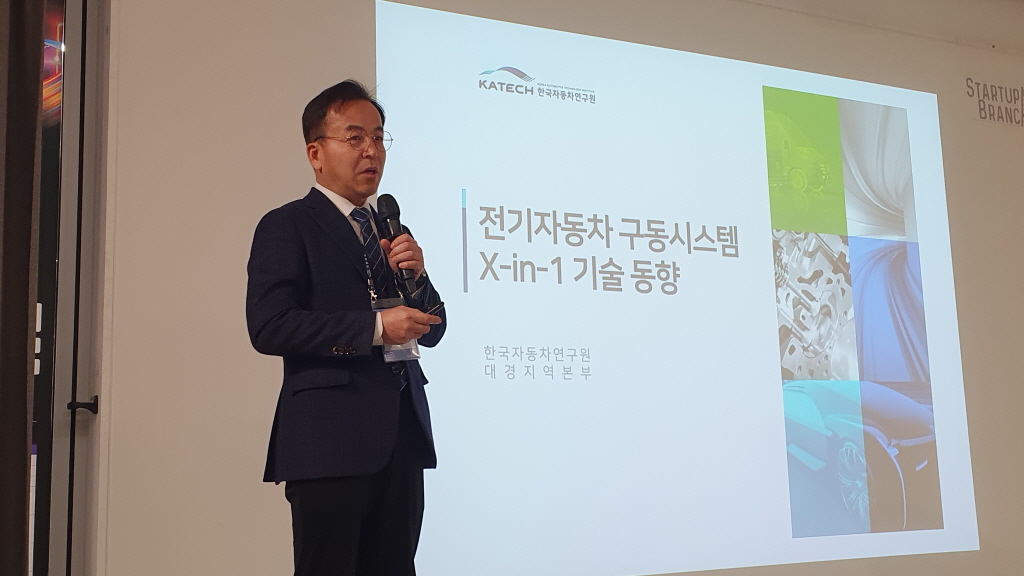
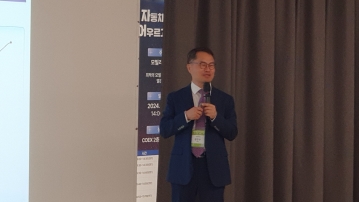
▲Son Young-wook, head of the Daegyeong Regional Headquarters of the Korea Automobile Research Institute, is giving a presentation.
Market leadership, including China's BYD's 12-in-1 achievement, requires Korean technology development
“The integrated electric vehicle drive module is a key to leading electric vehicle technology. “The Chinese automobile industry has considerable technological prowess ahead of us and is leading the global market. We, too, must overcome technological challenges and actively engage in technological development.”
Son Young-wook, head of the Daegyeong Regional Headquarters of the Korea Automobile Research Institute, presented the EV drive system X-in-1 technology trend at the 17th Jasan Eobo event held at the COEX Startup Branch on the 18th and emphasized the importance of developing electric vehicle integrated drive module technology.
According to CEO Son Young-wook, the electric vehicle integrated drive module is a module that converts electrical energy to generate rotational force and converts it into mechanical energy required by various systems, including components responsible for driving such as motors, inverters, and reducers.
It minimizes energy transfer loss between drive system components, improves power efficiency, enhances drive performance, and enables optimal torque and speed control. It also increases component integration to optimize weight reduction and space utilization, and contributes to improved fuel efficiency and battery efficiency.
In addition, the production process is simpler than conventional methods, and mass production of standardized modules can increase overall productivity.
Accordingly, it is receiving attention as a key to securing leadership in electric vehicle technology.
On the other hand, since the performance required for each individual part is different for each vehicle, the number of vehicle models to which the drive module can be applied is limited, which reduces profitability, and since many parts are integrated into one housing, there are difficulties with heat management.
In addition, component failure may affect the operation of the entire system, requiring replacement of the entire module. Excessively integrated drive modules are difficult to deploy horizontally and have poor space utilization.
Looking at global technology cases, China is demonstrating the most advanced technology.
▲Summary of technology development cases by company
BYD integrated 12 components into one, JAC Motors integrated 9 components into one, and Huawei and Changan integrated 7 components into one.
On the other hand, Hyundai Transys of Korea was found to have technology that is still inferior to that of overseas companies, such as integrating only three components - a motor, inverter, and reducer - into a single module.
Integrated drive module technology is expected to further develop in the future.
Let's take another look at the technology of China's BYD, which is said to be the most advanced. The integrated scope integrates 12 components, including the motor, inverter, reducer, VCU, PDU, LDC, OBC, BMS, EMS, ISHM, IUM, and IBM, into one. It uses the next-generation power module to increase the maximum power efficiency to 99.86%, and the overall average efficiency to 92%, showing off considerable technological prowess.
A total of 12 PCB slaves were placed in the BMS to improve performance and safety, and the V-shaped structure showed a motor slot filling rate of 92%.
However, the circuit has not been integrated yet, and it was confirmed that there are still technical issues to be resolved by showing the level of circuit stacking.
Referring to BYD's technology case, we also analyzed that in order to develop integrated drive module technology, we need thermal management integration that takes into account the cooling conditions required by each component, such as the motor, inverter, and reducer, and circuit integration technology that takes into account voltage, current, and signal characteristics.
In particular, circuit design that takes into account insulation design, EMC/EMI mains, noise suppression, and wiring optimization is required.
Also, defects in individual parts may occur. Fault detection and functional safety requirements are also taken into consideration as the components can be distributed.

Comments
Related news
Hanjayeon, Asset Management Event Held...Battery Material Related Companies in One Place
The Korea Automotive Research Institute (hereinafter referred to as KARI) has established a forum for diverse communication and exchange among relevant companies regarding issues and industry trends in the battery materials sector.
2023.11.17by 성유창 기자
Carbon neutrality for electric vehicles depends on renewable energy.
Kim Hyun-soo, Professor Emeritus at Sungkyunkwan University, emphasized the use of renewable energy in the electric vehicle industry at the 6th Sanchoenepo event, which the Korea Automotive Research Institute (hereinafter referred to as KARI) held on the 15th at the COEX Startup Branch, on the subject of the latest trends and prospects including hybrid technology.
2024.02.16by 성유창 기자
Hanjayeon, forming consensus on eco-friendly material technology for full-process evaluation
The Korea Automotive Research Institute (President Na Seung-sik) is holding the 12th Jasan Eo-bo event under the theme of 'Carbon Reduction Material Technology Based on LCA,' and has established a forum for forming consensus on development trends and advancement strategies for eco-friendly mobility material technologies based on Life Cycle Assessment (LCA) as part of global carbon neutrality efforts.
2024.09.13by 배종인 기자
“Vehicle integrated thermal management essential, transition to modular component development”
The Korea Automotive Research Institute (Director Na Seung-sik) held the 14th Ja-San-Eo-Bo event on the 14th at the COEX Startup Branch, with the theme of "Mobility Thermal Management / Thermal Management Strategy for Optimal Mobility Performance." At this event, presenters stated that "with the transition into the electric vehicle era, the adoption of an integrated thermal management system that efficiently utilizes the heat of automobiles has become essential, and to implement this in vehicles, it is necessary to automate processes and manufacture modular components that can reduce volume and weight."
2024.11.15by 배종인 기자
.jpg)
Hanjayeon, 15th Asset Report 2024 Mobility Industry Settlement
The Korea Automotive Research Institute (President Na Seung-sik) held the 15th Sasan Eobo event on the 16th at COEX Startup Branch in Gangnam-gu, Seoul, under the theme of "Settlement and Outlook of the Mobility Industry: Challenges and Strategies for Future Mobility Development (subtitle)."
2024.12.17by 배종인 기자











