


"HMI·UX: A New Frontier in Automotive Competition: User Experience is Key"
 Published2025.04.30 15:18
.jpg)
Future Automotive UX: Creating New Business Opportunities
As the core competitiveness of automobiles is shifting towards 'passenger experience,' it has emerged that a new approach is needed that views automobiles not as simple means of transportation but as human-centered experience spaces.
The Korea Automobile Research Institute recently published the April 2025 issue of 'Mobility Insight' and emphasized the importance of HMI (Human-Machine Interface) and UX (User Experience) in the automotive industry.
With the full-fledged arrival of the autonomous vehicle era, automobiles are transforming beyond mere transportation into "smart living spaces," and as a result, passenger experience is becoming a key competitive factor.
According to this researcher's presentation, HMI is evolving from the traditional focus on physical buttons and levers to intuitive interfaces such as voice recognition and gesture control.
At the same time, UX encompasses the entire vehicle use experience and is rapidly being reorganized from driver-centered to passenger-centered.
This shift was also evident at CES 2025 earlier this year. Major global automakers have focused on transforming the in-car user experience by introducing advanced HMI technologies.
Reflecting this, the Korea Automobile Research Institute recently held a symposium with domestic experts on HMI and UX, which have emerged as a new chapter in automotive competition.
The symposium examined domestic and international trends in related technologies and discussed strategies and challenges for domestic companies to secure competitiveness in the global market.
At this symposium, experts emphasized the concept of 'HVE (Human Vehicle Experience),' which is an integrated concept of HMI and UX.
This approach views vehicles not simply as a means of transportation, but as human-centered experience spaces. It starts from the recognition that in the era of autonomous driving, every moment before and after boarding must be connected as a single experience.
On the other hand, a UX-centric approach is currently lacking in the domestic automotive industry. Experts point out the need for a comprehensive strategy that considers not only technological development but also the industrialization process.
In particular, the need for standardization work through government projects was also discussed. While Europe and the United States are already actively conducting HMI/UX research at the government level, there have been criticisms that related projects in Korea are classified as design-related and therefore lack policy support.
Accordingly, experts unanimously agreed that institutional improvements are needed to improve the research environment and expand corporate participation.
Additionally, the issue was raised that HMI technology is undervalued despite being directly linked to safety rather than simply providing convenience.
As it is a key element involved in accident prevention and driver cognitive response, there were opinions that the government should establish an HMI roadmap and establish a clear support system.
Automotive UX goes beyond providing usability and convenience while driving; it can also serve as an opportunity to create new revenue models.
Experts explained, “Introducing the concept of business UX can create an ecosystem that can generate revenue in the automotive space.”
There is also a prediction that UX will likely be implemented as a new function in the future SDV (Software Defined Vehicle) environment.
Along with this, the need for talent development and expanded research in the automotive HMI/UX field was emphasized.
Because the technology is a convergent field that includes multidisciplinary elements, a more comprehensive research approach is required.
Experts advised that automotive HMI should be linked to complex technologies such as perception and signal processing, rather than simply designing an interface.
The Korea Automotive Research Institute plans to continue conducting research on HMI and UX in the future and support domestic automobile companies in securing global competitiveness.
Experts say, “Changes in the automobile industry are not only driven by technological advancements but also by innovations in user experience.He emphasized that “it must proceed together.”

Comments
Related news
Han Ja-yeon, “AI Autonomous Manufacturing is the Key Driving Force for Manufacturing Innovation”
The Korea Automotive Research Institute (Director Jong-wook Jin) has spotlighted a new paradigm called "AI Autonomous Manufacturing" in the February 2025 issue of Mobility Insight recently released, which addresses the adoption of artificial intelligence (AI) to enhance productivity and resolve challenges such as labor shortage, supply chain stabilization, and carbon reduction in order to overcome multiple limitations faced by manufacturing.
2025.02.12by 권신혁 기자
.jpg)
“E-powertrain, increased number of motors and controllers, control difficulties must be resolved”
The Korea Automotive Research Institute (President Jin Jong-wook) held the 17th Sasan-eo-bo event on the 18th at COEX Startup Branch under the theme of "E-Powertrain | The Power Accelerating Future Mobility, Found in the Heart of Future Vehicles." At the event, Professor Im Myung-seop from Hanyang University presented on "E-Powertrain, Solutions for a Sustainable Future." Professor Im Myung-seop stated that challenges must be addressed as the number of motors and inverters increase in E-powertrains, leading to system complexity.
2025.02.18by 명세환 기자
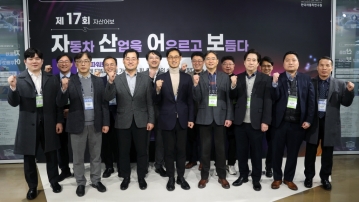
Han Ja-yeon, “Increasing importance of E-powertrain, the heart of future cars”
The Korea Automotive Research Institute (KARI, Director Jong-wook Jin) held the 17th Sasan Eo Bo event at COEX Startup Branch under the theme "E-Powertrain: Finding the Driving Force for Future Mobility in the Heart of Future Vehicles," opening a forum for exchange to develop sustainable future mobility solutions through electrified powertrain (e-PT) technology.
2025.02.18by 배종인 기자
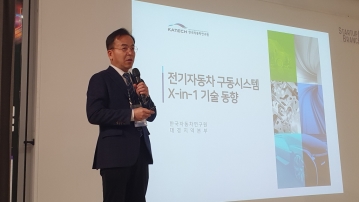
“Electric vehicle integrated drive module, must overcome technical challenges in thermal management, circuit integration, and functional safety”
Son Young-uk, head of the Daegyeong Regional Division at Korea Automotive Research Institute, presented trends in EV propulsion system X-in-1 technology at the 17th Sasan Eo-bo event held at COEX Startup Branch on the 18th, emphasizing the importance of developing integrated propulsion module technology for electric vehicles.
2025.02.19by 배종인 기자
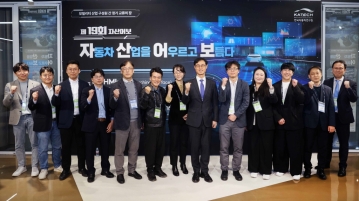
Hanjayeon Creates a Platform for Exchange on HMI Technology Innovation
The Korea Automotive Research Institute (Director Jong-wook Jin) has established a platform for exchange to promote innovation and advancement in HMI (Human Machine Interface) technology that connects humans and vehicles.
2025.04.15by 배종인 기자











