


"The Russian auto market has become a high-risk market since the Russo-Russian War."
 Published2025.05.09 15:13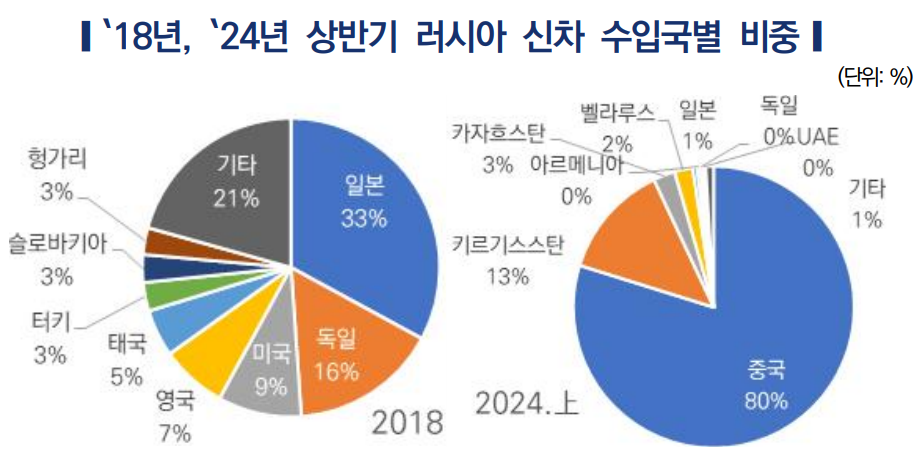
Global manufacturers' re-entry potential intensifies competition.
After the war in Russia and Ukraine, the Russian automobile market was expected to become a high-risk market due to fierce competition between Chinese brands that dominated the market after the withdrawal of global manufacturers and global manufacturers seeking to re-enter the market.
The Korea Automobile Research Institute recently published an industry analysis report titled ‘(Industry Analysis Vol. 146) Changes and Outlook for the Russian Market after the Russo-Russian War.’
According to this, the Russian automobile market has undergone significant changes since the Russo-Ukrainian War, and interest in the possibility of global automakers re-entering the market is growing.
The war significantly reduced Russia's domestic production base, and economic sanctions by major Western countries and the voluntary withdrawal of global manufacturers drastically altered the automotive supply chain.
Accordingly, the market has shifted to an import-oriented one, with Chinese automobile brands in particular dominating the market.
Before the war, the Russian automobile market was dominated by global brands such as Hyundai, Renault, Toyota, and Volkswagen, with local production accounting for 80% of total supply.
Meanwhile, local production plummeted from 1.4 million units in 2021 to 740,000 units in 2024 as major manufacturers withdrew due to policy changes by the Russian government and international sanctions.
To alleviate the shortage of automobiles, the Russian government has pursued a policy of allowing parallel imports and expanding imports of Chinese brands.
As a result, Chinese brands will account for approximately 80% of new car imports to Russia as of 2024, and the share of new car sales will also change rapidly, with Chinese brands accounting for over half.
The Russian government has recently been strengthening policies to protect the domestic automotive industry and reduce its dependence on foreign brands.
Accordingly, recycling fees, which act as a non-tariff barrier to imported vehicles, were significantly increased, reaching 8% of the average vehicle price in October 2024, and further increases were made in January 2025.
In addition, a customs clearance information sharing system was established among member countries of the Eurasian Economic Union (EAEU) to block price manipulation and tax evasion of imported vehicles, and a policy was introduced to prohibit parallel imports of vehicles from brands with official distributors in the country.
The move is seen as a strategy to curb imports from Chinese brands, with Chinese automakers considering ways to strengthen their local production systems to remain competitive in the Russian market.
Although the Russian market is being reorganized around Chinese brands, consumer trust in Chinese-branded vehicles remains low.
In a September 2024 survey of Russian car consumers, 27.6% said they would never buy a Chinese brand car, while 27.5% said they would buy it if they had no other choice.
Nonetheless, consumer perceptions are rapidly changing as the market share of Chinese brands in Russia increases, with 65.3% of respondents who own Chinese cars saying they are satisfied with their cars.
Global manufacturers re-enter the Russian market Although it is being considered, it is expected that it will not be easy to recover the high market share of the past.
Furthermore, the Russian government is likely to impose conditions for foreign manufacturers to re-enter the market, such as establishing branches in Russia, making joint ventures, sharing technology, and achieving a high localization rate, which will likely lead to more cautious strategies for companies entering the market.
The Russian market is a high-risk market subject to rapid change depending on factors such as the direction of the war, policy changes, and whether Western countries ease sanctions.
Currently, durability and after-sales service quality issues of Chinese brand vehicles are continuously being raised, and there is a high possibility that the Russian automobile market structure will be restructured in the medium to long term.
Global manufacturers should carefully consider whether to re-enter the Russian market and develop various scenarios and response strategies, including whether to establish a local production system or maintain existing brand strategies.
A cautious approach is also essential, taking into account the potential for intensifying competition from Chinese brands and the Russian government's uncertain policy stance.

Comments
Related news
.jpg)
“E-powertrain, increased number of motors and controllers, control difficulties must be resolved”
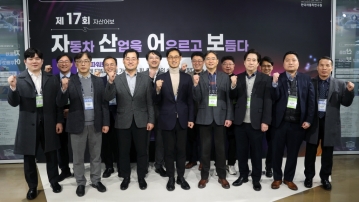
The Korea Automotive Research Institute (President Jin Jong-wook) held the 17th Sasan-eo-bo event on the 18th at COEX Startup Branch under the theme of "E-Powertrain | The Power Accelerating Future Mobility, Found in the Heart of Future Vehicles." At the event, Professor Im Myung-seop from Hanyang University presented on "E-Powertrain, Solutions for a Sustainable Future." Professor Im Myung-seop stated that challenges must be addressed as the number of motors and inverters increase in E-powertrains, leading to system complexity.
2025.02.18by 명세환 기자
Han Ja-yeon, “Increasing importance of E-powertrain, the heart of future cars”
The Korea Automotive Research Institute (KARI, Director Jong-wook Jin) held the 17th Sasan Eo Bo event at COEX Startup Branch under the theme "E-Powertrain: Finding the Driving Force for Future Mobility in the Heart of Future Vehicles," opening a forum for exchange to develop sustainable future mobility solutions through electrified powertrain (e-PT) technology.
2025.02.18by 배종인 기자
“Electric vehicle integrated drive module, must overcome technical challenges in thermal management, circuit integration, and functional safety”
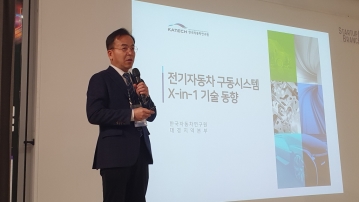
Son Young-uk, head of the Daegyeong Regional Division at Korea Automotive Research Institute, presented trends in EV propulsion system X-in-1 technology at the 17th Sasan Eo-bo event held at COEX Startup Branch on the 18th, emphasizing the importance of developing integrated propulsion module technology for electric vehicles.
2025.02.19by 배종인 기자
Hanjayeon Creates a Platform for Exchange on HMI Technology Innovation
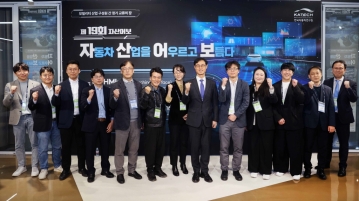
The Korea Automotive Research Institute (Director Jong-wook Jin) has established a platform for exchange to promote innovation and advancement in HMI (Human Machine Interface) technology that connects humans and vehicles.
2025.04.15by 배종인 기자
.jpg)
Hanjayeon, AI convergence and eco-friendly mobility personnel training in full swing
Korea Automobile Research Institute (Director Cho Jong-wook) and Gyeonggi Science and Technology University (President Huh Nam-yong) have concluded a memorandum of understanding for "cultivating human resources in AI-converged and eco-friendly mobility industries and conducting joint domestic and international research."
2025.04.24by 명세환 기자











