


[2025 e4ds Tech Day] "High-Speed Interface and Measurement Technology: Core Competitive Edges of Future Mobility"
 Published2025.09.19 11:38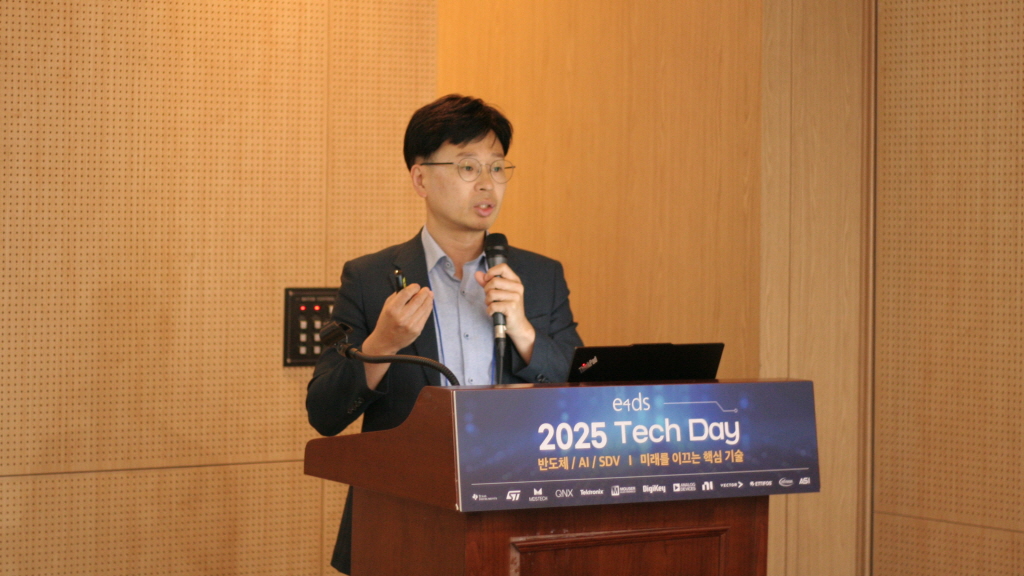
▲Tektronix Managing Director Park Young-jun is giving a presentation at the '2025 e4ds Tech Day.'
Requires advanced measurement tools such as the Tektronix Serial Data Link Analyzer
Advances in high-speed interfaces and measurement technology are not just technological advancements; they are becoming core competitive advantages for future mobility.
Tektronix Managing Director Park Young-jun presented on the topic of “Verification for High-Speed Data Communication Technology and Power System Design for Automotive” at the “2025 e4ds Tech Day” event held on the 9th.
In this announcement, Managing Director Park Young-jun strongly suggested a paradigm shift in the automobile industry.
Managing Director Park Young-jun emphasized, “Cars are no longer simply a means of transportation, but high-performance computing systems,” and “High-speed data communication and complex interface technologies are emerging as core technologies in vehicle development.”
Park explained that high-speed serial interface technology has become essential due to the recent increase in demand for in-vehicle infotainment systems and ADAS (advanced driver assistance systems).
Especially when the dimensions inside the vehicle are large and the cable length is 10 to 15 meters. In many cases, jitter and noise problems are becoming serious problems during data transmission.
“Even simple turn signals must be linked to various devices, including clusters, displays, and camera sensors, to process high-resolution data in real time,” said Park. “These changes are accelerating the adoption of automotive Ethernet.”
Existing low-speed interfaces such as CAN and LIN are gradually being integrated into automotive Ethernet.
“It will expand beyond 100Base-T1 and 1,000Base-T1 to 10Base-T1, and all communications within the vehicle will be integrated into a single protocol,” said Executive Director Park.
This simplifies the vehicle's backbone architecture and provides an environment optimized for high-speed data processing.
Video data collected from vehicle rear cameras or rearview mirror sensors starts at 480p and is currently at 6-12 Gbps, with the transmission speed expected to increase to 24 Gbps in the future.
For this high-speed data transmission, signaling technologies such as PAM3 and PAM4 are being introduced, and equalizing technology on the receiver side to process this stably is also becoming important.
“The future of vehicle interfaces is the PAM method, which transmits multiple bits in a single symbol, rather than the NRZ method, which only consists of 0s and 1s,” explained Executive Director Park.
Precise measurements are essential to ensure the stability of high-speed interfaces.
“Beyond simple probing, simulation-based eye diagram analysis using an oscilloscope is necessary,” said Park, emphasizing the importance of advanced measurement tools such as Tektronix’s Serial Data Link Analyzer.
In particular, the process of setting the equalizing parameters of the receiver chip and verifying the stability of actual data is a key step that determines the quality of vehicle development.
In-vehicle connectivity is also changing rapidly.
The existing USB Type-A is gradually disappearing, and Type-C is becoming the standard.
It expands from USB 3.2 Gen1 to USB 4, enabling data transfer of up to 40 Gbps.
Internal interfaces are also introducing high-speed memory and communication technologies such as PCIe Gen4~Gen6 and DDR5, and vehicles are increasingly evolving into high-performance computing environments.
Tektronix also offers high-power DC power solutions through its EA (ElectroAutomatik) brand.
It can be applied to various electrification applications such as electric vehicle charging and inverter/converter testing, and is equipped with measuring equipment that satisfies global test specifications such as VW 80300.
Managing Director Park Young-jun said, “Cars are not simply machines, but complex systems organically connected by sensors, displays, communications, and power systems.” He added, “Solutions that can precisely measure and verify all of these elements determine the safety and performance of the vehicle.”

Comments
Related news
Tektronix Updates SignalVu… Simultaneous Multi-Signal Analysis of Up to 8 Channels
Tektronix has released version 5.4 of its SignalVu spectrum analysis software, which enables simultaneous analysis of multiple signals across up to eight channels.
2024.04.24by 배종인 기자
Tektronix Launches 7m Long Active Single-Ended Probe TAP1500L
Global test and measurement solutions provider Tektronix has recently launched the TAP1500L active single-ended probe equipped with a 7-meter probe cable.
2024.08.21by 명세환 기자
Tektronix Releases Two New Power Measurement Equipment Products to Solve Various High-Voltage Measurements That Were Previously Inaccessible
Tektronix has launched the TICP Series IsoVu™ Isolated Current Probe, which introduces RF isolation technology for the first time globally, and the EA-PSB 20000 Triple Series, a 3-channel bidirectional power supply.
2024.11.14by 배종인 기자
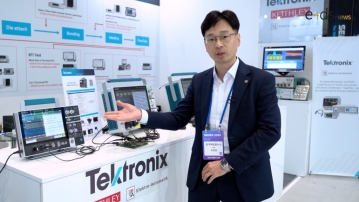
[SEDEX 2024] Tektronix, high performance with portability and convenience… high-speed communication measurement without problems
Tektronix Korea participated in the Semiconductor Exhibition (SEDEX 2024) held at COEX from October 23 to 25, showcasing a diverse product lineup ranging from 2-series through 6-series oscilloscopes as well as PAM4 measurement solutions. The company demonstrated its electronic measurement technology capabilities, which combine excellent portability and convenience with high performance, enabling seamless measurement of semiconductors and high-speed communications applications.
2024.11.15by 배종인 기자
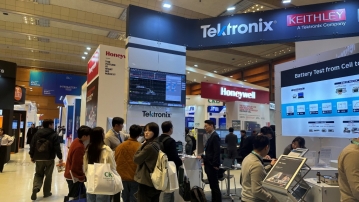
Tektronix, Precision Measurement Technology for Electric Vehicles, ESS, and Eco-friendly Energy
Korea Tektronix, a leader in precision measurement solutions, successfully concluded its exhibition at InterBattery 2025, held at COEX from March 5th to 7th.
2025.03.14by 명세환 기자











