



Technological advancements brought about by AI will provide unprecedented opportunities for startups.
 Published2025.10.28 15:25
.jpg)
Jared Quincy Davis, CEO of Mithril AI
A balance between perfectionism and priorities, curiosity and focus, and optimism and skepticism.
“Technology makes the world a plus island.”
Jared Quincy Davis, CEO of Mithril AI, delivered a keynote speech titled “The Era of Unprecedented Opportunity in AI Transformation: The Role of AI Pioneers” at the “2025 Global Hyper-Gap Tech Conference” held at the Walkerhill Hotel on the 28th. He stated that technology creates new value and enables a world of positive outcomes where everyone benefits.
“Without technology, the world would remain a zero-sum game, where one person’s gains are someone else’s losses,” said CEO Gerard Quincy Davis. “On the other hand, technology enables a plus-sum world where everyone benefits by creating new value.”
This perspective becomes more persuasive when we consider the historical conflicts in the Middle East.
Behind the conflicts that appear to be religious or political, there is a scarcity of resources, such as a shortage of materials.
On the other hand, in the early days of industrialization in the United StatesThe expansion of technology and capital has led to an optimism that “anything is possible” spreading throughout society, which has led to social harmony.
In this context, startups play an important role not only as profit-seeking organizations, but also as entities that create new value.
“As Peter Thiel said, companies are judged on two axes: ‘How much value do they create?’ and ‘How much of that value do they capture?’” said CEO Gerard Quincy Davis. “Many companies focus on the latter, but true success depends on the former.”
Gerard Quincy Davis, CEO, stated, "Technological advancements are happening faster than ever before. Technologies once considered science fiction—AI, self-driving cars, biotechnology, drones, robotics—are becoming a reality." He added, "AI, in particular, is a core technology that can be expanded into diverse fields, to the point where it's often called a 'root node technology.' The strategies demonstrated by AI in Go suggest the potential for generalized problem-solving methods applicable to diverse fields, including healthcare, education, and energy."
He stated that there are three conditions under which AI can be effectively applied.
First, the number of possible combinations is so large that it is a problem that cannot be solved by simple calculation, and second, there must be a clear objective function that can define 'what a good result is.'
Third, he said that if there is a large amount of data or an accurate simulator, AI can achieve amazing results.
In the past decade, computational power in the AI field has increased by about a million times. In particular, in the field of deep learning, the amount of computation has been doubling every 3.4 months.
This is a much faster rate than Moore's Law in the past. At the same time, computational efficiency for the same performance is doubling every 16 months. In other words, we've entered an era where better results can be achieved with fewer resources.
These technological advances present unprecedented opportunities for startups.
Startups with limited initial resources benefit from a faster pace of change. The resources and systems of established large corporations can actually hinder their agility to change. Now is the time when entrepreneurs can exert their greatest influence.
CEO Gerard Quincy Davis noted, "On the other hand, the path to building a great company is never easy. Entrepreneurs must balance 'paranoid realism' with 'world-changing optimism.'" He added, "Andy Grove's dictum, 'Only the paranoid survive,' and Steve Jobs's dictum, 'Those who believe they can change the world are the ones who actually do,' perfectly capture the inner tension entrepreneurs face."
This tension is explained by the concept of 'consergrity'.
This means finding the optimal balance within a structure that, like the tension in the cables supporting the Golden Gate Bridge, can collapse if it's too tight or too loose. Startups are no different. They must strike a balance between perfectionism and prioritization, curiosity and focus, and optimism and skepticism.
Ultimately, great companies are not created solely through technological prowess. We need entrepreneurs who possess multiple, conflicting capabilities, and the social support to support them.
"This is why the Korean government actively supports startups," said CEO Gerard Quincy Davis. "We live in a time of both uncertainty and possibility. At the same time, this is the moment when the greatest challenges are possible."
"Dream big. Embrace your vision. What seemed impossible will become possible," said CEO Gerard Quincy Davis. "These words are not mere encouragement. Right now, we are riding the wave of technology, moving toward a new future."

Comments
Related news
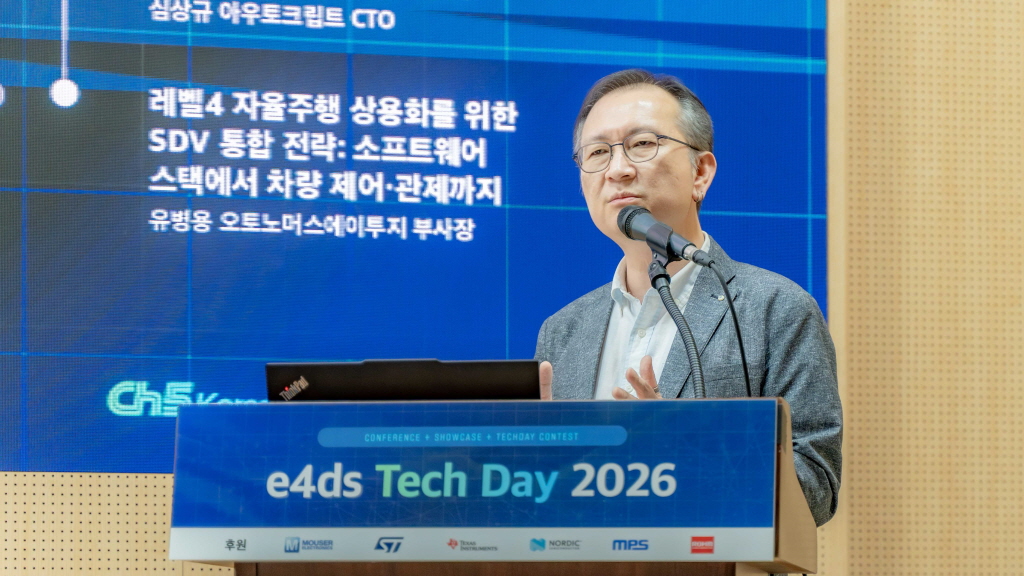
[e4ds Tech Day 2026 ⑨] Sim Sang-gyu, Autocrypt CTO: "In the Physical AI Era, Automotive Security Must Extend Beyond the Vehicle"
At e4ds Tech Day 2026, Sim Sang-gyu, CTO of Autocrypt, explained automotive cybersecurity strategies in the era of Physical AI and SDV (Software-Defined Vehicle). Automobiles are evolving as part of an ecosystem connected to AI, cloud, chargers, IoT, and robots, and he emphasized that the scope of security must expand beyond the vehicle interior to the entire connected environment. In particular, AI model tampering, adversarial attacks, OTA updates, and EV charger hacking were identified as major threats. He explained that response measures require zero trust, AI model integrity protection, intrusion detection, Security by Design and Default, and full lifecycle security management, and that proactive security system establishment beyond regulatory compliance is critical for securing future mobility competitiveness.
2026.10.12by 배종인 기자
NVIDIA to Invest $1 Billion in U.S. Science Over Next Five Years
NVIDIA has announced plans to invest $1 billion over the next five years to strengthen U.S. scientific and technological competitiveness. The company will enhance cutting-edge artificial intelligence research and development capabilities in key areas including quantum computing, healthcare, and energy security, while expanding support for higher education research institutions and cloud service providers. NVIDIA is participating as a major industry partner in the White House Office of Science and Technology Policy's Genesis Mission, and is promoting supercomputer construction in collaboration with national laboratories including Argonne and Los Alamos.
2026.10.12by 배종인 기자
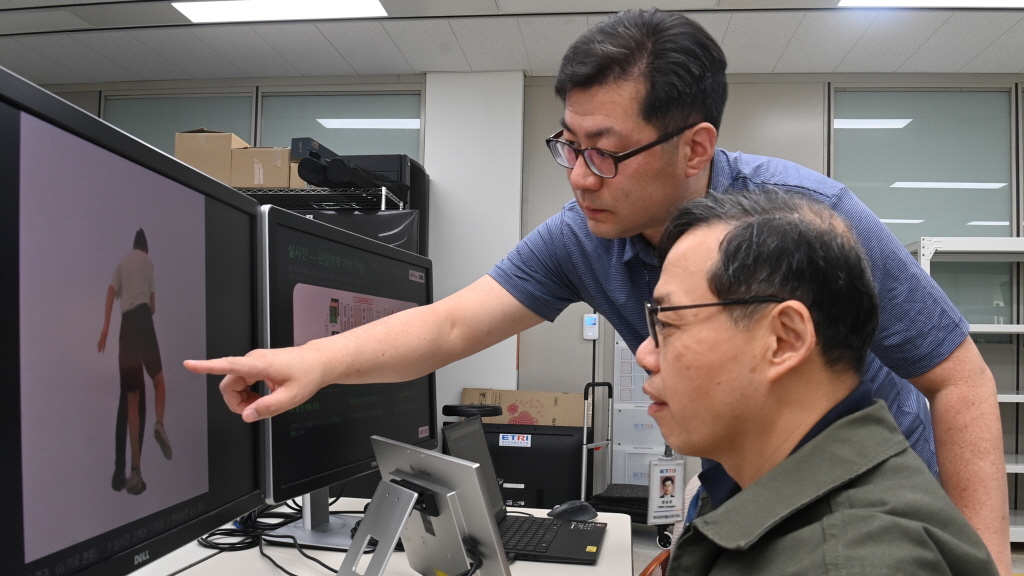
ETRI Unveils 3 Next-Generation Media Technologies Including AI-Dedicated Video Compression
ETRI has unveiled three next-generation media technologies optimized for AI. These include AI-based video encoding (VCM), 3D human generation based on sparse cameras, and generative AI-based pre-visualization technology. In environments where AI directly processes video such as autonomous vehicles, robots, and drones, these technologies enable efficient compression and transmission of large-scale data, and can be applied across various industrial sectors including smart cities, video security, and sports broadcasting.
2026.10.12by 배종인 기자
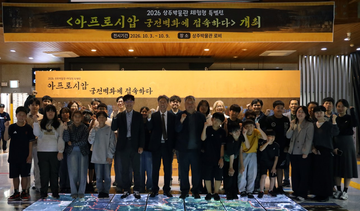
KETI Connects Domestic and Uzbekistan Museums Through Robot Telepresence for Remote Exhibition
The Korea Electronics Technology Institute (KETI) has hosted a remote experiential exhibition that connects domestic museums with an Uzbekistan museum in real-time using robot telepresence technology. Elementary school students in the Sangju area were able to directly operate autonomous robots to remotely view 7th-century Goguryeo envoy palace murals at the Afrasiab Museum in Samarkand, and the exhibition provides spatial experience comparable to on-site visits by combining real-time high-quality video transmission, AI docent, and autonomous driving technologies.
2026.10.12by 배종인 기자
Arduino UNO Q Technical Whitepaper: MPU·MCU Hybrid Board for Cloud-Free Edge AI
Arduino UNO Q is a product that integrates a Qualcomm Dragonwing QRB2210 microprocessor (MPU) running Debian Linux and an STM32U585 microcontroller (MCU) executing Arduino sketches on Zephyr RTOS into a single UNO form factor board. The two processors do not share RAM and resources, exchanging data only through remote procedure calls (RPC) of Arduino_RouterBridge, and the development environment Arduino App Lab and apps reside within the board. This whitepaper describes the design intent of this hybrid architecture, development workflow, hands-on verification results, and limitations in industrial application based on webinar presentation materials and technical Q&A.
2026.10.09by 편집부











