


Nvidia's 260,000 GPUs: A thorough utilization plan is essential to avoid expensive imports.
 Published2025.11.04 14:03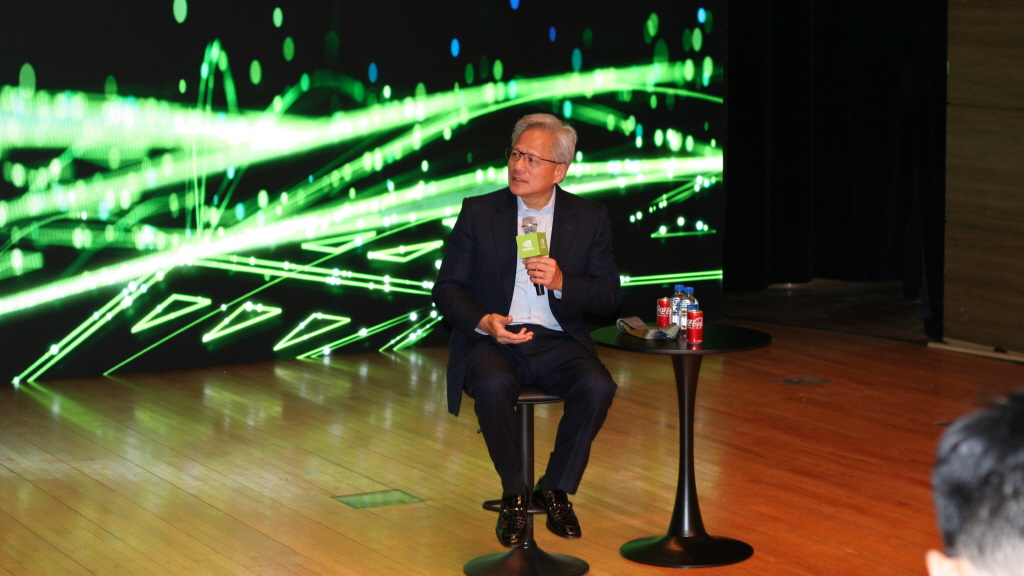
▲NVIDIA CEO Jensen Huang responds at the 2025 APEC Gyeongju NVIDIA press conference.
Expanding industrial use, opening up the cloud, and developing domestically produced AI semiconductors will determine the outcome.
While NVIDIA has secured a key component for cutting-edge AI data centers by promising to supply GPUs for AI data centers in Korea, some argue that thorough planning from AI data center planning through construction and utilization is necessary to achieve benefits that outweigh the enormous introduction costs.
NVIDIA CEO Jensen Huang, who visited Korea on the 30th and 31st to commemorate the 25th anniversary of APEC and the launch of NVIDIA GeForce Korea, announced that the company would supply 260,000 GPUs to Korea over the next year.
If this supply becomes a reality, Korea is expected to leap to become the world's third-largest GPU holder.
Looking at the major suppliers, there are △50,000 Korean government, △50,000 Samsung Electronics, △50,000 SK Group, △50,000 Hyundai Motor Group, and △60,000 Naver Cloud, and the total investment is expected to reach 11 to 14 trillion won.
260,000 GPUs are enough to build 5-6 new ultra-large AI data centers, and Samsung Electronics and SK Hynix are expected to generate over 1 trillion won in sales efficiency by supplying HBM for GPUs.I'm looking forward to it.
On the other hand, there are concerns that the introduction of GPUs is just the beginning, and that this investment could end up being an 'expensive income' if it is not supported by the construction of data centers to accommodate them, a stable power supply, and above all, actual demand for use.
Currently, Korea only has about 45,000 GPUs.
This supply will increase the total quantity to over 300,000 units, making it the third largest in the world after the United States and China.
This is an infrastructural turning point that enables training of ultra-large AI models.
Samsung Electronics plans to invest in digital twins for its semiconductor manufacturing process, SK in semiconductor R&D and cloud computing, Hyundai Motor in autonomous driving and robotics, and Naver in next-generation generative AI learning.
The government also announced that it would establish a national AI computing center and open GPU resources to researchers and startups.
GPUs are not simply devices that are plugged into servers.
Running tens of thousands of GPUs simultaneously requires extremely large data centers.
The problem is power. Just 10,000 GPUs require as much power as a medium-sized city.
A stable power grid, redundant facilities, and emergency power plants are essential.
Cooling is also a key issue. GPUs generate significantly more heat than CPUs, so air cooling has its limitations. Recently, global data centers have been adopting liquid immersion cooling and water cooling, and Korea should also adopt these advanced technologies.
In Ulsan, SK Group is building the country's largest AI data center near an LNG power plant, and in South Jeolla Province, a 46 trillion won mega-AI data center project is underway.
This is a larger scale than the 'Stargate Project' promoted by OpenAI and SoftBank in the United States.
11 to 14 trillion won will be invested in the introduction of 260,000 GPUs alone.
On the other hand, experts say that the total investment cost, including data center construction, power, cooling infrastructure, and operating costs, will easily exceed 20 trillion won.
The problem is the pace of GPU generational changes. As CEO Jensen Huang emphasized, new GPUs are released virtually every year, meaning they can become obsolete in just one or two years.
In particular, AI models grow exponentially in size with each generation. From GPT-4 to GPT-5, the number of parameters increases exponentially. Training larger models requires the memory capacity and computational power of modern GPUs.
Additionally, new products can perform more calculations with the same power, and enterprises have a strong incentive to upgrade to the latest GPUs to reduce data center operating costs.
In addition, as the NVIDIA ecosystem, including CUDA and TensorRT, is optimized for new products, support for older GPUs is gradually decreasing.
Therefore, simply ‘buying and stacking’ GPUs is dangerous.
Industry experts say that how to utilize the data center is the key to this investment.
First, experts agree that GPU demand must be created in various fields, such as digital twins in manufacturing, risk analysis based on ultra-large language models in finance, new drug development in medicine, and generative AI in the content industry.
Additionally, for startups and small and medium-sized enterprises that find it difficult to purchase GPUs directly, a platform for renting and sharing GPUs in the cloud should be established, which will maximize utilization and reduce idle resources.
Here, the strategy is to efficiently distribute core research to its own GPUs and the rest to the cloud, and in the long term, to reduce dependence on NVIDIA and increase power efficiency by introducing AI semiconductors currently under development by Samsung and SK.
The introduction of GPUs is a prerequisite for Korea to become an AI powerhouse.
On the other hand, GPUs are just 'expensive imports', and if they are not utilized, the investment cost only increases.
Therefore, the government and companies must go beyond simple equipment purchases and create a virtuous cycle: data center construction → stable power supply → expanded industrial utilization → domestic technology development.
Industry experts said, “Ultimately, the success or failure of this investment depends not on the ‘number’ of GPUs, but on how well they are operated and utilized.”

Comments
Related news
Intel Strengthens AI Accelerator Portfolio for Data Centers
Intel unveiled a new data center GPU called 'Crescent Island,' optimized for AI inference workloads, at the '2025 OCP Global Summit.' The product features a design with high-capacity memory and energy efficiency, and is expected to contribute to building next-generation AI infrastructure in response to the real-time, global inference era.
2025.10.15by 배종인 기자
AMD Unveils 'Helios' Rack for Next-Generation AI Infrastructure, Based on Meta's OCP Open Rack Design
AMD unveiled 'Helios,' an Open Rack-based AI infrastructure system for next-generation AI datacenters at the 2025 OCP Global Summit. Designed based on Meta's proposed 2025 Open Rack Wide (ORW) specification, Helios is drawing attention as a key platform to accelerate open infrastructure innovation across the industry.
2025.10.15by 배종인 기자
Infineon Transforms Efficiency and Maintenance with 800V AI Data Center Power Architecture
Infineon Technologies (Korea Representative Lee Seung-soo) has unveiled an 800V direct current (VDC) power architecture for next-generation AI data centers in collaboration with NVIDIA, revolutionizing efficiency and ease of maintenance.
2025.10.21by 명세환 기자
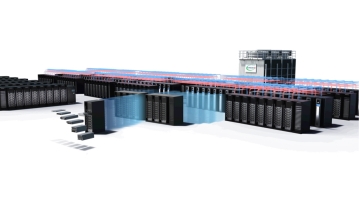
Supermicro Innovates Data Center Energy Efficiency and Deployment Speed
Super Micro Computer, Inc., a leader in advanced IT infrastructure markets including AI, cloud, and 5G, has officially launched Data Center Building Block Solutions (DCBBS), revolutionizing data center energy efficiency and deployment speed.
2025.10.21by 명세환 기자
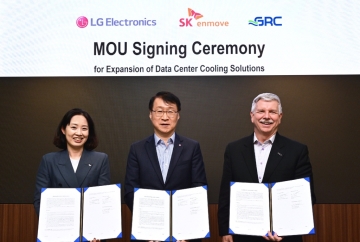
LG Electronics, SK Enmove, and GRC Partner on Liquid Immersion Cooling for AI Data Centers
LG Electronics is expanding its cooling solutions for AI data centers to include immersion cooling in collaboration with SK Enmove and U.S.-based GRC. By combining LG Electronics' chillers, CDUs, and FWUs with SK Enmove's specialized cooling fluid and GRC's immersion cooling tanks, the companies will conduct technology demonstrations and explore new business opportunities. Immersion cooling directly submerges servers in liquid to efficiently remove heat, delivering superior power efficiency and energy-saving benefits. LG Electronics plans to strengthen its global competitiveness through this approach.
2025.10.29by 명세환 기자











