


UNIST: AI Improves Wireless Image Transmission Efficiency by 45 Times
 Published2025.11.06 13:49
▲Professor Yoon Seong-hwan (left) and Researcher Park Jeong-hoon (right, first author)
A technology has been developed that improves wireless image transmission efficiency by 45 times, and is expected to enable real-time visual tasks in various wireless channel environments.
Ulsan National Institute of Science and Technology (UNIST) announced on the 6th that a research team led by Professor Seonghwan Yoon of the Graduate School of Artificial Intelligence has developed AI technology that dramatically increases the efficiency of wireless image transmission.
This technology is expected to be of great help in fields such as autonomous driving, telemedicine, and the metaverse, which require real-time processing of large-scale image data.
The 'Task-Adaptive Semantic Communication' technology developed by the research team is a method that selects and transmits only the semantic information absolutely necessary for task performance, unlike the existing method of compressing and transmitting the entire image.
By analyzing the semantic structure of objects, layouts, and relationships within an image, it drastically reduces the amount of data by extracting and transmitting only the information necessary for the task's purpose.
For example, in a simple object classification task, only object information such as 'cat' and 'car' is transmitted, while in an image generation task, information on the arrangement and relationship of objects is also transmitted.
Especially “to peopleWe reduced unnecessary data transmission by applying a ‘semantic filtering’ algorithm that filters out information that is always true, such as “there is a league,” or redundant relationship expressions.
This technology has been proven to achieve transmission efficiency up to 45 times higher than conventional methods through simulation results, and to be capable of performing real-time visual tasks even in various wireless channel environments.
Professor Yoon Seong-hwan emphasized, “In the future, the core of communication will be not just sending accurately, but sending meaningfully,” and “This research is a signal that will change the landscape of intelligent wireless communication.”
“It has high potential for application in various fields, such as recognition systems for autonomous vehicles, remote surgery and diagnosis, and real-time rendering in the metaverse,” said first author Park Jeong-hoon.
The results of this study were published on October 20th in the IEEE Journal on Selected Areas in Communications (JSAC), the top journal in the IEEE communications field, and were conducted through numerous national research support projects including the Ministry of Science and ICT, the Institute for Information & Communications Technology Planning and Evaluation (IITP), the Ministry of Health and Welfare, and the National Research Foundation of Korea (NRF).
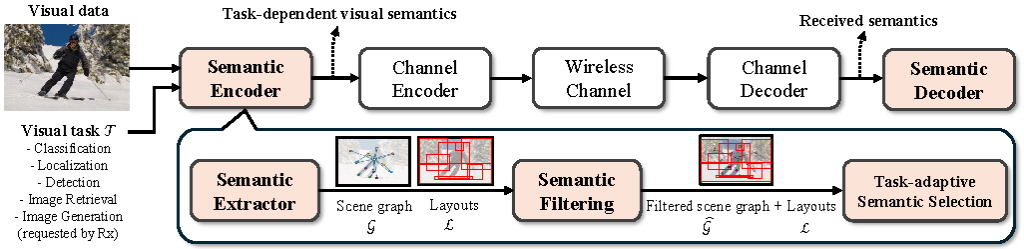
▲Task-adaptive information transmission structure proposed by the research team

Comments
Related news
Commercialization of artificial leaves 'quickly'
A research team led by Professors Lee Jae-sung, Seok Sang-il, and Jang Ji-wook from the Department of Energy and Chemical Engineering at UNIST (Ulsan National Institute of Science and Technology) has advanced modular artificial leaf (artificial photosynthesis) technology to a commercializable stage, which directly produces green hydrogen by converting solar energy through water splitting.
2025.06.23by 배종인 기자
UNIST Develops World's First Magnetically Based Memory Device... One Step Toward Realizing AI Semiconductors
Ulsan National Institute of Science and Technology (UNIST) has developed a magnetic tunnel junction (MTJ) device based on 'ruthenium dioxide (RuO₂)', which is drawing attention as a next-generation material for realizing AI memory semiconductors capable of low-power and high-speed computation, and has observed for the first time in the world the reversal of tunnel magnetoresistance (TMR).
2025.07.04by 배종인 기자
UNIST develops the world's first solid-state galvanic battery capable of powering electronic devices with body heat.
Researchers at Ulsan National Institute of Science and Technology (UNIST) led by Professor Jang Sung-yeon have developed the world's first high-performance n-type solid-state thermogalvanic battery that can generate voltage equivalent to an AA battery using only body heat. This technology represents a breakthrough achievement that can accelerate the commercialization of wearable devices and Internet of Things (IoT) sensors operating without batteries, and has been published in the British Royal Chemical Society (RSC) academic journal 'Energy & Environmental Science' on July 7.
2025.08.20by 배종인 기자
.jpg)
No battery life loss even with fast charging
A joint research team led by Professor Kang Seok-ju from the Department of Energy Chemical Engineering at UNIST (Ulsan National Institute of Science and Technology), Professor Kwak Sang-gyu from Korea University, and Dr. Ahn Seok-hun from the Korea Institute of Science and Technology (KIST) has developed a hybrid anode material combining graphite and curved nanoGraphene. This material features a structure capable of maintaining stable battery performance and lifespan even during fast charging.
2025.09.24by 배종인 기자
AI can perform 1,000 chemistry experiments a day without any problems.
Ulsan National Institute of Science and Technology (UNIST) announced on the 25th that a research team led by Professor Bartosz Grzybowski of the Department of Chemistry has developed an 'AI and robot-based automated experimentation platform' capable of automatically performing over 1,000 chemical experiments per day using artificial intelligence (AI) and robotics. This technology is expected to provide a breakthrough turning point in new drug development and novel material discovery by precisely mapping complex chemical reaction networks and rapidly generating new chemical compounds.
2025.09.25by 명세환 기자











