



Gartner: Low growth is the biggest risk in Q3 2025
 Published2025.11.07 09:36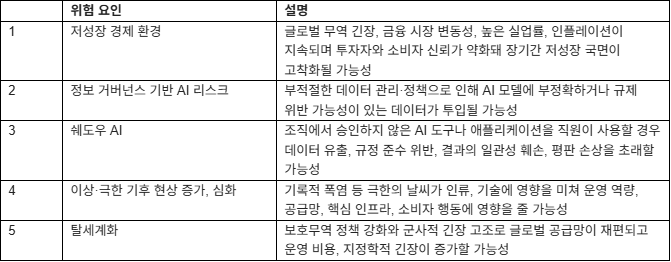
▲Top 5 Emerging Risks for Q3 2025 (Source: Gartner, November 2025)
A low-growth economic environment is identified as the biggest risk in the third quarter of 2025, and companies are expected to proactively respond to the crisis through risk priority management.
Global market research firm Gartner announced on the 7th that the 'low-growth economic environment' was the emerging risk factor that corporate risk managers were most concerned about in the third quarter of 2025.
This ranked first, surpassing AI-related risks, and is analyzed to be mainly due to trade tensions, job insecurity, and persistent inflation.
Gartner, in its Quarterly Emerging Risk Report, surveying 184 corporate risk and audit executives worldwide, warned that volatility in global financial markets and weakening consumer sentiment could entrench a long-term low-growth trend.
The weakening of investor and consumer confidence could have a direct impact on corporate operations.
AI-related risks rose from fourth place in the second quarter to second place in the third quarter.
In particular, the risk of inaccurate or potentially unregulated data being fed into AI models is increasing due to poor information governance. 'Shadow AI', which involves using AI tools not approved by the organization, also rose from fifth to third place, raising concerns about data leaks, regulatory violations, and reputational damage.
The report said that unusual and extreme weather events, such as record-breaking heat waves, could impact operational capabilities, supply chains, and consumer behavior, while "deglobalization" due to increased protectionism and heightened geopolitical tensions could also lead to a restructuring of global supply chains and increased operating costs.
Gartner emphasized that the ability to distinguish between “risks requiring immediate response” is essential for companies to survive in an increasingly complex risk environment.
In fact, while 72% of ERM leaders recognize the importance of timely response, only 15% are confident in which risks should be addressed first.
Accordingly, Gartner suggested setting response priorities in three stages: △ setting impact criteria based on various variables such as regulation, reputation, and ESG; △ linking strategic priorities with emerging risks; and △ determining priorities considering response time, impact, and speed.
“With the proliferation of AI and macro uncertainty simultaneously at play, having a risk prioritization system in place to avoid strategic confusion is key to corporate survival,” said Gartner Research Director Kamika Takar.

Comments
Related news
.jpg)
“Multimodal Generative AI and Open Source LLM to Have a Big Impact in 5 Years”
Gartner, which provides actionable objective insights, has recently identified "Multimodal Generative AI" and "Open-source LLM (Large Language Models)" as technologies with potential to significantly impact organizations within the next five years, according to its 2024 Gartner Hype Cycle for Generative AI report. Furthermore, Gartner has highlighted "Domain-Specific Generative AI Models" and "Autonomous Agents" as the most promising technologies expected to become mainstream within the next decade.
2024.09.10by 권신혁 기자
Gartner: "Electric Vehicle Market Growth of 17%, But Uncertainty Deepens"
According to the key trends for the 2025 automotive market announced by Gartner, regulatory pressure on exhaust emissions and trade disputes between Western countries and China are expected to serve as core drivers of trends in the automotive industry this year.
2025.01.20by 배종인 기자
.jpg)
“PC shipments to grow 1.3% to 245 million units in 2024”
The PC market is showing signs of recovery with a slight increase in shipments, overcoming the downturn of 2023. Gartner announced preliminary survey results on the 22nd, showing that global PC shipments in the fourth quarter of last year totaled 64.4 million units. This represents a 1.4% increase compared to the same period of the previous year, with total annual PC shipments reaching 245.4 million units, a 1.3% increase compared to 2023.
2025.01.22by 권신혁 기자
“Semiconductors to grow by double digits by 2025”
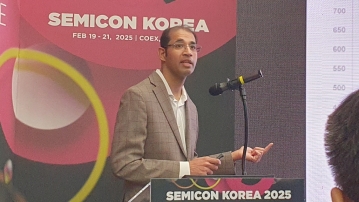
Gaurav Gupta, vice president of Gartner, stated at the Semicon Korea 2025 press briefing held on February 19th, "The semiconductor market in 2025 will achieve double-digit growth. Additionally, with the expansion of autonomous driving and electric vehicle markets, significant growth will be achieved over the next decade," indicating that the semiconductor industry will continue to grow.
2025.02.24by 명세환 기자
“AI Agents Accelerate Account Takeover Risk” Warning
Global research firm Gartner has warned of the severity of account takeover (ATO) and social engineering attacks resulting from advances in AI technology, emphasizing the importance of preparing security countermeasures. According to Gartner, AI agents are projected to reduce the time required for account takeover by 50% by 2027.
2025.03.20by 배종인 기자











