


Hanjayeon Secures Advanced Testing Infrastructure for Future Aviation Mobility
 Published2025.11.07 15:09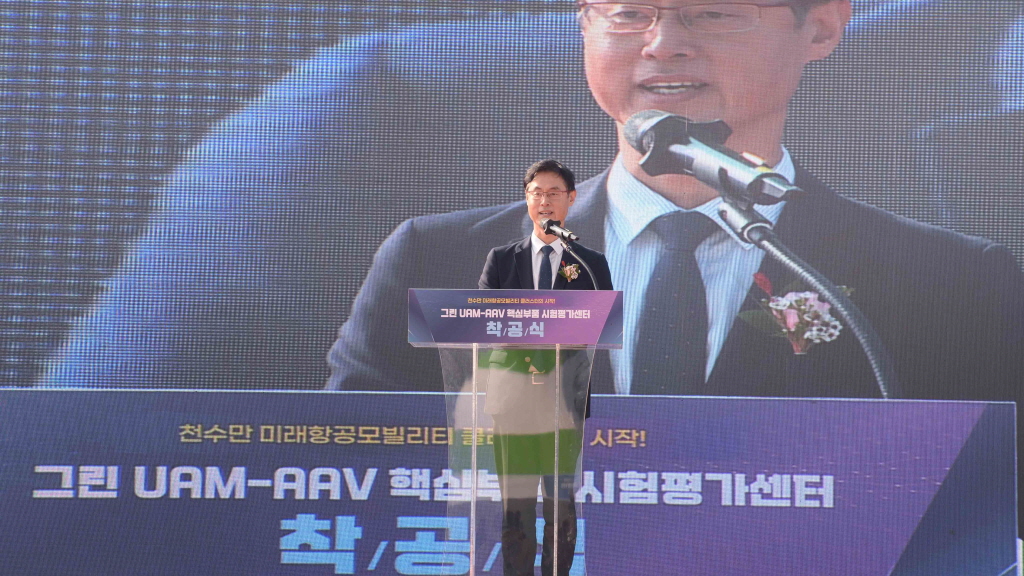
▲Jin Jong-wook, president of the Korea Automotive Research Institute, is giving a speech at the groundbreaking ceremony.
Equipped with a vertiport and high-performance testing equipment, the facility is scheduled for completion in the second half of 2026.
The Korea Automobile Research Institute (KARI) is expected to secure advanced testing infrastructure for future aviation mobility, fostering a future aviation mobility industry ecosystem and strengthening global technological competitiveness.
On the 6th, Hanjayeon, together with the Korea Aerospace Industries, South Chungcheong Province, and Seosan City, broke ground on the 'Green UAM-AAV Core Component Testing and Evaluation Center,' a key infrastructure for the eco-friendly future air mobility (AAM) industry, in the Seosan Bio-Wellness Special Zone in Galma-ri, Buseok-myeon, Seosan-si, Chungcheongnam-do.
The event was attended by approximately 300 people, including Jin Jong-wook, President of Hanjayeon, Jeon Hyeong-sik, Vice Governor of South Chungcheong Province, Noh Kyung-won, Vice Minister of the Korea Aerospace Industries, National Assembly Member Seong Il-jong, Seosan Mayor Lee Wan-seop, and Hanseo University President Ham Ki-seon, as well as officials from the aviation industry, including Hyundai Motor Company and Hanwha Aerospace, and local residents.
This test and evaluation center was selected for the 2024 National Aeronautics and Space Administration's 'Green UAM-AAV Core Component Test and Evaluation Infrastructure Construction' public offering project, and its purpose is to establish an advanced test infrastructure capable of evaluating the performance, safety, and reliability of hydrogen-powered future aircraft (AAV) and core components.
The center is slated for completion in the second half of 2026, with a total area of 22,588 square meters. It will be built on a site with a total floor area of 2,915㎡, and will include five test buildings, including a complex test building, a flight performance test building, and a hydrogen test building, as well as one vertiport and two mooring areas.
Additionally, a total of six types of high-performance testing equipment, including outdoor takeoff and landing environment evaluation equipment, hydrogen fuel cell stack evaluation equipment, and electric engine evaluation equipment, are scheduled to be introduced.
President Jin Jong-wook stated, “Future aviation mobility is a key technology that will revolutionize urban structures and industrial ecosystems and advance toward a carbon-neutral society.” He added, “Through the Seosan Test and Evaluation Center, we will foster an industrial ecosystem where regions, companies, and institutions can collaborate, and bring forward an era of aviation mobility that the public can use with confidence.”

Comments
Related news
.jpg)
Hanjayeon, Chungnam Boryeong 'Carbon Neutral Mobility Center' Completed
The Korea Automotive Research Institute (Director Jong-wook Jin, hereinafter KARI) has completed the integrated construction of the 'Carbon-Neutral Mobility Center' within the Gwanchang General Industrial Complex in Jugyomyeon, Boryeong-si, Chungcheongnam-do, and is commencing full-scale operations following the completion of test and certification infrastructure to foster a carbon-neutral mobility industry ecosystem and enhance technological competitiveness.
2025.04.30by 배종인 기자
.jpg)
"HMI·UX: A New Frontier in Automotive Competition: User Experience is Key"
The Korea Automotive Research Institute (KARI) has recently published the "Mobility Insight April 2025" issue, emphasizing the importance of HMI (Human-Machine Interface) and UX (User Experience) within the automotive industry. According to Mobility Insight, as the core competitiveness of automobiles is shifting toward "passenger experience," a new approach is needed to view vehicles not simply as conventional means of transportation, but as human-centered experiential spaces.
2025.04.30by 배종인 기자
.jpg)
Hanjayeon, Establishment of a Base for Supporting the Full Cycle of Autonomous Driving and Automotive Semiconductors
The Korea Automobile Research Institute (KAERI) has broken ground on a "Comprehensive Support Center for Autonomous Driving and Automotive Semiconductors" at a site near Cheonan-Asan KTX Station in Baebang-eup, Asan-si, Chungcheongnam-do, to establish a hub for technological self-sufficiency and full-cycle support in the autonomous driving and automotive semiconductor industries.
2025.06.09by 배종인 기자
Hanjayeon, presents a solution for future car reliability
The Korea Automotive Research Institute (Director Jin Jong-wook) held the 20th Jasan Automotive Forum on the 10th at COEX Startup Branch under the theme of "Promise Beyond Future Vehicle Reliability Performance, Future Vehicle Reliability Innovation."
2025.06.11by 배종인 기자

Domestic auto parts industry in the midst of global shocks must respond to structural advancement
According to Industry Analysis Vol. 149 titled "Environmental Changes in the Parts Industry and Response Directions," recently published by the Korea Automotive Research Institute (KARI), domestic major automotive parts companies are showing improvement trends in management performance and technology investment, but analysis indicates they still lag behind global competitors. As multiple factors such as industrial paradigm shifts and intensifying protectionism overlap, there is a point that strategic responses from both the private sector and government are urgently needed for structural upgrading.
2025.07.24by 배종인 기자











