


"Future data centers require decentralized, high-efficiency, and high-density infrastructure innovation."
 Published2025.11.12 10:29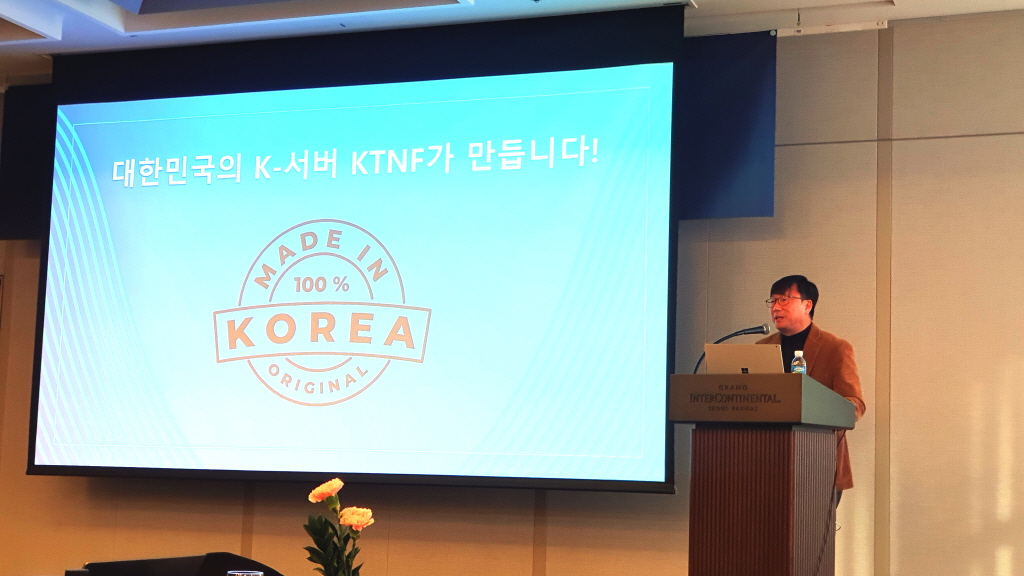
▲ At the 13th Artificial Intelligence Semiconductor Forum breakfast lecture, KTNF CEO Lee Jung-yeon is giving a lecture on the topic of "Next-Generation Data Center Architecture in the AI Era."
KTNF accelerates development of micro data centers utilizing domestically produced AI semiconductors for rapid on-site application.
“Next-generation AI infrastructure must deliver scalability and flexibility while simultaneously achieving three key benefits: energy savings, enhanced security, and operational efficiency. KTNF will overcome these challenges with its technological prowess and lead the innovation of Korea's future data centers."
The Artificial Intelligence Semiconductor Forum held its 13th breakfast lecture at the InterContinental Seoul Parnas in Samseong-dong, Seoul on the 12th.
At the event, KTNF CEO Lee Jung-yeon gave a lecture on the topic of “Next-Generation Data Center Architecture in the AI Era.”
CEO Lee Jung-yeon provided an in-depth explanation of the rapid advancements in AI technology, the resulting changes in data centers, and the company's vision for the future.
The representative first reviewed the current state of global AI competition.
Major countries such as the United States, China, and South Korea are accelerating the development of large-scale language models (LLMs). The US's GPT and Gemini models are ultra-large models with 1 to 2 trillion parameters, while China's mid-sized models centered on open source are mainstream, and South Korea's small models that emphasize efficiency are mainstream, he explained.
In particular, he mentioned that efficient models such as 'DeepSeek', which recently emerged, are emerging as a key driving force for the popularization of AI by achieving equivalent performance at a cost 97% lower than existing models.
AI workloads are broadly categorized into LLM, generative AI, and HPC (high-performance computing).
All of these require enormous computing power and memory bandwidth, pushing the limits of data center infrastructure.
For example, training the GPT-4 model requires 25,000 GPUs to operate for 100 days, and existing data centers often cannot accommodate even a few hundred GPU servers. Demand for AI is doubling every year, but infrastructure isn't keeping pace.
Regarding this, CEO Lee Jung-yeon emphasized, “Data centers in the AI era require not a simple upgrade, but a completely new design.”
Currently, NVIDIA monopolizes the GPU market, which is causing problems such as high prices and rising operating costs along with improved performance.
In response, open architectures and various AI accelerators (NPUs, TPUs, FPGAs, etc.) are being actively introduced.
In particular, the NPU that Korea is leading is specialized in neural network operations and is showing strengths in power efficiency and token generation performance.
Building an open ecosystem for data centers is also an important topic.
Open standards such as the Open Compute Project (OCP) and Universal Base Board (UBB) contribute to hardware architecture integration, cost reduction, and improved energy efficiency.
Designed to allow a variety of accelerators and servers to operate on the same baseboard, it creates an environment where both large and small businesses can participate in innovation.
Advances in network technologies such as NVLink, InfiniBand, and high-speed Ethernet for ultra-high-speed data transmission are also notable.
NVIDIA's MVL 72 platform integrates 72 GPUs into a single system, eliminating network bottlenecks between existing servers and enabling ultra-fast data transfer.
UA Link, developed jointly by global companies such as AMD, Intel, Meta, and Microsoft, is an open, high-speed connection technology that is leading the way in open AI infrastructure and industrial innovation.
Memory technology is also evolving rapidly. Next-generation memories such as GDDR7 and HBM4 pursue both bandwidth and economy, and the NVIDIA Rubin GPU, scheduled for release in 2026, is expected to use both types of memory in parallel.
New memory standards such as DDR6 and MR DIMM maximize processing and power efficiency.
Energy efficiency and cooling technology in data centers are also emerging as important issues.
With servers and cooling devices accounting for 80% of total power consumption, advanced cooling technologies such as liquid cooling systems, immersion cooling, and direct liquid cooling (DLC) are being introduced.
These technologies offer cooling efficiency up to 1,000 times greater than air cooling, playing a key role in energy savings and implementing eco-friendly data centers.
Security is also a key element of data centers. AI is changing the security paradigm, requiring a multi-layered security strategy that includes hardware supply chain security, BIOS integrity, and firmware verification.
“Supply chain security is the foundation of national competitiveness,” the representative said, emphasizing the importance of hardware security based on physical trust and next-generation cryptographic technologies (PUF, QRNG, PQC).
The data center of the future requires decentralization, high efficiency, and high-density infrastructure innovation.
Central, edge, and micro data centers must be organically linked to ensure both stability and scalability, and containerized data centers and rack-based micro data centers are emerging to provide flexible scalability and mobility.
CEO Lee Jung-yeon said, “KTNF is accelerating the development of micro data centers that can be quickly applied in the field by utilizing domestically produced AI semiconductors,” and added, “We will lead innovation in future data centers in Korea with our technological prowess.”
.jpg)
▲Attendees of the 13th Artificial Intelligence Semiconductor Forum breakfast lecture take a commemorative photo.

Comments
Related news
“Evolution of on-device AI in automobiles requires high-performance and high-capacity memory”
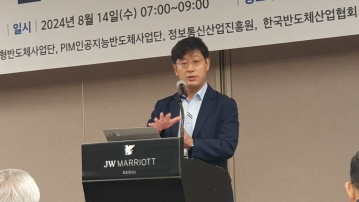
Kang Wook-sung, Vice President of SK Hynix, delivered a presentation on "The Direction of Intelligent Vehicle Memory-Storage Development in the AI Era" at the "7th Artificial Intelligence Semiconductor Forum Breakfast Seminar" held on the 14th at JW Marriott Seoul. He stated that automobiles are rapidly commercializing AI functions, including performing AI inference in ADAS, utilizing LLM-based on-device AI in the cockpit, and leading the earliest adoption of robotics in autonomous driving, and that the necessity for high-performance, high-capacity vehicle memory storage is consequently increasing sharply in the future.
2024.08.14by 배종인 기자
.jpg)
“AI Semiconductor Accelerates Evolution Centered on High-Bandwidth, High-Integrity, and Low-Power DRAM”
Son Gyo-min, Master at Samsung Electronics, presented on "DRAM Solutions in the AI Era" at the "10th Artificial Intelligence Semiconductor Forum Breakfast Lecture" held on the 13th at the InterContinental Parnas in Samseong-dong, Seoul. He stated that AI semiconductor technology centered on DRAM is undergoing complex and sophisticated evolution toward three key keywords: High Capacity, High Bandwidth, and Low Power.
2025.05.13by 배종인 기자
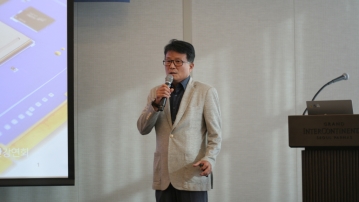
Close collaboration with automakers is crucial for the success of automotive AI semiconductors.
The Artificial Intelligence Semiconductor Forum held the 12th AI Semiconductor Forum breakfast seminar on the 10th with the theme "Key to Securing the Automotive AI Market - What Matters in Semiconductor Competitiveness?" Park Won-ju, CSO of Bosch Semiconductor, who presented at the event, stated that the automotive industry operates by looking ahead five years into the future market, and that autonomous driving and in-vehicle infotainment are at the center of AI innovation.
2025.09.12by 배종인 기자

[e4ds Tech Day 2026 ⑨] Sim Sang-gyu, Autocrypt CTO: "In the Physical AI Era, Automotive Security Must Extend Beyond the Vehicle"
At e4ds Tech Day 2026, Sim Sang-gyu, CTO of Autocrypt, explained automotive cybersecurity strategies in the era of Physical AI and SDV (Software-Defined Vehicle). Automobiles are evolving as part of an ecosystem connected to AI, cloud, chargers, IoT, and robots, and he emphasized that the scope of security must expand beyond the vehicle interior to the entire connected environment. In particular, AI model tampering, adversarial attacks, OTA updates, and EV charger hacking were identified as major threats. He explained that response measures require zero trust, AI model integrity protection, intrusion detection, Security by Design and Default, and full lifecycle security management, and that proactive security system establishment beyond regulatory compliance is critical for securing future mobility competitiveness.
2026.10.12by 배종인 기자
NVIDIA to Invest $1 Billion in U.S. Science Over Next Five Years
NVIDIA has announced plans to invest $1 billion over the next five years to strengthen U.S. scientific and technological competitiveness. The company will enhance cutting-edge artificial intelligence research and development capabilities in key areas including quantum computing, healthcare, and energy security, while expanding support for higher education research institutions and cloud service providers. NVIDIA is participating as a major industry partner in the White House Office of Science and Technology Policy's Genesis Mission, and is promoting supercomputer construction in collaboration with national laboratories including Argonne and Los Alamos.
2026.10.12by 배종인 기자











