


[Serial Feature] Physical AI: Redefining the Future of Industry ④, "Physical AI Emerges as a Key to Bridging the Automation Gap"
 Published2025.11.24 15:45
Global companies are taking swift steps toward platform integration, not individual technologies.
[Editor's Note] While conventional AI focuses on inference and generation within digital data, Physical AI directly acts and reacts in the real world through sensors, edge computing, robots, and control systems. The implementation of Physical AI can significantly advance industrial innovation and automation because it directly acts and solves problems in the real world, and it directly interacts with the real world. Accordingly, global companies such as Nvidia, Tesla, and Google are making massive investments in Physical AI, and the related market is expected to grow explosively. To implement this Physical AI, recognition technologies such as sensors, as well as edge computing and embedded systems for real-time data processing, local computing, robotics, and control technologies are essential. Accordingly, e4ds News has prepared a series of articles to examine the core technologies and implementation strategies of physical AI, including the concept, market outlook, related technologies, and actual cases.
.jpg)
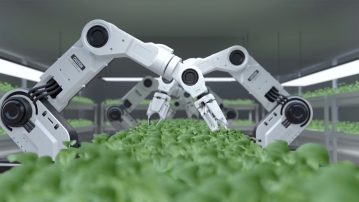
▲The manufacturing and logistics industries are among the first to experience the impact of physical AI. (Photo: Pixabay)
As the era of "physical AI" arrives, where artificial intelligence (AI) directly interacts with the physical world, the manufacturing and logistics industries are among the first to experience the wave of change. Physical AI is rapidly emerging as a key to bridging the automation gap between large and small businesses.
Recently, various events such as the Physical AI International Forum and various Physical AI seminars related to manufacturing and logistics have been held in Korea, and we are entering the golden age of Physical AI.
The industry expects that physical AI will go beyond simply processing data and become a new driving force that maximizes productivity and efficiency in the real world through sensors and actuators.
■ A new paradigm for smart factory innovation and logistics automation
Manufacturing is the sector that will most directly benefit from physical AI.
In smart factories, robots monitor the production line in real time through various recognition systems such as cameras, LiDAR, and tactile sensors.
This enables precise assembly, quality inspection, and risk factor elimination.
In particular, robots equipped with tactile sensors can safely handle fragile parts and collaborate with humans. The risk of collision is also minimized during the process.
Advances in drive systems also accelerate manufacturing innovation.
Electric actuators reduce noise and maintenance burden, and increase production line efficiency through high-precision control.
Here, robots equipped with edge AI chips can instantly process massive amounts of data generated within the factory, enabling decision-making in seconds.
This is positioned as a key factor in reducing defect rates and maximizing productivity.
Physical AI is also emerging as a game changer in the logistics sector.
Autonomous transport robots and logistics robots combine sensors and AI models to automatically sort and transport items within warehouses.
Boston Dynamics' logistics robot 'Stretch' is expanding its commercial logistics applications by moving large boxes quickly and reliably.
Naver Labs is also advancing cloud-based multi-robot orchestration and preparing to maximize the efficiency of logistics centers.
SK Telecom is preparing an ultra-low latency collaboration environment with next-generation infrastructure such as a 5G specialized network and AI semiconductors.
This is considered essential infrastructure for large-scale logistics automation.
■ Necessity of introduction according to automation level
What's interesting is that the need for physical AI isn't the same for all businesses.
Large companies with well-established automation systems already achieve significant efficiencies through existing smart factories and logistics automation systems, so the introduction of physical AI is not urgent in the short term.
Rather, they often make selective investments for long-term expansion and advancement.
Automation on the other hand The need for physical AI is even greater in small and medium-sized enterprises (SMEs) with slow transitions or in non-standard production environments rather than standardized systems.
Unpredictable work environments, production lines handling diverse product lines, and logistics sites with many customized orders make it difficult to cope with existing automated equipment alone.
In this case, physical AI, which combines sensors, AI, and robots, provides flexibility and adaptability and emerges as a key means of securing competitiveness.
In other words, physical AI is not simply a "cutting-edge technology," but rather a strategic tool for bridging the automation gap.
■ Intensifying platform competition
The physical AI race is coming down to platform integration, not individual technologies.
NVIDIA aims to be the "operating system for physical AI" by building a horizontal platform encompassing hardware, simulation, and AI models.
Their Isaac Sim supports simulation learning of logistics robots to bridge the gap with reality, and their GR00T model accelerates the development of general-purpose humanoid robots.
Google DeepMind provides the robot's "brain" with its RT-2 model, enabling it to recognize new objects and perform abstract commands in logistics settings.
Tesla is piloting and advancing humanoid robots in its factories.
Domestic companies are also moving quickly.
Samsung Electronics is strengthening its robotics capabilities through a gradual increase in its stake in Rainbow Robotics and strategic collaboration.
Hyundai Motor Group has acquired Boston Dynamics and is applying cutting-edge robotics technology to smart factories and future mobility.
YesBased on their cloud-based brains and communications infrastructure, Verlabs and SK Telecom are each playing a key role in logistics automation, establishing themselves as key players in the physical AI ecosystem.
■ Overcoming challenges such as physical limitations and safety
There are still challenges to commercializing physical AI.
Representative examples include the physical limitations of actuators and batteries, the gap between simulation and reality (simulation-to-reality), and ensuring safety.
On the other hand, as the ability to generate synthetic data through simulations emerges as a key factor in determining the intelligence of AI models, innovation in the manufacturing and logistics sectors is expected to accelerate.
Ultimately, physical AI will establish itself as a key engine that determines the competitiveness of the manufacturing and logistics industries, and its necessity is becoming increasingly urgent, especially for companies with slow automation and in non-standard production environments.

Comments
Related news
[Serial Project] Physical AI: Redefining the Future of Industry ①, "The Success of Physical AI Depends on the Design of Interactions Between Humans and Intelligent Machines."
While conventional AI has focused on inference and generation within digital data, Physical AI acts and responds directly in the real world through sensors, edge computing, robots, and control systems. The implementation of Physical AI can significantly advance industrial innovation and automation since AI directly acts and solves problems in the real world, interacting directly with the physical environment. Accordingly, global companies including NVIDIA, Tesla, and Google are making massive investments in Physical AI, and the related market is expected to grow explosively. To implement such Physical AI, perception technologies including sensors, edge computing and embedded systems for local computing to process real-time data, as well as robotics and control technologies are essential. In response, e4ds news has prepared a series of articles to examine core technologies and implementation strategies ranging from the concept of Physical AI to market outlook, related technologies, and practical cases.
2025.10.20by 배종인 기자
.jpg)
AMD Platforms: A Perfect Fit for Physical AI
Robotec.ai will unveil a fully autonomous warehouse robot powered exclusively by AMD Ryzen™ AI processors at ROSCon 2025 held in Singapore, in collaboration with AMD and Liquid AI. The robot is equipped with agentic AI technology that performs tasks through real-time inference and natural language understanding, moving away from traditional hardcoded command methods.
2025.10.27by 배종인 기자
.jpg)
[Serial Feature] Physical AI: Redefining the Future of Industry ②, "The 'Physical AI Market' Will Become a $1 Trillion Ecosystem by 2030."
According to some experts, 'Physical AI' is projected to become the greatest revolution in human history, surpassing the Industrial Revolution. While it will have significant impacts on society, culture, and economy, since we cannot predict the entirety of these effects, from an economic perspective, citing forecasts from global market research institutions, Physical AI is expected to establish itself as a key driving force that will reshape industrial structures, with the market reaching approximately one trillion dollars by 2030. Below is an examination of the Physical AI market size by industrial sector.
2025.10.27by 명세환 기자
.jpg)
Hanwha Robotics and Mind AI accelerate the commercialization of autonomous robots.
Hanwha Robotics and Maum AI signed a "Memorandum of Understanding (MOU) for cooperation in the Physical AI field" at Maum AI's headquarters in Seongnam, Gyeonggi Province on the 28th, and announced that they will begin full-scale joint projects to develop next-generation robotics platforms and strengthen verification systems.
2025.10.29by 배종인 기자

DeepX: "AI must become a 'real-world intelligence' that transforms industry and society, not just a server-side technology."
Kim Nok-won, CEO of DeepX, an ultra-low-power AI semiconductor specialist, was recently invited as an official speaker to the 'New Drivers of Industry Transformation Meeting 2025' hosted by the World Economic Forum (WEF), where he presented the technology vision for 'Physical AI' alongside global innovation leaders.
2025.11.04by 배종인 기자











