



AMD Supports Zyfra's Frontier AI Model Training
 Published2025.11.25 16:33
▲Photo: AMD
Global semiconductor company AMD is supporting the training of frontier-level AI models by innovative AI startup Zyphra.
AMD announced today that it has successfully trained ZAYA1, the first large-scale Mixture-of-Experts (MoE) foundation model, in collaboration with Zyfra.
This achievement was achieved based on the AMD Instinct MI300X GPU, AMD Pensando networking, and the ROCm open source software stack, and is evaluated as a case that demonstrates AMD's technological excellence in the field of large-scale AI model training.
The ZAYA1 Base model developed by Zaipla has demonstrated competitive performance compared to existing open models in various areas such as reasoning, mathematics, and coding.
In particular, it outperformed Llama 3 8B and OLMoE in several benchmarks, and demonstrated performance comparable to Qwen3 4B and Gemma3 12B.
ZAYA1, with only 760 million active parameters out of a total of 8.3 billion parameters, achieved high-performance, low-cost learning through an efficient structure.
This was made possible by the 192GB of high-bandwidth memory of the AMD Instinct MI300X GPU, which enabled complex tensor sharding.g) Supported stable and fast learning without procedures.
The AMD Instinct MI300X GPU delivers performance and scalability optimized for large-scale AI workloads.
Complexity is reduced and throughput is improved with 192GB of high-bandwidth memory, and model storage time is shortened by approximately 10 times with AMD-optimized distributed I/O, ensuring efficient learning stability.
“AMD’s leadership in accelerated computing is enabling innovators like Xifra to push the boundaries of AI,” said Emad Barsoum, vice president of AI and Engineering, AMD Artificial Intelligence Group. “This achievement is a significant example of the flexibility and performance that AMD Instinct GPUs and Pentium Networking deliver.”
“Efficiency is a core philosophy at Zyfra, and is reflected in every process, from model architecture design and learning algorithms to hardware selection that provides the best price-performance ratio,” said Krithik Puthalath, CEO of Zyfra. “ZAYA1 is very significant as it is the first example of large-scale learning implemented on an AMD platform.”
He continued, “This achievement demonstrates the power of our approach of co-designing model architectures with semiconductors and systems,” adding, “Zifra will further strengthen its collaboration with AMD and IBM to build the next generation of multimodal foundation models.”

Comments
Related news
.jpg)
AMD Platforms: A Perfect Fit for Physical AI
Robotec.ai will unveil a fully autonomous warehouse robot powered exclusively by AMD Ryzen™ AI processors at ROSCon 2025 held in Singapore, in collaboration with AMD and Liquid AI. The robot is equipped with agentic AI technology that performs tasks through real-time inference and natural language understanding, moving away from traditional hardcoded command methods.
2025.10.27by 배종인 기자
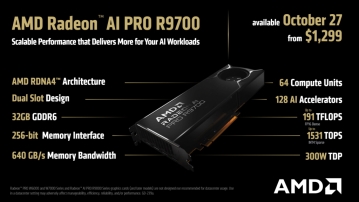
AMD Launches 'Radeon AI PRO R9700' GPU for AI Workstations… $1,299, Sales Begin October 27
AMD officially launches the high-performance workstation GPU 'AMD Radeon™ AI PRO R9700' optimized for AI workloads, enabling AI developers and creators to maximize GPU performance while maintaining their existing workflows.
2025.10.27by 명세환 기자
.jpg)
AMD Accelerates Open AI Stack to Strengthen US AI Leadership
AMD is supplying its high-performance computing technology to next-generation supercomputers 'Lux' and 'Discovery' in collaboration with the U.S. Department of Energy (DOE) and Oak Ridge National Laboratory (ORNL).
2025.10.29by 배종인 기자

Nota, Edge AI Benchmarks Aligned with Nvidia, Qualcomm, Samsung, and Intel
Nota (CEO Chae Myung-soo), a specialist company in AI model compression and optimization technologies, has been listed in the Edge AI category for the second consecutive year in the '2025 MAD Landscape,' which is evaluated as a key benchmark in the global AI industry. In this MAD Landscape, Nota was listed in the Edge AI section alongside global enterprises including Nvidia, Qualcomm, Samsung, Intel, Apple, and AMD, demonstrating its technological competitiveness.
2025.11.13by 명세환 기자

AMD and StradVision Present Future Vision of Autonomous Driving at CES 2026
AMD and autonomous driving perception software specialist STRADVISION will showcase MultiVision Perception software based on the AMD Versal™ AI Edge Gen 2 VEK385 platform at CES 2026.
2025.11.13by 명세환 기자











