


52% of Global Government CIOs to Increase AI Budget by 2026
 Published2025.11.27 14:17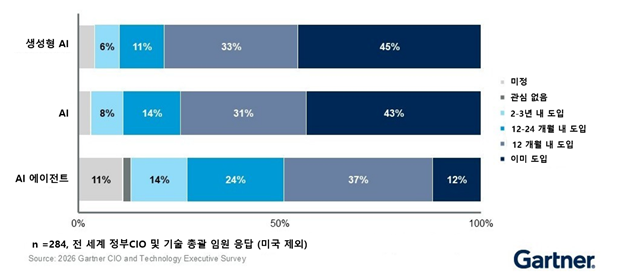
Accelerating AI Adoption, Attention on Generative AI and AI Agents
Gartner, a global business and technology insights firm, announced on the 27th that 52% of government Chief Information Officers (CIOs) worldwide, excluding the United States, plan to increase their IT budgets for AI and key technology sectors in 2026.
This demonstrates that, despite budget constraints, the strategic value of technology for modernizing public services and achieving core mission outcomes is still highly regarded.
Gartner conducted the '2026 CIO & Technology Executive Survey' from May to June 2025, targeting 2,501 CIOs and technology executives worldwide, 284 of whom were government CIOs excluding the United States.
According to the survey results, government CIOs announced plans to expand investment in key technology sectors next year, including cybersecurity (85%), AI and generative AI (80% each), and cloud platforms (76%).
This suggests that technological innovation is essential for improving public sector services and enhancing organizational operational efficiency.
According to the survey, 74% of government CIOs responded that they have adopted or plan to adopt AI within the next year, while generative AI recorded an even higher figure of 78%.
In addition, 49% of respondents have already adopted AI agents or They announced that they plan to introduce it within a year.
Gartner Director Analyst Arthur Mickoleit emphasized, “Agentic AI is emerging as a new driver of government innovation, but CIOs need a strategy to balance it with proven technologies such as machine learning and process automation.”
Government CIOs cited improving employee productivity (51%), developing new digital services (38%), and improving the public experience (37%) as the areas to focus on most in 2026.
This demonstrates that government organizations are simultaneously pursuing internal operational efficiency and innovation in public services through technology investment strategies.
"CIOs must prioritize AI projects that can rapidly increase internal efficiency and modernize procurement systems and governance to strengthen resource management and risk response," said a Micolite analyst.
Geopolitical risks and digital sovereignty issues are also influencing government CIOs' vendor strategies.
55% of CIOs participating in the survey expected a change in the way they relate to global technology suppliers, and 39% responded that they plan to expand collaboration with domestic or regionally based suppliers.
This reflects that the public sector is strengthening long-term resilience by closely managing technology dependence and supply chain risks.
"Government CIOs are re-evaluating risks and dependencies across their technology stacks and focusing on laying the groundwork to prepare for geopolitical changes or external shocks," explained an analyst at Mikolight.
The results of Gartner's latest survey show that AI, cybersecurity, and cloud have established themselves as key investment areas for government CIOs.
In addition, productivity improvement and nationalTechnological innovation to improve the civil experience and changes in supply chain strategies to respond to geopolitical risks are emerging as key directions for public sector IT policy.
Gartner customers can find more details in the report '2026 Global Government CIO Agenda: Technology Priorities and Shifting IT Strategies'.

Comments
Related news
“Semiconductors to grow by double digits by 2025”
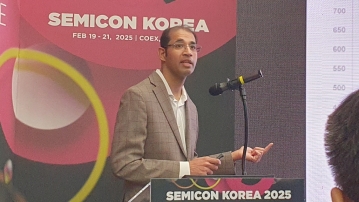
Gaurav Gupta, vice president of Gartner, stated at the Semicon Korea 2025 press briefing held on February 19th, "The semiconductor market in 2025 will achieve double-digit growth. Additionally, with the expansion of autonomous driving and electric vehicle markets, significant growth will be achieved over the next decade," indicating that the semiconductor industry will continue to grow.
2025.02.24by 명세환 기자
“AI Agents Accelerate Account Takeover Risk” Warning
Global research firm Gartner has warned of the severity of account takeover (ATO) and social engineering attacks resulting from advances in AI technology, emphasizing the importance of preparing security countermeasures. According to Gartner, AI agents are projected to reduce the time required for account takeover by 50% by 2027.
2025.03.20by 배종인 기자

Lenovo Recognized for Global Supply Chain Innovation Achievements through AI Integration
Global IT company Lenovo has ranked 8th in the "Gartner Supply Chain Top 25" selected by Gartner for 2025, achieving a two-step rise compared to the previous year.
2025.06.26by 배종인 기자
Gartner: Spending on Generative AI Models to Grow 148% by 2025
Global IT market analysis firm Gartner released a report on the 11th titled "Global Generative AI Model Outlook 2023-2029, Q2 2025 Update," forecasting that worldwide generative AI model spending from end-users will reach $14.2 billion this year.
2025.07.15by 배종인 기자
SUSE Named a Leader in Container Management by Gartner
SUSE, a global open source-based enterprise solutions company, has reaffirmed its position in the cloud-native market by being selected as a Leader in Gartner's '2025 Magic Quadrant for Container Management' with its 'SUSE Rancher Prime' solution.
2025.08.13by 배종인 기자











