



DigiKey: "'QSPICE' Innovatively Overcomes High-Frequency Parasitic Effects and Design Challenges"
 Published2025.12.05 09:58
Focus on ergonomics and intuitive interaction, immersing engineers in the design process.
Radio frequency (RF) technology is at the heart of modern communications, forming the foundation of wireless systems that connect devices, homes, and industries.
From high-speed 5G networks and satellite communications to IoT devices and automotive radar systems, RF systems power the invisible networks that power our world.
For engineers, understanding RF design and its challenges is essential to overcoming the limitations that exist in electronics.
RF design is a unique and complex field that requires a balance of theoretical knowledge, practical expertise, and creative problem solving.
Unlike digital systems, where signals are binary and predictable, RF operates in the dynamic analog domain, where even small adjustments can have a significant impact on performance.
There have been significant changes in RF design over the past 50 years.
With the emergence of a new generation of RF designers, modern designs are increasingly focused on simulation to optimize performance, model parasitic effects, and ultimately reduce development time.
From its roots in amateur radio, DigiKey has evolved into a company that helps engineers using RF systems navigate real-world constraints like size, cost, and regulatory compliance while considering factors like signal integrity, power management, and noise reduction.
DigiKey offers superior hardware components including chips, antennas, and RF connectors. We continue to support the RF community.
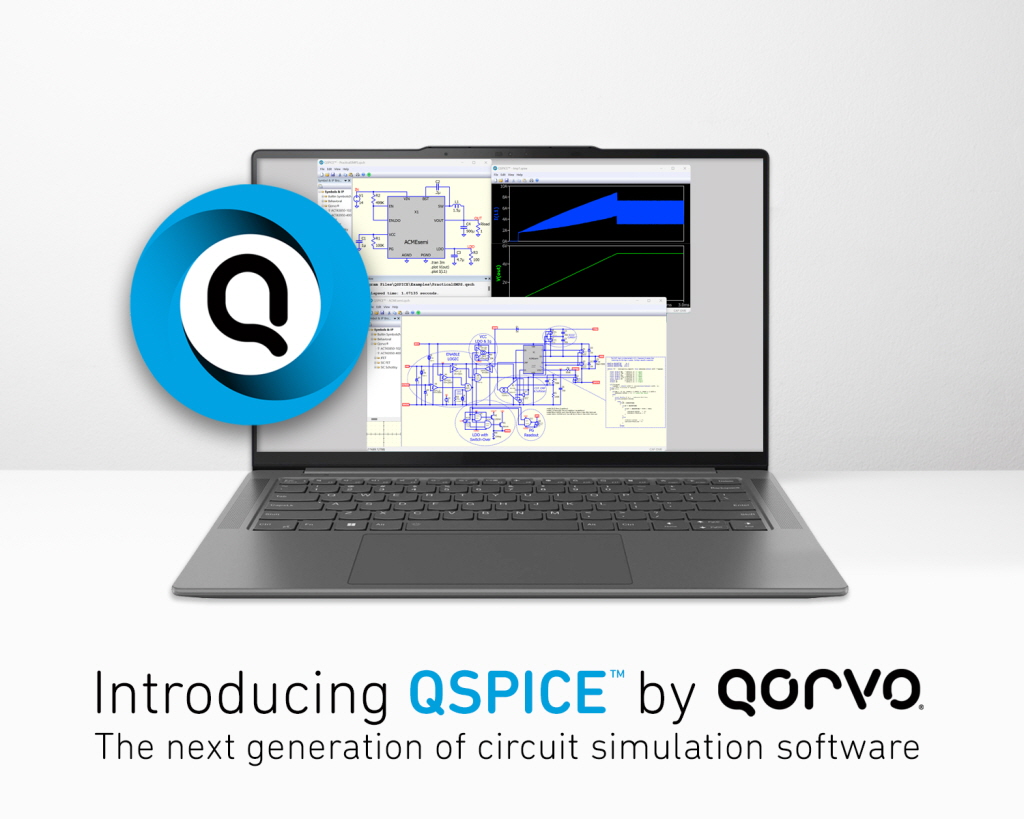
I recently had a 'Let's Talk Technical' session with Mike Engelhardt, a renowned physicist and analog engineer at Qorvo, to discuss simulation for RF design.
As an engineer, Mike has contributed significantly to circuit simulation software including LTspice and QSPICE.
■ Q&A with Qorvo's Mike Engelhardt
The Q&A below is based on the conversation we had that day, and explores Qorvo's development of QSPICE and its simulation innovations for RF engineers and mixed-signal designers.
Q: RF engineers have traditionally preferred frequency-domain simulators over SPICE. Why is a new approach needed?
A: Traditionally, RF engineers have relied heavily on frequency-domain or harmonic balance simulators, as SPICE tools struggle to accurately simulate spurious harmonics and low-level nonlinearities. QSPICE represents a significant shift, providing a more complete and realistic understanding of circuit behavior through precise time-domain simulation.
Time-domain simulation allows designers to directly work with physical bias points and overall circuit nonlinearities to determine actual power losses and avoid assumptions inherent in frequency-domain analysis. Frequency behavior is central to RF design, but QSPICE handles it from first principles by linearizing real circuits at real bias points, resulting in a more accurate and less error-prone design flow.
Q: How does QSPICE address the challenge of visualizing large amounts of simulation data?
A: Visualization often becomes a bottleneck in simulation tools, as traditional SPICE programs generate more data than can be efficiently plotted. QSPICE solves this problem by leveraging the same GPU-based graphics technology used in video games. This allows it to compress massive amounts of data up to 100,000 times faster than traditional tools, or render them without loss of fidelity.
The graphics engine uses triangle tessellation, a technology borrowed from games, to display data with incredible speed and clarity. This technology allows users to view uncompressed, real-world simulation results and perform accurate FFTs to easily identify spurious signals and harmonics.
Q: What are the specific benefits for RF engineers working on cutting-edge designs?
A: The essence of simulation is to deepen understanding. Simulation allows designers to build intuition, explore behavior, and refine designs in ways impossible on a physical bench. This is especially important for RF circuits.
Unlike baseband designs, RF circuits are susceptible to PCB parasitics, unintended reactive elements caused by the physical layout of the printed circuit board. Simulation allows designers to isolate and study core circuit behavior by removing these parasitic effects. This ability to isolate parasitic effects allows us to more clearly understand which factors are actually impacting performance.
This type of analysis is nearly impossible on a benchtop. Parasitic effects cannot be "unlocked" on a physical PCB, nor can components embedded in a multilayer board be easily modified or rerouted. Simulation provides a clean, flexible environment for testing, iteration, and learning.
Q: As technology advances into the gigahertz range, what are the biggest challenges in simulating high-frequency phenomena?
A: The most important challenge is accurately identifying parasitic effects—unintended inductive, capacitive, or resistive elements—that arise in the physical layout. At high frequencies, even small parasitic effects can significantly impact circuit behavior. While basic formulas for wire or trace inductance can address many of these issues, the real challenge arises when lumped-element models fail. Due to QSPICE's built-in models for solenoids, striplines, and straight wires, component behavior varies with frequency. Materials such as dielectrics and magnets exhibit frequency-dependent properties at the atomic level, making broadband lumped-element models virtually impossible. In these cases, designers must shift from attempting to eliminate parasitic effects to adopting a defensive design approach that considers their inevitable impact.
Q: What improvements has QSPICE made to the RF designer's user experience?
A: While most electronic CAD tools lack modern user interface design, QSPICE has innovated by focusing on ergonomic and intuitive interaction. For example, instead of modal pop-up dialog boxes that interrupt workflow, QSPICE uses built-in text editing features, allowing users to remain visually and mentally focused on the schematic. Furthermore, QSPICE replaces traditional toolbar navigation with context-sensitive right-click menus, minimizing mouse movement and allowing users to remain focused. Designed with flow and efficiency in mind, QSPICE allows engineers to focus on the design process without unnecessary distractions.
Q: What are the advantages of QSPICE for mixed-signal designers?
A: QSPICE offers outstanding mixed-mode simulation performance, making advanced features accessible to all designers. It natively compiles C++ and Verilog directly into executable object code that runs during simulation. As a result, digital logic is evaluated faster than actual hardware, except when simulating high-frequency signals, such as those at 5 GHz, on processors running at less than 5 GHz.
Simply drag and drop the box onto your schematic, enter your code, and run it. QSPICE streamlines the experience by providing all the necessary compilers built-in, enabling designers to quickly and easily simulate complex analog-digital interactions.
■ Conclusion
For RF engineers tackling GHz-level challenges and mixed-signal designers requiring integrated logic simulation, QSPICE represents a significant advancement in circuit simulation technology.
DigiKey understands the unique challenges engineers face in the RF field. Designing high-performance systems requires access to the right components, tools, and resources, as well as a thorough understanding of the principles that govern RF operation. By combining innovative products and expert support, we aim to help engineers overcome these challenges and develop solutions that meet the demands of today's connected world. Learn more about simulation for RF design in this Let's Talk Technical segment with Qorvo's Mike Engelhardt, as well as in our e-magazine, articles, and other resources on DigiKey.com.
※ Contributor
 Shawn Luke is a technical marketing engineer at DigiKey. DigiKey is a recognized global leader and innovator in the advanced commercial distribution of electronic components and automation products, offering more than 17 million components from over 3,000 leading, name-brand manufacturers.
Comments
Related news

Intel Unveils Next-Generation 'Core Ultra Series 3' and vPro Platform for Enterprise PCs
Intel has officially unveiled the "Intel Core Ultra Series 3" for next-generation enterprise PCs and the latest vPro platform, addressing a wide range of demands from enterprise notebooks to high-performance workstations.
2026.03.26by 배종인 기자

ROHM Launches ESD Protection Diode Compatible with High-Speed Interfaces of 10Gbps or Higher
Semiconductor specialist ROHM has developed the 'RESDxVx series' of ESD (electrostatic discharge) protection diodes capable of responding to next-generation high-speed data communication environments exceeding 10Gbps, simultaneously enhancing both signal quality maintenance required in high-speed interfaces and IC protection performance.
2026.03.26by 배종인 기자

ST Launches 75V Drive IC Targeting 48V Industrial Motor Driving
ST Microelectronics has unveiled the 'STSPIN9P' series of 75V motor drive ICs tailored for 48V-class industrial drive system design. The new product family is characterized by half-bridge and full-bridge configurations that enable design scalability according to motor type and output conditions. Power supply circuits, protection functions, and current sensing circuits are integrated on-chip to simplify system configuration, and the devices are designed to support applications up to 500W maximum. The company plans to provide reference designs and demo boards to support development and evaluation in industrial automation, robotics, pumps, fans, lighting, and textile machinery.
2026.03.26by 배종인 기자

Nordic supports security updates for the entire lifecycle of IoT devices at a single fixed cost
Nordic Semiconductor, a global leader in low-power wireless connectivity solutions, has unveiled a single fixed-cost licensing model that delivers FOTA (Firmware Over-the-Air) and device management capabilities throughout the device lifecycle via nRF Cloud, and introduced a new firmware update solution to prepare for the enforcement of the European Union's Cyber Resilience Act (CRA).
2026.03.26by 배종인 기자

Practical Training in Low-Noise, Low-Power Circuit Design All in One Place… Training Fee Support
The "2026 Advanced Engineer Practical Masterclass" to strengthen competencies in high-sensitivity analog circuit and sensor-based system design will be held on April 16 at the e4ds Conference Center in Gasan-dong, Seoul. This program will be conducted as an offline paid hands-on training session, not online, and is targeted at engineers seeking on-site intensive learning. Texas Instruments will provide educational support for this training, allowing participation at 150,000 won, a 100,000 won discount from the original price of 250,000 won.
2026.03.26by 배종인 기자











