



AI supercomputing will become a core infrastructure for the new industrial revolution.
 Published2025.12.11 10:02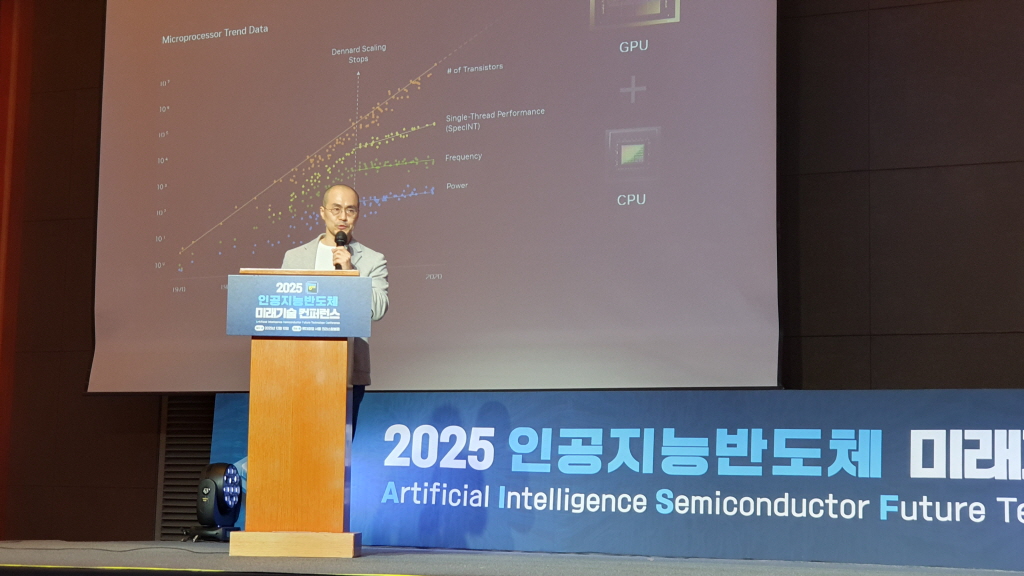
▲Jeong So-young, CEO of NVIDIA Korea, is giving a keynote speech on the topic of 'AI Supercomputing for New Industrial Revolution.'
AI Factory: Producing "Intelligence" with Electricity and Data, Incorporating This into Industry to Create Added Value
AI supercomputing will become a core infrastructure for a new industrial revolution, as an accelerated computing platform that goes beyond GPUs.
At the '2025 Artificial Intelligence Semiconductor Future Technology Conference' held at the Lotte Hotel in Seoul on the 10th, Nvidia Korea CEO Jeong So-young gave a keynote speech on the topic of 'AI Supercomputing for New Industrial Revolution.'
CEO Jeong So-young emphasized that Nvidia is positioning itself as an “accelerated computing platform company” beyond a simple GPU manufacturer, and predicted that AI supercomputing will become a core infrastructure of the upcoming industrial revolution.
CEO Jeong So-young said, “Many people know Nvidia only as a GPU company, but in reality, it is an accelerated computing platform company that encompasses GPU, CPU, networking, and software.” He added, “In an era where data is growing explosively, existing legacy data centers have limitations, and we need to solve this problem.” To this end, NVIDIA is building a new platform that can solve challenging problems such as AI and HPC (high-performance computing),” he said.
He specifically defined AI as a new software development methodology, not simply an algorithmic computation accelerator.
He emphasized that while existing software was implemented through algorithm definition and programming, AI follows a completely different development paradigm of data collection, model learning, optimization, and service provision.
CEO Jeong So-young defined AI as a “new value-creating industry” and introduced the “AI Factory” concept proposed by Nvidia.
While traditional factories produced products using raw materials and labor, AI factories produce "intelligence" using electricity and data, and apply this to all industries to create added value.
As a representative example supporting this, he mentioned the GB200 NVL72 supercomputer.
The system connects 72 GPUs via NVLink and InfiniBand networks to act as a single, massive virtual computing resource.
Rather than being a simple hardware set, it is designed to be utilized in various fields such as AI, quantum computing, EDA, communications, and media by providing CUDA-X libraries optimized for each industrial domain.
CEO Jeong So-young cited the scaling law as a key principle in AI development.
The combination of a lot of data, large models, and powerful computing resources leads to dramatic improvements in AI performance.
Initially, large-scale infrastructure investments were mainly focused on learning foundation models, but recently, they have expanded to include not only pre-training but also fine-tuning andHe explained that even post-training stages such as distillation and quantization require massive computing resources.
He also pointed out that as generative AI evolves beyond simple question-and-answer to reasoning-based problem-solving, massive resources are required even at the inference stage.
CEO Jeong So-young said, “Inference is no longer a light task. “As the scale and complexity of services grow, they create infrastructure issues that are more complex than training,” he emphasized.
He cited the Mixture of Experts (MoE) model as a key trend in recent AI research.
Although MoE is a large-scale model with tens of billions to hundreds of billions of parameters, it is structured to increase efficiency by activating only the necessary expert modules during the actual inference stage.
Despite these advantages, the MOE model presents new technical challenges, including distributed serving and memory latency issues.
CEO Jeong So-young emphasized that the NVL72 supercomputer is the optimal platform for solving these problems.
The NVLink-based ultra-high-speed interconnect minimizes bottlenecks that occur in distributed serving of the MOE model, providing up to 10 times the performance of the existing H200.
In fact, NVIDIA has announced that it has improved performance by over 50% by serving the LLaMA 3.1 model based on NVL72.
“With powerful AI computing platforms, inference costs are steadily decreasing, creating a virtuous cycle that promotes the development of more complex and advanced AI services,” said CEO Jeong So-young.
He added that recently, much heavier workloads have emerged, moving beyond simple text generation to high-resolution video and image generation and large-scale code writing, and that appropriate optimization techniques are essential.
CEO Jeong So-young emphasized that “AI supercomputing is not simply a technological advancement; it is the foundation for a new industrial revolution,” and that Korean companies should also actively participate in this paradigm shift.

Comments
Related news
“Evolution of on-device AI in automobiles requires high-performance and high-capacity memory”
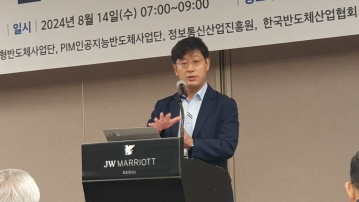
Kang Wook-sung, Vice President of SK Hynix, delivered a presentation on "The Direction of Intelligent Vehicle Memory-Storage Development in the AI Era" at the "7th Artificial Intelligence Semiconductor Forum Breakfast Seminar" held on the 14th at JW Marriott Seoul. He stated that automobiles are rapidly commercializing AI functions, including performing AI inference in ADAS, utilizing LLM-based on-device AI in the cockpit, and leading the earliest adoption of robotics in autonomous driving, and that the necessity for high-performance, high-capacity vehicle memory storage is consequently increasing sharply in the future.
2024.08.14by 배종인 기자
.jpg)
“AI Semiconductor Accelerates Evolution Centered on High-Bandwidth, High-Integrity, and Low-Power DRAM”
Son Gyo-min, Master at Samsung Electronics, presented on "DRAM Solutions in the AI Era" at the "10th Artificial Intelligence Semiconductor Forum Breakfast Lecture" held on the 13th at the InterContinental Parnas in Samseong-dong, Seoul. He stated that AI semiconductor technology centered on DRAM is undergoing complex and sophisticated evolution toward three key keywords: High Capacity, High Bandwidth, and Low Power.
2025.05.13by 배종인 기자
Close collaboration with automakers is crucial for the success of automotive AI semiconductors.
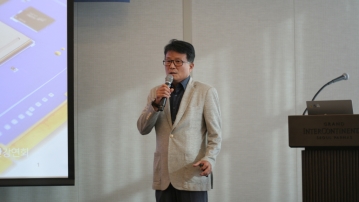
The Artificial Intelligence Semiconductor Forum held the 12th AI Semiconductor Forum breakfast seminar on the 10th with the theme "Key to Securing the Automotive AI Market - What Matters in Semiconductor Competitiveness?" Park Won-ju, CSO of Bosch Semiconductor, who presented at the event, stated that the automotive industry operates by looking ahead five years into the future market, and that autonomous driving and in-vehicle infotainment are at the center of AI innovation.
2025.09.12by 배종인 기자
"Future data centers require decentralized, high-efficiency, and high-density infrastructure innovation."
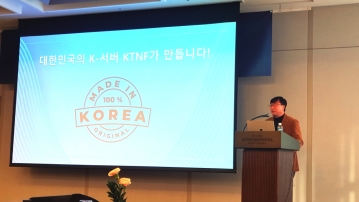
At the 13th AI Semiconductor Forum breakfast seminar, KTNF CEO Lee Jung-yeon delivered a presentation titled "Next-Generation Data Center Architecture in the AI Era," stating that due to the rapid advancement of AI technology, next-generation AI infrastructure must provide scalability and flexibility while simultaneously achieving three core benefits: energy savings, enhanced security, and operational efficiency.
2025.11.12by 배종인 기자
.jpg)
The key to AI success lies in securing high-quality data, parallelizing infrastructure like GPUs, and optimizing it.
At the AI Semiconductor Future Technology Conference held at Lotte Hotel Sogong on December 10, Jeon Gyeong-jeong, Division Head of LG AI Research Institute, presented on the topic "Keys to AX Success: EXAONE AI Stock Strategy Cases," stating, "For successful AI implementation, automation of data generation and processing, efficient infrastructure expansion, and development of customized models for each industry are essential."
2025.12.10by 배종인 기자











