


[Serial Project] Physical AI: Redefining the Future of Industry ⑦, "Physical AI: The Engine of Humanoid Evolution"
 Published2025.12.16 09:50
Global companies are investing in humanoid development, making it the optimal testing ground for physical AI.
[Editor's Note] While conventional AI focuses on inference and generation within digital data, Physical AI directly acts and reacts in the real world through sensors, edge computing, robots, and control systems. The implementation of Physical AI can significantly advance industrial innovation and automation because it directly acts and solves problems in the real world, and it directly interacts with the real world. Accordingly, global companies such as Nvidia, Tesla, and Google are making massive investments in Physical AI, and the related market is expected to grow explosively. To implement this Physical AI, recognition technologies such as sensors, as well as edge computing and embedded systems for real-time data processing, local computing, robotics, and control technologies are essential. Accordingly, e4ds News has prepared a series of articles to examine the core technologies and implementation strategies of physical AI, including the concept, market outlook, related technologies, and actual cases.
▲Photo: pixabay.com
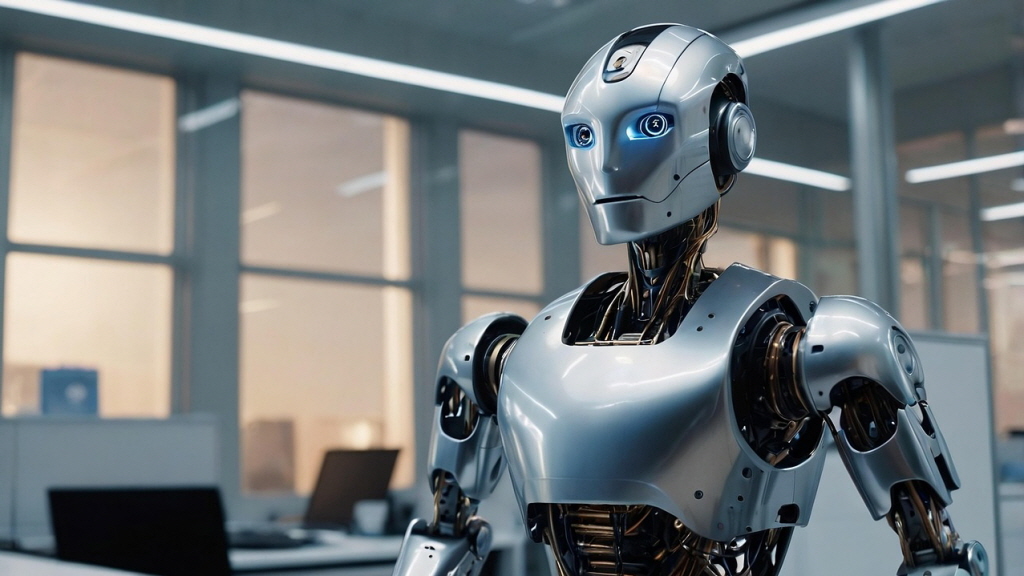
As artificial intelligence (AI) expands beyond the digital realm into the physical world, 'physical AI' is rapidly emerging as a next-generation technology paradigm.
In particular, humanoids, the robots that most closely resemble humans, can be said to be the epitome of physical AI, and their development direction is directly linked to the future of physical AI.
■ The meeting of humanoids and physical AI
Humanoids are not simply robots that mimic human appearance.
Human-like senses, intelligence, and behavior must be realized, and the key technology that makes this possible is physical AI.
According to the report, physical AI consists of four axes: AI-based models (brain), computer vision and sensors (senses), edge computing and network infrastructure (connectivity), and control and actuators (behavior).
A humanoid can see, hear, judge, and move like a human only when these four elements are organically combined.
For example, Google DeepMind's Gemini Robotics is designed to enable robots to interpret verbal commands and translate them into actual physical actions through a vision-language-action (VLA) model.
Tesla's Optimus is a self-driving car with a vast amount of experience.We are enhancing the humanoid brain using data and the AI supercomputer 'Dojo'.
NVIDIA bills itself as the “operating system for physical AI” through its simulation platform Isaac Sim and its universal humanoid model GR00T.
In this way, global companies are using humanoid development as the optimal testing ground for physical AI.
■ Generalization of intelligence, refinement of senses, naturalization of behavior, and expansion of connectivity
Examining the impact of physical AI on humanoids, the first is the generalization of intelligence. While robots in the past performed only repetitive, specific tasks, physical AI enables them to understand and respond to diverse situations through multimodal models. This expansion of intelligence allows humanoids to go beyond simple assembly to converse and collaborate with humans.
Second, the sophistication of senses. A recognition system combining cameras, LiDAR, and tactile sensors enables humanoids to understand space and manipulate objects with precision, much like humans. Soft robotics technologies, particularly "artificial skin," ensure safe interaction with humans.
Third, naturalization of behavior. Advances in actuators are essential for humanoid robots to achieve human-like gait and movement. Boston Dynamics' Atlas' transition from hydraulic to electric propulsion is a significant milestone toward commercialization.
Fourth, connectivity is expanding. 5G and 6G communications and edge computing will enable humanoids to collaborate with multiple robots, transcending individual capabilities. An era is dawning where cloud brains, like Naver Labs' ARC, command armies of robots.
■ Challenges of Physical AI for Humanoid Development
For humanoids to be fully deployed in society, physical AI must advance in several directions.
First, we need to close the sim-to-real gap.
The problem of models that work perfectly in simulations failing in real-world environments remains significant. Technologies such as domain randomization and digital twins are essential to enhance real-world fit.
Energy efficiency and hardware innovation are also needed.
Limitations of actuators and batteries are bottlenecks in the commercialization of humanoids.
Electric actuators that are quiet and easy to maintain, as well as high-density battery technology, must be developed.
Ethics and legal system reform is also urgent.
As humanoids perform more human-like behavior, issues of legal responsibility and ethical standards arise. The development of physical AI must be accompanied by the establishment of an institutional foundation as well as technological advancements.
Optimizing human-robot collaboration is also important.
The goal of humanoids is not to replace humans, but to cooperate with them.
Sensor fusion, intuitive interfaces, and social acceptance are essential for safe interaction.
■ Coexistence of humans and robots
Physical AI is the brain and neural network of humanoids, and humanoids are the most iconic embodiment of physical AI.
The combination of these two technologies heralds a transition beyond simple automation to a society where humans and robots coexist.
As physical AI continues to evolve across the four axes of intelligence, sensation, behavior, and connectivity, humanoids will become true companions not only in industrial settings but also in everyday life.

Comments
Related news
[2025 e4ds Tech Day] "The Era of Physical AI: New Opportunities for the Semiconductor Industry"
"Physical AI and on-device AI have now become essential technologies rather than optional ones, and semiconductor development for these will determine competitiveness across the entire industry." Choi Hong-seob, CEO of Maum AI, presented on 'On-Device AI Technologies and Strategies in the Physical AI Era' at the '2025 e4ds Tech Day' event held on September 9th, delivering an in-depth presentation on the definition and market outlook of Physical AI as well as the importance of on-device AI semiconductors.
2025.10.20by 배종인 기자
[Serial Project] Physical AI: Redefining the Future of Industry ①, "The Success of Physical AI Depends on the Design of Interactions Between Humans and Intelligent Machines."
While conventional AI has focused on inference and generation within digital data, Physical AI acts and responds directly in the real world through sensors, edge computing, robots, and control systems. The implementation of Physical AI can significantly advance industrial innovation and automation since AI directly acts and solves problems in the real world, interacting directly with the physical environment. Accordingly, global companies including NVIDIA, Tesla, and Google are making massive investments in Physical AI, and the related market is expected to grow explosively. To implement such Physical AI, perception technologies including sensors, edge computing and embedded systems for local computing to process real-time data, as well as robotics and control technologies are essential. In response, e4ds news has prepared a series of articles to examine core technologies and implementation strategies ranging from the concept of Physical AI to market outlook, related technologies, and practical cases.
2025.10.20by 배종인 기자
.jpg)
[Serial Feature] Physical AI: Redefining the Future of Industry ②, "The 'Physical AI Market' Will Become a $1 Trillion Ecosystem by 2030."
According to some experts, 'Physical AI' is projected to become the greatest revolution in human history, surpassing the Industrial Revolution. While it will have significant impacts on society, culture, and economy, since we cannot predict the entirety of these effects, from an economic perspective, citing forecasts from global market research institutions, Physical AI is expected to establish itself as a key driving force that will reshape industrial structures, with the market reaching approximately one trillion dollars by 2030. Below is an examination of the Physical AI market size by industrial sector.
2025.10.27by 명세환 기자
[Serial Project] Physical AI: Redefining the Future of Industry ③, "Physical AI Sensors: A Key to Physical AI Competitiveness"
While conventional AI has focused on reasoning and generation within digital data, Physical AI directly acts and responds in the real world through sensors, edge computing, robots, and control systems. The implementation of Physical AI can greatly advance industrial innovation and automation since AI directly acts and solves problems in the real world, interacting directly with the physical environment. Accordingly, global companies including Nvidia, Tesla, and Google are making substantial investments in Physical AI, and the related market is expected to grow explosively. To implement such Physical AI, perception technologies including sensors, edge computing and embedded systems for local computation to process real-time data, as well as robotics and control technologies are essential. In response, e4ds news has prepared a series of planning articles to examine the core technologies and implementation strategies of Physical AI, ranging from its concepts to market prospects, related technologies, and practical cases. This edition covers sensors, which are the sensory organs of Physical AI.
2025.11.11by 명세환 기자
“Physical AI Revolutionizes Human-Robot Collaboration”
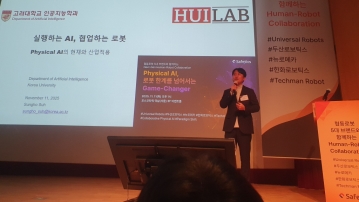
At a seminar titled "Next-Gen Human-Robot Collaboration with Top 5 Collaborative Robot Brands - Physical AI, Game-Changer Beyond Robot Limitations," held on the 11th at the event hall on the 3rd floor of POSCO Tower Yeoksam and hosted by Safetics, Professor Seo Seung-ho from the Department of Artificial Intelligence at Korea University presented on the topic of "Executing AI, Collaborating Robots - Current State and Industrial Application of Physical AI." Professor Seo Seung-ho stated, "Physical AI will revolutionize the collaboration between humans and robots," and explained, "It is important to understand how AI and robot technology connect with real-life applications, and the entire cycle that links data collection and interpretation to the actual movements of robots is crucial."
2025.11.12by 배종인 기자











