



[Serial Project] Physical AI: Redefining the Future of Industry, "Seize Hegemony in the AI Era"
 Published2025.12.23 09:54
Technology, industry, and standards are all in their infancy, and a strategic policy based on a world-class industry is essential.
[Editor's Note] While conventional AI focuses on inference and generation within digital data, Physical AI directly acts and reacts in the real world through sensors, edge computing, robots, and control systems. The implementation of Physical AI can significantly advance industrial innovation and automation because it directly acts and solves problems in the real world, and it directly interacts with the real world. Accordingly, global companies such as Nvidia, Tesla, and Google are making massive investments in Physical AI, and the related market is expected to grow explosively. To implement this Physical AI, recognition technologies such as sensors, as well as edge computing and embedded systems for real-time data processing, local computing, robotics, and control technologies are essential. Accordingly, e4ds News has prepared a series of articles to examine the core technologies and implementation strategies of physical AI, including the concept, market outlook, related technologies, and actual cases.
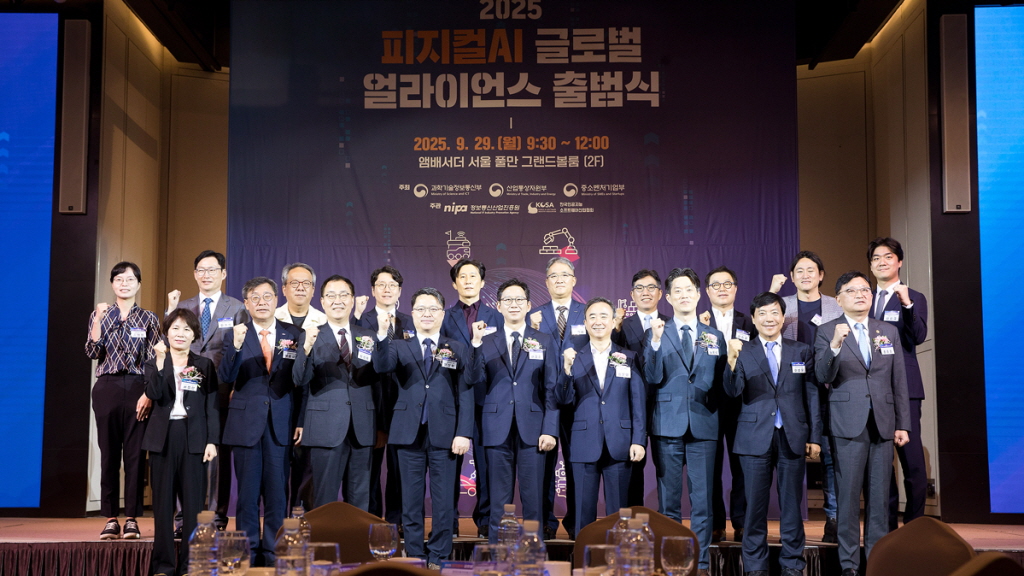
▲The launch ceremony of the Physical AI Global Alliance last September (Photo: Ministry of Science and ICT)
Last September, the 'Physical AI Global Alliance' was officially launched, with the participation of approximately 250 Korean institutions from industry, academia, research, and government.
This is a large-scale cooperative body centered around the Ministry of Science and ICT, the Ministry of Trade, Industry and Energy, the Ministry of SMEs and Startups, the National Artificial Intelligence Strategy Committee, and major companies and research institutes such as Hyundai Motor Company, LG AI Research Institute, Doosan Robotics, and Naver Cloud, participating as co-chairs and division heads.
It is unusual for government ministries to participate simultaneously and for major domestic companies to take charge of 10 sectors, including technology, industry, standards, talent, and international cooperation.
The reason this alliance was launched is clear.
This is because the 'physical AI era', in which AI expands beyond the digital world into the physical world, is fully dawning.
While generative AI was limited to handling text, images, and language, physical AI is a technology that sees, hears, judges, moves, and acts directly in the real world like a human.
As the entire industry is being reorganized around physical AI, including autonomous vehicles, humanoid robots, drones, smart manufacturing, and defense systems, Korea has determined that it is no longer possible to respond solely with the capabilities of individual companies.am.
■ National unity is needed
Physical AI is not a single technology.
AI models (brain), sensors/vision (sense), on-device semiconductors (computation), robots/actuators (body), networks (connection), and simulations (learning environment) must all be combined to complete the system.
In this regard, the government and research institutes commonly point out the following problems.
First, technological complexity and development costs skyrocket.
Humanoid robots, autonomous driving, drones, and industrial robots all require high-performance AI semiconductors, large-scale simulations, robotics foundation models, and precision control technology.
It is a level of cost and technical difficulty that is difficult for a single company to handle.
A convergence competition is also unfolding, with boundaries between industries disappearing.
Automobiles are being reorganized into 'AI-defined vehicles (ADVs)', and robots are expanding into manufacturing, logistics, healthcare, and national defense.
Because this is a competition that involves all industries, including AI, semiconductors, robotics, mobility, cloud, and security, national coordination is essential.
The competition for global hegemony is also accelerating.
The United States, China, the EU, and Japan have designated physical AI as a national strategic technology and are making large-scale investments.
NVIDIA is aiming to become the operating system for physical AI with a horizontal platform strategy that integrates hardware (GPU·Jetson), simulation (Omniverse·Isaac Sim), and AI models (GR00T).
Google DeepMind's RT-2 and Gemini Robotics are the robot's 'brains'is trying to take the lead.
Tesla and Figure AI are accelerating the commercialization of humanoid robots, while Boston Dynamics maintains its unrivaled edge in kinematics and control technology.
Their commonality is clear.
We are securing simulation-based synthetic data, developing a Robotics Foundation Model (VLA), and internalizing edge and on-device AI semiconductors, and are pursuing a commercialization strategy that can be immediately deployed in actual industrial settings.
If Korea falls behind, its competitiveness in key industries such as automobiles, shipbuilding, semiconductors, and robotics could rapidly weaken.
■ Physical AI has yet to have a winner
Despite this situation, government announcements and research reports commonly diagnose physical AI as an “incipient market with no clear leader.”
While the United States has an overwhelming lead in generative AI, physical AI is still in its infancy in terms of technology, industry, and standards.
Korea possesses strengths in the following areas: world-class manufacturing, automobile, and home appliance industries; a concentration of robotics, mobility, semiconductor, and AI companies; advanced industrial infrastructure (smart factories, logistics centers, shipyards, etc.); and the government's ability to swiftly implement policies.
In other words, this is the 'strategic window' in which Korea can secure physical AI hegemony.
■ The direction Korea should take
A synthesis of experts and key data suggests the following are the directions Korea needs to take to lead the era of physical AI.
○ On-device AI National Strategy for Semiconductors
Physical AI must perform real-time judgment and actions on the device itself, not in the cloud.
In other words, NPU and edge AI chips are the core of national competitiveness.
Korea is a memory powerhouse, but its system semiconductors are weak.
The government's K-on-Device AI semiconductor project should be expanded to encompass all sectors, including automobiles, robotics, home appliances, and defense, and triangular cooperation among fabless companies, demand companies, and foundries should be institutionalized.
○ Development of a Korean-style robotics foundation model
The brain of physical AI is not GPT, but a robot-specific model based on VLA (Vision-Language-Action).
There is an urgent need to build a Korean-style robot dataset, produce simulation-based synthetic data, and standardize industry-specific behavioral data.
There is a need for the government, large corporations, and AI research institutes to jointly pursue the 'K-Robotics FM' development project.
○ Establishment of simulation and digital twin infrastructure
Physical AI cannot make millions of trials and errors in the real world.
Therefore, a high-fidelity simulation platform is key to national competitiveness.
To reduce dependence on NVIDIA Isaac Sim, development of a Korean-style industrial simulator and standardization of digital twins are necessary.
○ Opening of large-scale demonstration test bed
Factories, logistics centers, hospitals, and shipyards of major corporations such as Hyundai Motor Company, Samsung, LG, Naver, and Doosan should be opened as physical AI testing zones.
Empirical data must be accumulated Technology is advancing rapidly.
○ Leading international standards, safety, and ethics
Physical AI inevitably raises safety, liability, and security issues.
We must lead discussions on international standardization based on global alliances.
■ Physical AI: Korea's Second Semiconductor Opportunity
Physical AI is not just a technology trend,
It is a national strategic technology that will determine the future of Korea's manufacturing, mobility, robotics, defense, and home appliance industries.
There is only one reason why the government and industry chose a national alliance.
The era of physical AI has yet to have a clear winner, and now is a crucial time for Korea to lead the world.
Just as Intel was in the PC era, Apple was in the mobile era, and Nvidia was in the generative AI era, a new winner will emerge in the era of physical AI.
For Korea to become that protagonist, we need to increase our current pace.
When government strategic investment, corporate technology internalization, academic and research collaboration, and global solidarity all come together, Korea can stand at the center of the physical AI era.

Comments
Related news
[2025 e4ds Tech Day] "The Era of Physical AI: New Opportunities for the Semiconductor Industry"
"Physical AI and on-device AI have now become essential technologies rather than optional ones, and semiconductor development for these will determine competitiveness across the entire industry." Choi Hong-seob, CEO of Maum AI, presented on 'On-Device AI Technologies and Strategies in the Physical AI Era' at the '2025 e4ds Tech Day' event held on September 9th, delivering an in-depth presentation on the definition and market outlook of Physical AI as well as the importance of on-device AI semiconductors.
2025.10.20by 배종인 기자
[Serial Project] Physical AI: Redefining the Future of Industry ①, "The Success of Physical AI Depends on the Design of Interactions Between Humans and Intelligent Machines."
While conventional AI has focused on inference and generation within digital data, Physical AI acts and responds directly in the real world through sensors, edge computing, robots, and control systems. The implementation of Physical AI can significantly advance industrial innovation and automation since AI directly acts and solves problems in the real world, interacting directly with the physical environment. Accordingly, global companies including NVIDIA, Tesla, and Google are making massive investments in Physical AI, and the related market is expected to grow explosively. To implement such Physical AI, perception technologies including sensors, edge computing and embedded systems for local computing to process real-time data, as well as robotics and control technologies are essential. In response, e4ds news has prepared a series of articles to examine core technologies and implementation strategies ranging from the concept of Physical AI to market outlook, related technologies, and practical cases.
2025.10.20by 배종인 기자
.jpg)
[Serial Feature] Physical AI: Redefining the Future of Industry ②, "The 'Physical AI Market' Will Become a $1 Trillion Ecosystem by 2030."
According to some experts, 'Physical AI' is projected to become the greatest revolution in human history, surpassing the Industrial Revolution. While it will have significant impacts on society, culture, and economy, since we cannot predict the entirety of these effects, from an economic perspective, citing forecasts from global market research institutions, Physical AI is expected to establish itself as a key driving force that will reshape industrial structures, with the market reaching approximately one trillion dollars by 2030. Below is an examination of the Physical AI market size by industrial sector.
2025.10.27by 명세환 기자
[Serial Project] Physical AI: Redefining the Future of Industry ③, "Physical AI Sensors: A Key to Physical AI Competitiveness"
While conventional AI has focused on reasoning and generation within digital data, Physical AI directly acts and responds in the real world through sensors, edge computing, robots, and control systems. The implementation of Physical AI can greatly advance industrial innovation and automation since AI directly acts and solves problems in the real world, interacting directly with the physical environment. Accordingly, global companies including Nvidia, Tesla, and Google are making substantial investments in Physical AI, and the related market is expected to grow explosively. To implement such Physical AI, perception technologies including sensors, edge computing and embedded systems for local computation to process real-time data, as well as robotics and control technologies are essential. In response, e4ds news has prepared a series of planning articles to examine the core technologies and implementation strategies of Physical AI, ranging from its concepts to market prospects, related technologies, and practical cases. This edition covers sensors, which are the sensory organs of Physical AI.
2025.11.11by 명세환 기자
.jpg)
[Serial Feature] Physical AI: Redefining the Future of Industry ④, "Physical AI Emerges as a Key to Bridging the Automation Gap"
As the era of 'Physical AI,' where artificial intelligence directly interacts with the physical world, arrives, the manufacturing and logistics industries are experiencing the first wave of change, while Physical AI is rapidly emerging as a key solution to bridge the automation gap between large and small-to-medium enterprises.
2025.11.24by 배종인 기자











