


AI that moves 3D characters with a single photo
 Published2025.12.26 09:28
.jpg)
▲(From left) Professor Joo Kyung-don, Researcher Kim Jin-hyeok (first author), Researcher Bang Jae-hoon, Researcher Seo Seung-hyeon, and other UNIST researchers
A domestic research team has developed an artificial intelligence technology that allows a 3D character to mimic the movements in a photo by inputting just one photo. This technology is expected to significantly lower production costs and entry barriers across the metaverse, game, and animation industries, as it can implement natural 3D movements without the need for multi-angle shooting data or complex motion capture equipment, which were essential in the existing 3D content production process.
A research team led by Professor Kyung-Don Joo of the UNIST Graduate School of Artificial Intelligence announced on the 25th that they have developed an AI model called 'DeformSplat (Rigidity-aware 3D Gaussian Deformation)' that deforms the posture of a 3D character generated based on 3D Gaussian Splatting without distortion.
3D Gaussian splatting is a cutting-edge AI technology that reconstructs 3D objects from 2D images, and is rapidly gaining attention in the graphics field.
On the other hand, the existing method required images or continuous video data taken from multiple angles to move the character, and had limitations in that if there was insufficient data, shape distortion occurred, such as abnormal bending of arms and legs.
The Deformsplat developed by the research team can naturally change the pose of a 3D character with just one photo.
The results of the experiment showed that when the character performed movements such as raising his arms or twisting his body, the proportions did not collapse not only from the front but also from the side and back, and the joints hardly ever stretched like rubber.
The core of this technology is two things: △Gaussian-to-Pixel Matching and △Rigid Part Segmentation.
Gaussian pixel matching connects the Gaussian points that make up a 3D character with the pixels in the photo, accurately conveying the pose information contained in the photo in 3D. />
Rigid body segmentation technology automatically finds and binds rigid structures that must be deformed during movement, thereby maintaining the shape of robots, dolls, and characters without distortion.
Professor Joo Kyung-don explained, “Existing technologies have the problem that when trying to move a 3D object with just a single photo, the shape is greatly damaged.” He added, “This research is a technology that allows AI to identify the structural characteristics of an object on its own, distinguish the area that acts as a skeleton, and generate natural movements.”
He then emphasized, “This will significantly lower the threshold for 3D content production, which previously required specialized equipment and expensive production personnel.”
This research result was accepted as a paper at SIGGRAPH ASIA 2025. SIGGRAPH ASIA, the world's most prestigious computer graphics and interactive technology conference hosted by the ACM, has been recognized for the technical perfection and innovativeness of the research.
This year's conference was held in Hong Kong from December 15th to 18th.
This research was conducted with the support of the Ministry of Science and ICT's Institute of Information and Communications Technology Planning and Evaluation (IITP) and UNIST Graduate School of Artificial Intelligence.

Comments
Related news
.jpg)
No battery life loss even with fast charging
A joint research team led by Professor Kang Seok-ju from the Department of Energy Chemical Engineering at UNIST (Ulsan National Institute of Science and Technology), Professor Kwak Sang-gyu from Korea University, and Dr. Ahn Seok-hun from the Korea Institute of Science and Technology (KIST) has developed a hybrid anode material combining graphite and curved nanoGraphene. This material features a structure capable of maintaining stable battery performance and lifespan even during fast charging.
2025.09.24by 배종인 기자
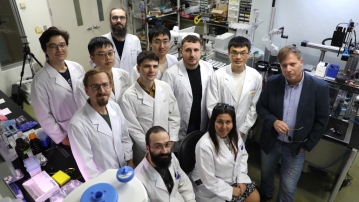
AI can perform 1,000 chemistry experiments a day without any problems.
Ulsan National Institute of Science and Technology (UNIST) announced on the 25th that a research team led by Professor Bartosz Grzybowski of the Department of Chemistry has developed an 'AI and robot-based automated experimentation platform' capable of automatically performing over 1,000 chemical experiments per day using artificial intelligence (AI) and robotics. This technology is expected to provide a breakthrough turning point in new drug development and novel material discovery by precisely mapping complex chemical reaction networks and rapidly generating new chemical compounds.
2025.09.25by 명세환 기자
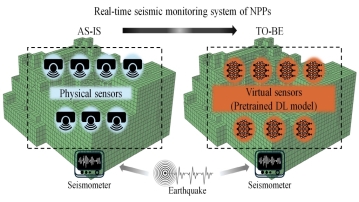
UNIST and Pyo Research Institute Use AI to Predict Nuclear Power Plant Earthquakes
UNIST (Ulsan National Institute of Science and Technology) and KRISS (Korea Research Institute of Standards and Science) have jointly developed an AI-based virtual sensor technology that implements a model capable of predicting seismic damage at 139 points within a nuclear power plant using only a single sensor. Real-time monitoring is now possible without establishing a conventional sensor network, which is expected to significantly improve inspection efficiency and safety.
2025.10.01by 명세환 기자
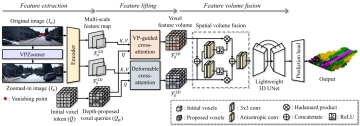
UNIST enhances autonomous driving with camera-based vanishing point technology.
A research team at UNIST's Graduate School of Artificial Intelligence has developed an AI model called 'VPOcc' that applies the Renaissance painters' concept of 'vanishing points' to artificial intelligence, compensating for perspective distortion in camera images. This research was conducted with support from the Ministry of Science and ICT and the National Research Foundation of Korea, and the results have been accepted for presentation at IROS 2025, an international conference in the field of intelligent robotics.
2025.10.15by 명세환 기자
UNIST: AI Improves Wireless Image Transmission Efficiency by 45 Times
A research team led by Professor Yun Sung-hwan from the Graduate School of Artificial Intelligence at Ulsan National Institute of Science and Technology (UNIST) has developed AI technology that dramatically improves the efficiency of wireless image transmission. The 'Task-Adaptive Semantic Communication' technology developed by the research team differs from the conventional method of compressing and transmitting entire images, instead selectively transmitting only the semantic information essential for task execution.
2025.11.06by 배종인 기자











