



In the SDV era, automotive development methods are shifting from "direct development" to "platform adoption."
 Published2026.01.27 11:36
EB Sibion, a standardized component approach that applies specification selection
As software-defined vehicles (SDVs) become a key keyword in the automotive industry, signs of fundamental change are also emerging in vehicle development methods.
According to 'CES 2026 Day 2: Integration as Product: The Platform Response to SDV Complexity' recently published by Ian Riches of TechInsights, QNX and Vector's 'Alloy Kore' and Elektrobit's 'EB civion' unveiled at CES 2026 may seem like solutions targeting different areas on the surface, but their essence is the same. It was analyzed that they are a strategy to increase development efficiency based on a pre-integrated platform, breaking away from the existing method of OEMs directly integrating and managing complex vehicle software.
Meanwhile, global automakers have been building large-scale internal software organizations and establishing joint ventures or acquiring software companies to transition to SDV.
On the other hand, the results fell short of expectations.
As the number of cross-domain connections, integration points between operating systems, middleware, and applications increased exponentially, development schedules were delayed, and the increased complexity led to staff turnover and cost burdens.
These limitations were particularly evident in traditional OEMs, and with the exception of some regions, the pace of SDV strategies became inevitable.
style="text-align: center;">
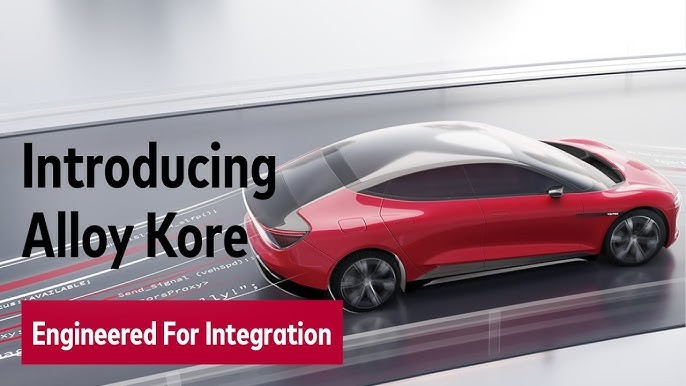
▲Vector and QNX's SDV operating platform, Alloy Core
In this situation, the alloy core that emerged is attracting attention because it ‘provides integration itself as a product.’
Combining QNX's safety-certified operating system and virtualization technology with Vector's safety middleware, this platform provides a common foundation across multiple domains within the vehicle.
Designed to meet ISO 26262 ASIL D and ISO/SAE 21434, it simultaneously considers functional safety and cybersecurity, and major OEMs, including Mercedes-Benz, are considering applying the next-generation SDV architecture.
OEMs can leave foundational tasks like real-time operating systems, domain separation, and fault tolerance to the platform, and focus on user experience and service differentiation.

▲EB Sivion, Elektrobit's SDV digital cockpit development acceleration solution
Electrobit's EB Sivion is also in the same trend.
This solution, specialized for digital cockpits, provides a cloud-native virtual development environment, hardware-independent software cores, and build-to-print cockpit designs tailored to specific SoCs, all in one package.
This means that cockpit controllers are no longer something OEMs have to design from scratch.Rather, the approach is to view them as standardized components that can be selected and applied to specifications.
The core values are shortening development time, reducing total cost of ownership, and streamlining supply chain management.
The commonalities between the two platforms are clear.
The point is to define integration as the core of the problem and to resolve it at the platform level.
It also assumes a cloud-based development environment and a multi-party collaborative ecosystem, overturning the existing perception that OEMs must own and develop all software.
This shows that SDV development is moving from ‘custom build’ to ‘adoption of industrialized platforms.’
Of course, this isn't the same solution for all OEMs.
Companies that already have a strong software organization and ecosystem may still prefer in-house development.
On the other hand, it is significant that even companies with large engineering capabilities, such as BMW and Mercedes-Benz, recognize the advantages of external platforms in the area of basic software.
Experts evaluate this as a realistic evolution of automobile development in the SDV era.
The analysis is that the method of making everything directly is not sustainable, and that a strategy of pursuing differentiation on a standardized platform will determine competitiveness.
While Alloy Core and EB Sivion won't solve application innovation or organizational culture changes, they are expected to play a role in reducing recurring inefficiencies from the outset of SDV development.

Comments
Related news
Infineon Sets New Standard for High-Voltage Battery Management in Electric Vehicles
Global semiconductor company Infineon Technologies has launched the PSOC™ 4 HVPA-SPM 1.0, an advanced microcontroller for high-voltage battery management systems (BMS). This new product combines precision, safety, and programming flexibility to support the transition to Zone architecture and software-defined vehicles (SDV), setting a new standard in electric vehicle battery management technology.
2025.11.20by 배종인 기자
.jpg)
TT Tech Auto Launches "MotionWise Communication," an Integrated Middleware for Automotive Communications
Global automotive software specialist TTTech Auto is advancing the SDV era by providing key technology that meets the latest communication requirements while maintaining interoperability with existing methods through its integrated middleware 'MotionWise Communication,' which spans the entire vehicle domain.
2025.12.12by 명세환 기자
Infineon and Lenovo Accelerate Autonomous Driving with AI-Integrated SDV Architecture
Infineon Technologies (Korean Representative Director Lee Seung-soo) and global technology company Lenovo have strengthened strategic cooperation for autonomous driving and smart mobility innovation, aiming to implement a high-performance automotive computing platform capable of AI integration in preparation for the SDV era. Lenovo's flagship autonomous driving domain controller units AD1 and AH1 leverage Infineon's AURIX™ microcontroller product family to support advanced driver assistance systems (ADAS), energy efficiency, and high-speed data exchange between in-vehicle networks.
2025.12.17by 배종인 기자
.jpg)
Elektrobit Unveils EB Sivion, a Solution to Accelerate SDV Digital Cockpit Development at CES 2026
Global automotive software company Elektrobit, leading the software-defined vehicle (SDV) transformation, will officially unveil its new product line 'EB civion' at CES 2026, held from the 6th to the 9th, which innovatively accelerates next-generation digital cockpit development. Through SDV digital cockpit development acceleration solutions, Elektrobit enhances development time reduction, cost efficiency improvement, and supply chain management capabilities.
2026.01.07by 배종인 기자
.jpg)
Infineon Accelerates the SDV Era with its Scalable ZCU Platform
Infineon Technologies has officially announced a Zone Controller Development Kit with global automotive design partner Flex to accelerate software-defined vehicle (SDV) development.
2026.01.15by 배종인 기자











