



Nota Unveils Upstage's "Solar Open 100B" Quantization Model, Increasing Weight Memory from 191.2GB to 51.9GB
 Published2026.03.05 10:31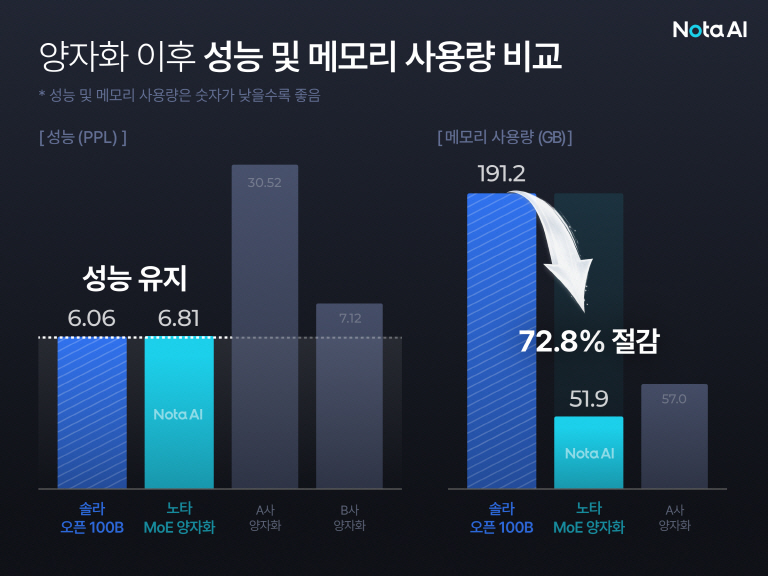
Results of MoE-specific quantization revealed amid the race to reduce the weight of large LLMs.
As demand for running Large Language Models (LLMs) on field devices or in limited GPU environments increases, competition for 'quantization' technology that reduces memory usage without significantly compromising model accuracy is intensifying.
Nota announced on March 5 that it had applied its quantization techniques to Upstage's 'Solar-Open-100B' to reduce memory usage.
According to the model card released by Nota on Hugging Face, the model weight memory footprint of Solar-Open-100B with 'Nota MoE Quantization' applied was presented as 51.9GB, down from 191.2GB. The same page explained that this approach is designed to mitigate **distortion** that can occur in the process of mixing experts in MoE (Mixture of Experts) structure-based LLM.
**Perplexity (PPL)** was also presented as a performance indicator. The table on the model card shows the PPL based on WikiText-2 as 6.06 for the original Solar-Open-100B and 6.81 for the Nota technique-applied model. PPL is used to indicate that the lower the value, the more stable the language model's predictions are.
This disclosure is noteworthy because, amid the proliferation of MoE-affiliated LLMs, it goes beyond a "universal reduction of the entire model" approach and instead presents a quantization approach that considers structural characteristics as an indicator of actual model card performance. However, some media reports have also highlighted the Ministry of Science and ICT's "Independent AI Foundation Model" project and whether a patent has been filed, and the extent of verification based on articles and publicly available data may vary.

Comments
Related news

Nota accelerates the spread of LLM with AI model lightweighting technology.
Nota, an AI model optimization and compression specialist led by CEO Chae Myung-soo, is accelerating LLM proliferation by applying Nota's AI compression technology to LG AI Research's EXAONE.
2025.12.10by 배종인 기자
.jpg)
Nota Leads Transportation Innovation in Africa, Following the Middle East
Nota, a specialized company in AI model lightweight optimization and efficiency (CEO Chae Myung-soo), will supply smart intersection systems in collaboration with Han-Il STM for the traffic control center project led by LG CNS and promoted by Kenya Urban Roads Authority (KURA).
2025.12.16by 배종인 기자
.jpg)
Nota Officially Recognizes On-Device AI Innovation
Nota (CEO Chae Myung-soo), an AI model optimization and lightweight technology company, has been selected for the 'Top 100 Emerging AI+X 2026' announced by the Korea Artificial Intelligence Industry Association (AIIA), once again demonstrating its technological competitiveness in the on-device AI sector.
2026.01.15by 배종인 기자
Nota emerges as a key partner for the UAE's transport infrastructure.
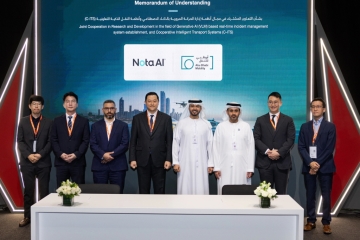
AI lightweight and optimization technology company Nota (CEO Chae Myung-su) has signed a memorandum of understanding (MOU) with the Abu Dhabi Department of Transportation in the United Arab Emirates (UAE) for joint research and development of an on-device AI-based real-time accident management system and cooperative intelligent transportation system (C-ITS), thereby strengthening its position in the Middle Eastern transportation infrastructure market.
2026.01.22by 배종인 기자
Nota simultaneously demonstrates ITS technology and commercialization success.
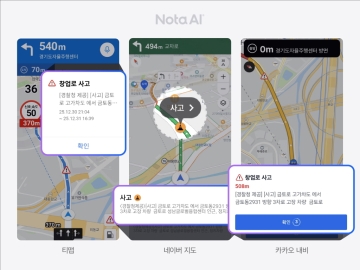
AI optimization and lightweight technology company Nota (CEO Chae Myung-soo) is applying its AI-based automatic incident detection system to the 'Gyeonggi-do Autonomous Cooperative Driving Traffic Information Service' operated by the Next Generation Convergence Technology Research Institute's Gyeonggi Future Mobility Center, providing real-time road hazard information to users of Kakao Map, Naver Map, and Tmap.
2026.02.05by 배종인 기자











