


Equinix Unveils 'Decentralized AI Hub' Based on Global Data Centers
 Published2026.03.12 11:25
.jpg)
Simplifying and strengthening the security of enterprise AI infrastructure, integrating real-time risk detection with Palo Alto Networks.
Equinix unveiled its Distributed AI Hub in Seoul on March 12th. Powered by Equinix Fabric Intelligence™, the hub is designed to enable enterprises to connect and leverage model providers, GPU clouds, data platforms, networking, and security services in a single environment.
Technically, the distributed AI hub provides low-latency private connectivity across 280 Equinix data centers. This allows enterprises to run AI workloads across multiple locations without data movement, while maintaining consistent governance and control. The vendor-neutral architecture allows customers to freely configure the AI stack they want.
In terms of application industries, IDC predicts that 80% of enterprises will deploy edge infrastructure by 2027. This is particularly significant in sectors where latency and response speed are critical, such as manufacturing, finance, and healthcare.
Openness and scalability are its design hallmarks. Unlike hyperscalers that focus on their own services, Equinix allows for integration with a variety of providers, allowing enterprises to scale their infrastructure as needed.
In operational environments, it integrates with Palo Alto Networks' Prisma AIRS to provide real-time risk detection and centralized policy enforcement. This allows enterprises to protect external data and model interactions and manage AI-based security services even in edge environments.
Equinix CBO John Lin emphasized the freedom of enterprises to perform inference close to their data and users, saying, "AI is distributed, but with the right infrastructure, it can run like a centralized system." Alembic CTO Lloyd Taylor also commented, "The distributed AI hub integrates deployment and governance into a single architecture, making distributed AI feasible at enterprise scale."
The industrial implications are clear. Companies can simplify complex infrastructure while ensuring security and performance, and deploy consistent AI operating patterns across a global network of data centers. This represents a turning point, moving distributed AI from the experimental stage to a real-world business infrastructure.

Comments
Related news
.jpg)
Equinix, “80% of companies will operate subscription-based digital infrastructure by 2026”
Global digital infrastructure company Equinix announced its annual Global Interconnection Index (GXI) 2024 on the 1st. According to the report, it is forecast that approximately 80% of new enterprise digital infrastructure investments will be operated through subscription-based models by 2026.
2024.02.02by 김예지 기자
.jpg)
Equinix, “Achieving 100% Renewable Energy Coverage by 2030… Supporting Scope 3 Reduction”
On the 4th, digital infrastructure company Equinix released its 2023 Sustainability Report containing performance achievements toward ESG targets and held a group interview with the press.
2024.06.05by 김예지 기자
.jpg)
Coupang, Kakao, Equinix Disaster Management Obligations Apply... “Preventing a Second IT Disaster”
The Ministry of Science and ICT held the 3rd Communication Disaster Management Council meeting in 2024 on the 23rd. Following amendments to the 'Broadcasting and Communications Development Basic Act' prompted by the Pangyo data center fire incident, starting this year, 11 major telecommunications operators including SKT and KT, 7 value-added telecommunications operators such as Naver and Kakao, and 8 data center operators including SK C&C are implementing disaster management obligations for the first time.
2024.07.24by 김예지 기자

Equinix Sets Up Geographic Duplication in '10 Minutes'
As dependence on the cloud has increased recently, ensuring stable and efficient access to cloud services has become increasingly important. Distributed digital infrastructure now requires a broader approach involving geographic redundancy across regions.
2024.09.27by 권신혁 기자
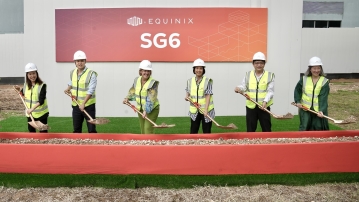
Equinix to Build High-Performance AI Data Center in Singapore
Singapore aims to drive innovation and economic growth by leveraging AI and to lead the launch of an AI governance framework. To this end, it is making substantial investments in quantum technology, blockchain, and edge computing to secure technological leadership.
2024.11.25by 명세환 기자











