



“In the Era of Agentic AI, Digital Resilience is a Competitive Advantage”
 Published2026.03.18 10:24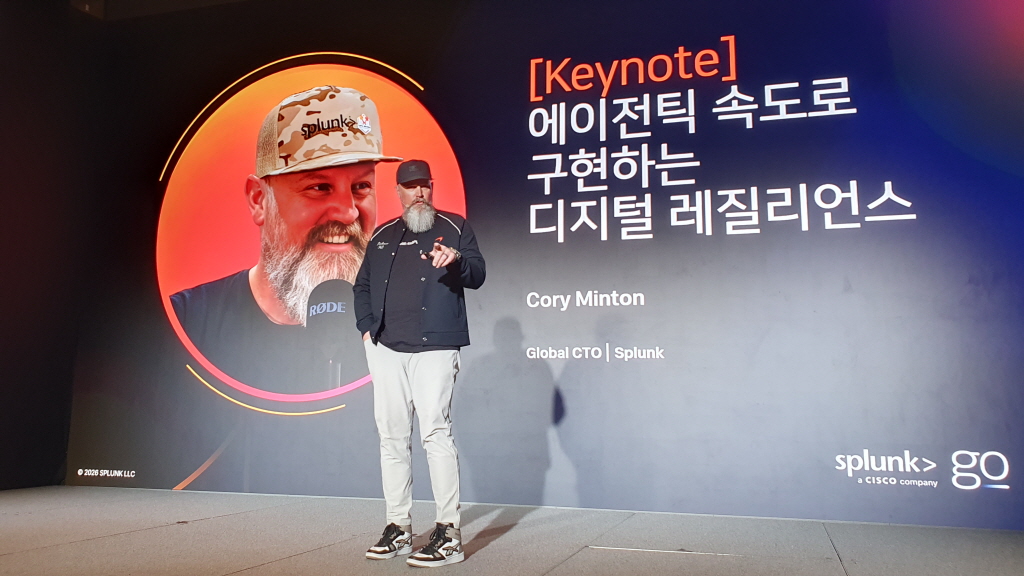
▲ Cory Minton, Splunk Global Chief Technology Officer (CTO)
The goal is to utilize AI for proactive prediction, automated response, and minimizing business impact.
As artificial intelligence (AI) fundamentally changes the way industries operate, 'Digital Resilience,' which stably protects and optimizes the entire AI environment, is the key to corporate competitiveness.
Splunk held the 'Splunk Go 2026 Seoul' event in Seoul on the 18th and presented new security and observation strategies required for the era of agentic AI through technology integration with Cisco.
Cory Minton, Splunk's Global Chief Technology Officer (CTO), who delivered the keynote speech that day, emphasized, "As AI enters the era of agentic AI that moves beyond mere recommendations to make decisions and take action on its own, the meaning of digital resilience is also fundamentally changing."
CTO Minton assessed that companies are currently standing at the intersection of two massive changes.
On the one hand, AI and agentic systems are redefining work productivity and decision-making, while on the other hand, applications, inThe vast amount of machine data generated by the system, users, and the AI system itself is increasing explosively.
He said, “The problem is not the amount of data, but how to manage, understand, and translate it into action.”
Splunk and Cisco presented 'Cisco Data Fabric' as the core foundation to address this.
This is a data-based architecture that enables access, management, and governance of data distributed across networks, clouds, and AI systems, regardless of location. The Splunk platform serves as the execution engine for this data fabric and is responsible for large-scale data search, federated search, data lifecycle management, and data preparation for AI utilization.
What attracted particular attention was the 'Splunk hosted AI model' and the machine data lake strategy.
It is designed to enable AI analysis and automation to be performed immediately where the data is located, without the need for customers to build and operate AI models themselves.
This enables AI-based prediction, detection, and response across security, observation, and IT operations.
In the security field, the concept of an 'Agentic SOC (Security Operations Center)' was presented as a key element.
This is a next-generation security operations model in which AI agents automate and assist the entire detection, investigation, and response process, allowing analysts to focus on high-value tasks.
CTO Minton emphasized, “As AI-based attacks become more sophisticated, security must also be redesigned based on AI,” adding that “Agentic SOCs are already a reality, not a roadmap.”
The change is also distinct in the observability domain.
Splunk has enabled integrated management of performance, cost, reliability, and security through 'AI Agent Monitoring,' which includes AI agents and the AI infrastructure itself as observation targets.
In particular, it was emphasized that the economic viability of AI operations can be ensured by tracking token usage and costs in real time, and that even anomalies or hallucination issues can be detected.
“Digital resilience is no longer limited to recovery after a failure,” said CTO Minton.He said, “The goal is to utilize AI to predict in advance, respond automatically, and minimize business impact.”
He added, “The combination of Splunk and Cisco will provide a foundation for trusted security and observation for enterprises in the AI era.”

Comments
Related news
MDS Technology Targets Market with Services Combining Big Data and Machine Learning
MDS Technology (CEO Lee Sang-heon), which entered the big data market by acquiring business rights to the big data platform Splunk, announced that it has also secured business rights to the machine learning solution Falkonry, thereby providing differentiated services for data analysis. Falkonry is a U.S.-based machine learning solution that derives optimal data models through its own learning algorithms. It becomes even more powerful when integrated with Splunk, a big data platform that collects, analyzes, and visualizes machine data in real time. This is because the data analysis results from Splunk can be automated using Falkonry's proprietary algorithms to detect anomalies in advance.
2016.05.13by 명세환 기자
CA Technologies Strengthens Solutions That Implement End-to-End Security
CA Technologies announced the latest versions of 'CA Data Content Discovery' and 'CA Compliance Event Manager' with enhanced mainframe data security capabilities. Through CA's new data-centric security features, all enterprises can streamline security management across the organization and implement strong end-to-end security for data-in-motion ranging from mobile to mainframe. Security and audit specialists at enterprises can export mainframe security incident logs to the Splunk analytics platform with CA's enhanced solutions and realize end-to-end security by consolidating and monitoring all risks in a single view.
2017.07.14by 김지혜 기자

[e4ds Tech Day 2026 ⑨] Sim Sang-gyu, Autocrypt CTO: "In the Physical AI Era, Automotive Security Must Extend Beyond the Vehicle"
At e4ds Tech Day 2026, Sim Sang-gyu, CTO of Autocrypt, explained automotive cybersecurity strategies in the era of Physical AI and SDV (Software-Defined Vehicle). Automobiles are evolving as part of an ecosystem connected to AI, cloud, chargers, IoT, and robots, and he emphasized that the scope of security must expand beyond the vehicle interior to the entire connected environment. In particular, AI model tampering, adversarial attacks, OTA updates, and EV charger hacking were identified as major threats. He explained that response measures require zero trust, AI model integrity protection, intrusion detection, Security by Design and Default, and full lifecycle security management, and that proactive security system establishment beyond regulatory compliance is critical for securing future mobility competitiveness.
2026.10.12by 배종인 기자
NVIDIA to Invest $1 Billion in U.S. Science Over Next Five Years
NVIDIA has announced plans to invest $1 billion over the next five years to strengthen U.S. scientific and technological competitiveness. The company will enhance cutting-edge artificial intelligence research and development capabilities in key areas including quantum computing, healthcare, and energy security, while expanding support for higher education research institutions and cloud service providers. NVIDIA is participating as a major industry partner in the White House Office of Science and Technology Policy's Genesis Mission, and is promoting supercomputer construction in collaboration with national laboratories including Argonne and Los Alamos.
2026.10.12by 배종인 기자
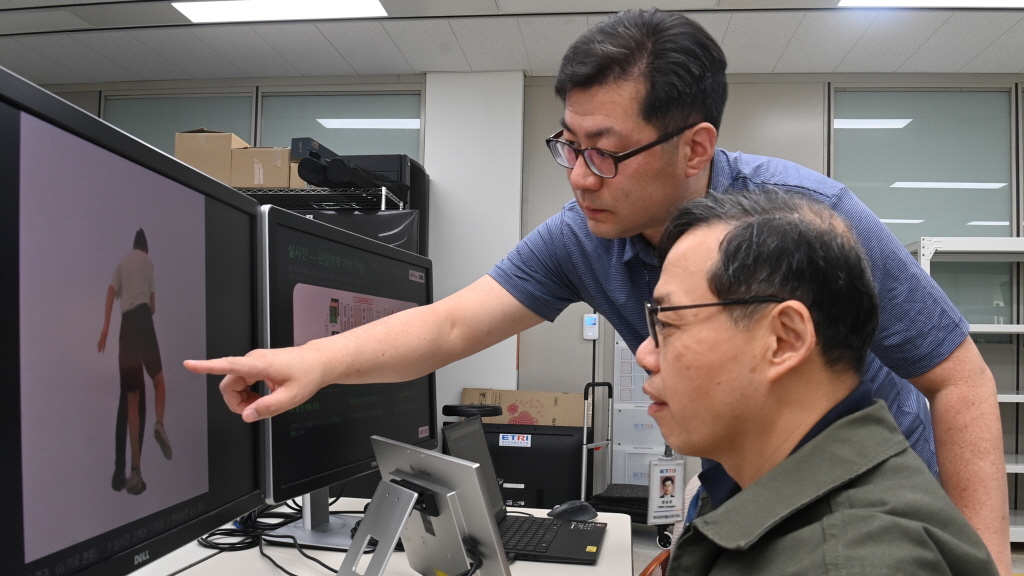
ETRI Unveils 3 Next-Generation Media Technologies Including AI-Dedicated Video Compression
ETRI has unveiled three next-generation media technologies optimized for AI. These include AI-based video encoding (VCM), 3D human generation based on sparse cameras, and generative AI-based pre-visualization technology. In environments where AI directly processes video such as autonomous vehicles, robots, and drones, these technologies enable efficient compression and transmission of large-scale data, and can be applied across various industrial sectors including smart cities, video security, and sports broadcasting.
2026.10.12by 배종인 기자











