



Samsung Electronics Launches Car-to-Home with Hyundai Motor and Kia… Control Home Appliances from Your Vehicle
 Published2026.03.23 10:11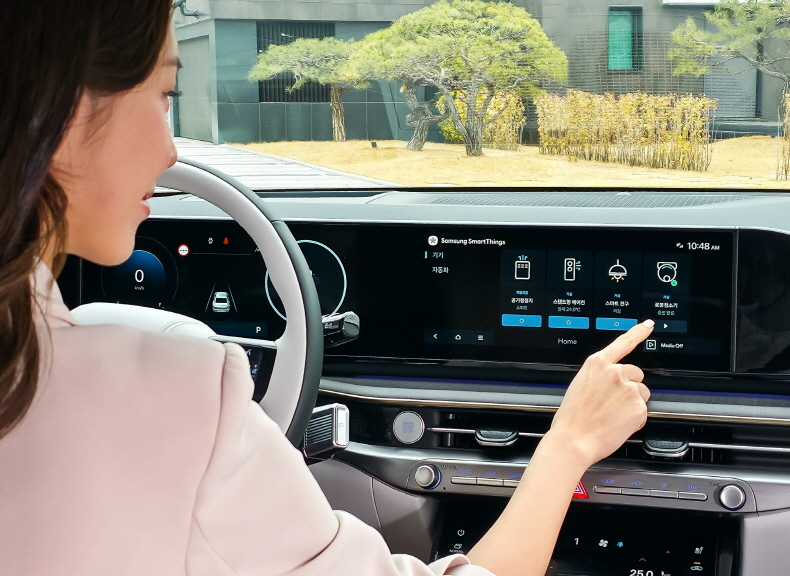
SmartThings integration with in-car infotainment… Two-way connectivity expanded to include return-home and outing routines
According to Samsung Electronics, this service will be available starting on the 23rd. Customers using Hyundai Motor and Kia’s BlueLink or Kia Connect can use the feature after linking their accounts by scanning a QR code in the SmartThings app installed on the vehicle’s infotainment system. The service will initially be available for Hyundai Motor and Kia models equipped with the CCNC infotainment platform that have been mass-produced since November 2022, and will be expanded through sequential software updates in the future.
The core of the technology lies in connecting Samsung Electronics' smart home platform, SmartThings, to the vehicle system. This allows drivers to directly remotely control home appliances such as air conditioners, air purifiers, robot vacuums, and lighting from the in-car screen. Supported devices start with some air conditioners manufactured after 2021 and some air purifiers and robot vacuums manufactured after 2024. Beyond simple on/off control, it is also possible to automatically execute pre-set routines based on vehicle location information.
For example, when the vehicle approaches the house, 'Home Mode' activates, allowing the air purifier to manage indoor air quality and the lights to turn on, and during hot weather, the air conditioner can be turned on in advance to lower the indoor temperature. Conversely, when the vehicle moves away from the house, 'Away Mode' is activated, turning off lights and unnecessary appliances and operating a robot vacuum cleaner. In essence, the car functions as a control hub for lifestyle automation, going beyond being a simple means of transportation.
In terms of applicable industries, this service is situated at the intersection of home appliances, automobiles, connected cars, and smart home platforms. Consumers can directly control household devices within the vehicle's infotainment environment, while manufacturers can expand the user experience by combining mobility and residential services. While the Home-to-Car service launched last year focused on checking vehicle status, climate control, starting the engine, locking and unlocking doors, and controlling electric vehicle charging, Car-to-Home is significant in that it extends the scope of connectivity into the home.
This collaboration aligns with the growing trend of smart home and software-centric vehicle ecosystems expanding their intersections. This is because services are evolving beyond the integration of individual devices to operate based on the user's location and movement context. As attempts to link vehicles and homes into a single, continuous user environment rather than separate spaces gain momentum, the next key point to watch in the market is expected to be how far the range of compatible vehicle models and connected home appliances expands in the future.

Comments
Related news
Samsung Electronics equips Hyundai Motor with Exynos Auto
Samsung Electronics will supply the 'Exynos Auto V920,' a premium in-vehicle infotainment (IVI) processor, to Hyundai Motor Company's vehicles.
2023.06.07by 배종인 기자
Automotive OEMs Expanding Their SDV Businesses… "Infotainment Isn't Everything"
As OEMs expand various SDV-related businesses, Tesla is generating revenue through insurance, while BMW and others are creating income through subscription-based services, shifting from the traditional revenue model that relied solely on vehicle sales to alternative business models.
2024.02.27by 성유창 기자
NXP Launches SAF9xxx Audio DSP... Strengthens AI Audio Processing
NXP Semiconductor announced the SAF9xxx product family on the 17th, which delivers AI audio capabilities for vehicle infotainment and significantly enhances vehicle audio processing technology.
2024.07.17by 명세환 기자
K-Display Trends, SDV and Infotainment Markets in the Spotlight
As automotive infotainment functions become increasingly important, the vehicle display market is attracting attention as a next-generation growth driver. At K-Display 2024 held this year, various exhibits showcasing automotive display products and concepts were unveiled, drawing significant attention.
2024.08.16by 권신혁 기자
SDV in full swing, Hyundai infotainment system, Samsung IoT control
Samsung Electronics' SmartThings enables control of Hyundai Motor vehicles, while Hyundai Motor's vehicle infotainment system allows control of Samsung Electronics appliances, marking the full-scale advent of the SDV (Software Defined Vehicle) era, where software plays a central role in automobiles.
2024.09.25by 배종인 기자











