



European Patent Applications Surpass 200,000 for the First Time… South Korea Maintains 5th Place, Led by Batteries and Telecommunications
 Published2026.03.24 13:23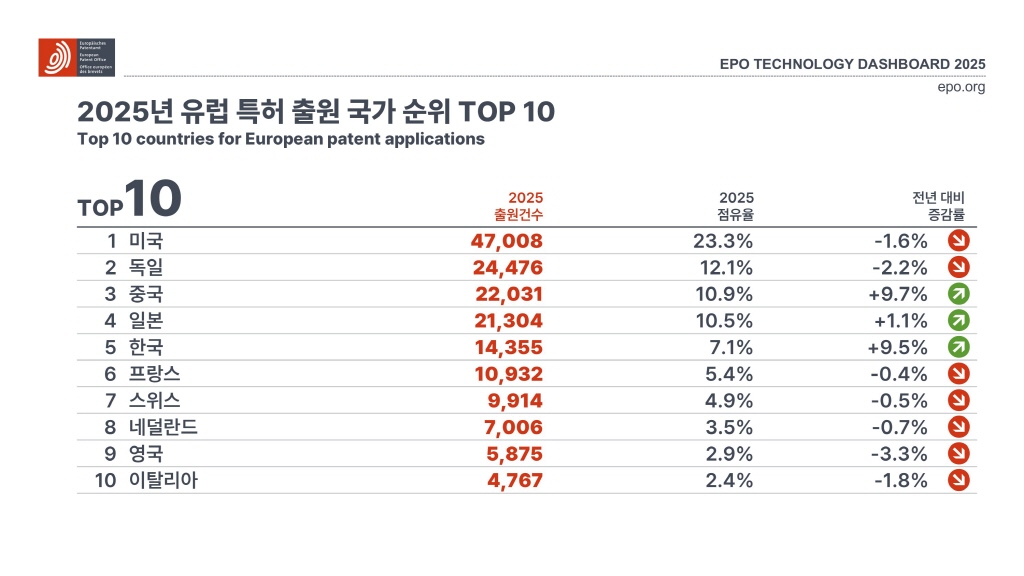
Korean Applications Up 9.5%, Second Growth Rate Among Top 10 Countries
The European Patent Office (EPO) released its annual report, "EPO Technology Dashboard 2025," in Munich, Germany, on the 24th (local time). According to the report, European patent applications for 2025 are projected to reach 201,974, a 1.4% increase from the previous year. This marks the first time the annual number of applications has exceeded 200,000. South Korea's application volume rose by 9.5% to 14,355, and the country ranked 5th for the third consecutive year.
Korea's growth was notable in specific technology sectors. The sector with the largest share was electromechanical, devices and energy, including batteries, and Korea was the largest applicant country in this field. The number of applications increased by 26.0% compared to the previous year, significantly exceeding the average growth rate of the EPO. In the battery sector as well, Korea's market share rose from 22% in 2021 to 35% last year, with LG, Samsung, and SK ranking among the top applicants. Digital communications also increased by 22.1% compared to the previous year, ranking third following the U.S. and China.
Korean companies continued their activities in computer technology, artificial intelligence, and semiconductors. Although computer technology applications decreased slightly, Korea maintained its fifth-place ranking globally. In the specific field of AI, Samsung and LG were among the top contenders. Semiconductor applications increased by 7.8% to 921 cases, ranking third following Europe and China; Samsung ranked first in European applications for this field, while LG ranked fourth. High growth rates were also observed in the fields of metrology and measurement technology and transportation, indicating a trend toward expanding application portfolios.
This trend aligns with demand across various industries. Batteries are connected to electric vehicles and energy storage systems, digital communications to next-generation networks, and semiconductors and AI to the entire electronics and information technology sector. The rush by Korean companies to secure rights in Europe is interpreted as being driven not only by competition in finished products but also by international competition surrounding core components, communication infrastructure, and data processing technologies. This trend is further evidenced by the fact that Samsung ranked as the top EPO applicant for the second consecutive year with 5,337 applications last year, while LG took third place with 4,464 applications.
Movements at the city and research institution levels were also confirmed. Seoul ranked 6th globally with 6,466 cases, while Suwon and Yongin were also included in the top 15. Seoul National University ranked 13th among universities with 52 European patent applications. In addition, the utilization of the single patent system, introduced in 2023, is on the rise. As of 2025, 28.7% of all European patents were registered as single patents, and 19.1% of European patents granted to Korean patent holders were also converted to this system.
This report demonstrates that Korea's patent strategy in Europe is expanding beyond single-technology competition centered on a few large conglomerates to encompass multiple industries, including batteries, telecommunications, semiconductors, and measurement technology. Amidst continuously rising patent demand in Europe, the increased filings by Korean companies are interpreted as a move aimed at simultaneously securing market dominance and defending their technology. If the utilization of the single patent system increases further, it is likely to lead to changes in how Korean companies secure intellectual property rights in Europe.
Comments
Related news
.jpg)
Next-Generation Intelligent Semiconductor Technology Development Project Achieves 1,426 Patents and Creates 1,628 Jobs Over 5 Years
The Ministry of Science and Technology (Minister Bae Gyeong-hun) and the Ministry of Trade, Industry and Energy (Minister Kim Jeong-gwan) jointly hosted the "2025 Next-Generation Intelligent Semiconductor Technology Development Project Integrated Technology Exchange Conference" in Jeju for two days from October 27 to 28. The event was organized by the Next-Generation Intelligent Semiconductor Business Division (Director Kim Hyeong-jun), bringing together approximately 550 researchers from industry, academia, and research institutions representing Korea's semiconductor sector to share research achievements and technology trends while strengthening collaborative networks.
2025.10.27by 명세환 기자
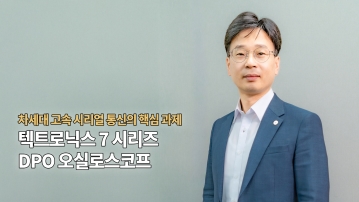
The challenge of "test margin" in the era of high-speed interfaces: Finding a solution with next-generation oscilloscopes.
The era of ultra-high-speed interfaces represented by PCIe Gen6, USB4, and DDR5 has arrived, but advances in speed bring with them measurement challenges. As signal bandwidth expands and the effects of jitter and noise increase, the test margin that must be secured during the design verification phase is trending downward. In this context, Tektronix is setting a new standard for signal fidelity through the 7 Series DPO, which leads with industry-leading ENOB (Effective Number of Bits) and proprietary QuietChannel™ technology. The 7 Series to be unveiled at this seminar is drawing attention as a "next-generation measurement platform" that goes beyond a simple oscilloscope to address the fundamental limitations of high-speed interface verification.
2025.11.02by 명세환 기자
.jpg)
ETRI Selected as 'Outstanding Standard Patent Institution'... Receives Commendation from Head of Intellectual Property Office
ETRI has been recognized for its achievements in creating international standard patents and selected as an 'Outstanding Standard Patent Creation Institution 2025,' receiving a commendation from the Intellectual Property Office Commissioner. The organization currently holds over 1,250 international standard patents and is actively engaged in technology transfer and licensing through participation in 16 patent pools. Technology royalty revenues over the past three years have reached approximately 100 billion won, with the majority generated from overseas companies, contributing to the improvement of Korea's intellectual property trade balance.
2025.11.05by 명세환 기자
.jpg)
South Korea ranks fifth globally in quantum technology patents, but the investment gap remains a challenge.
According to the Global Quantum Ecosystem Report published by the European Patent Office (EPO) and the Organization for Economic Cooperation and Development (OECD), South Korea ranked fifth globally in quantum technology patents over the past five years, capturing a 10% market share. Although LG was included among the top five global companies, Korean companies' share of global investment stood at merely 0.1%, highlighting a "technology-capital gap" as a key challenge.
2025.12.18by 명세환 기자
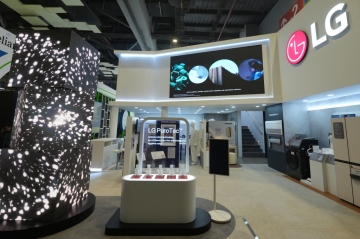
LG Electronics expands into the Asian B2B market with its new antibacterial material, Purotech.
LG Electronics is advancing into the Asia B2B market with its antibacterial functional material 'PuroTech'. Leveraging participation in India's largest industrial materials exhibition as an opportunity, the company is expanding contact points with local customers in manufacturing, sanitation, packaging, and medical sectors, while simultaneously strengthening production capacity and research and development to respond to growing global demand. The strategy involves establishing a second production base in Hai Phong, Vietnam, following Changwon, to enhance supply responsiveness, and concurrently pursuing market entry into North America and Europe based on patents and international certifications.
2026.02.05by 명세환 기자











