


Keysight Launches 220GHz Optical Component Analyzer… Aims at Verifying Next-Generation Optical Transceivers
 Published2026.03.25 09:39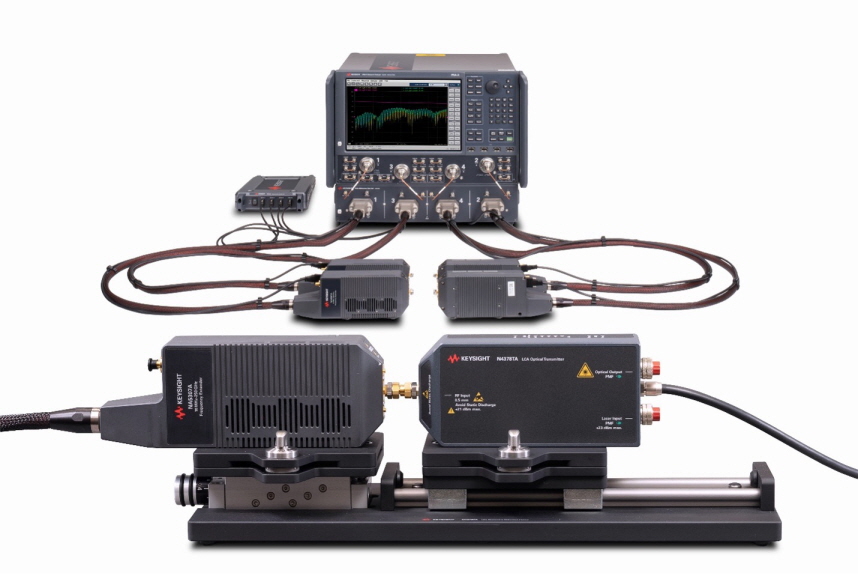
Expansion of component characteristic analysis scope for 1.6T and 3.2T class optical transceivers in line with AI and data center acceleration
Keysight Technologies has launched the N4378A, an optical component analyzer supporting measurements up to 220 GHz, to meet the demand for verifying ultra-high-speed optical transceiver components. This move comes in response to the growing need to precisely measure electrical-optical conversion components, such as optical modulators and photodetectors, at higher frequency bands as the spread of AI and machine learning increases connection speeds within data centers.
Keysight announced the launch of this product on the 12th and unveiled the equipment for the first time at OFC 2026, held in Los Angeles, USA, from March 17 to 19. The company explained that the equipment is designed to be used in the design and verification process of next-generation 1.6T and 3.2T optical transceiver components.
The key feature of the N4378A is that it provides fully calibrated S-parameter measurements up to 220 GHz. S-parameters are numerical indicators of the characteristics of high-frequency signals passing through or reflecting off a component, and are used to verify the actual operation of optical communication components. Keysight stated that this instrument supports single-sweep broadband measurements at 1310nm and 1550nm wavelengths, enabling it to cover a wide range of areas including not only the O-band for data centers but also the C/L-band used for terrestrial and submarine communications.
The configuration combines Keysight's PNA-X vector network analyzer and frequency extender. It is used with a newly designed optical test head and supports differential measurement, enabling verification of dual-drive optical modulators. Additionally, a quick-release mechanism is applied to protect the 0.5mm coaxial connection, reducing the risk of damage that may occur when moving the equipment during calibration and measurement processes.
This equipment launch aligns with the trend of data center infrastructure demanding higher bandwidth and lower latency. As optical transceiver speeds increase, it becomes critical to reduce the discrepancy between design-stage simulation results and actual measurements; Keysight appears to have focused on expanding measurement ranges and advancing analysis software to address this. This demonstrates that the verification framework for high-speed optical interconnection technologies, which will connect AI servers and switches in the future, is becoming increasingly refined, extending beyond just the performance of the optical components themselves.

Comments
Related news

Dr. Kim Se-soon of Keysight Technologies was selected as one of the UN's "Quantum 100" to commemorate the International Year of Quantum Science and Technology.
Dr. Seesoon Kim of Keysight Technologies has been selected as one of the "Quantum 100" global leaders announced by UNESCO for the United Nations-designated "2025 International Year of Quantum Science and Technology (IYQ)."
2025.12.24by 배종인 기자

Keysight Accelerates Direct-to-Cell Commercialization Based on 3GPP Release 19
Keysight Technologies recently demonstrated successful end-to-end live NR-NTN (New Radio-Non Terrestrial Networks) connectivity in the n252 band conforming to 3GPP Release 19 specifications, utilizing Samsung Electronics' next-generation modem chipset at CES 2026.
2026.01.20by 배종인 기자
.jpg)
“AI, Not a Choice, but a Technology Penetrating the Automotive Industry”
At the Keysight World Tech Day webinar, Thomas Goetzl, General Manager of Automotive and Energy at Keysight Technologies, presented on the topic of "A New Era in the Automotive Industry Led by AI," outlining the direction of automotive innovation encompassing electric vehicles (EVs) and software-defined vehicles (SDVs).
2026.01.28by 명세환 기자
.jpg)
“NG eCall Integrated Verification: Solving Communications, Location, IMS, and PSAP on a Single Platform”
At the 'Keysight World Tech Day' webinar held online on the 29th, Seung-taek Jang, Automotive Solutions Manager at Keysight, presented on the topic of 'SDV Transition and NG eCall Testing Challenges and Solutions,' emphasizing next-generation vehicle architecture changes, corresponding regulatory and standards trends, and the importance of test environments. To address this, Keysight provides a test environment capable of emulating 2G~5G, GNSS, IMS, and PSAP functions on a single platform, enabling precise configuration of regulatory conditions by country and simplification of complex test configurations.
2026.01.30by 배종인 기자
"Competitiveness hinges on end-to-end testing capabilities for EV charging infrastructure."
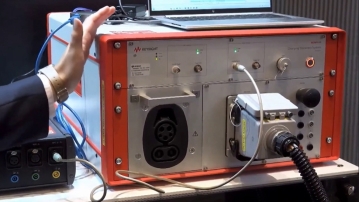
While the electric vehicle (EV) market is entering a phase of temporary growth deceleration, technological requirements surrounding charging infrastructure and energy storage systems (ESS) are rapidly advancing, with bidirectional charging, ultra-high power output, and grid-connected testing emerging as key challenges. At the "Keysight World Tech Day" webinar held online on the 29th, Jongwon Moon, Senior Engineer of Automotive Solutions at Keysight Technologies, emphasized under the topic "Testing Challenges and Solutions for Future EV Infrastructure" that electric vehicle charging technology is evolving beyond simple power supply to become a core element of energy infrastructure.
2026.02.02by 배종인 기자











