


BYD Weakness and Structural Changes in the Chinese Auto Market Accelerate Tech Competition and Restructuring
 Published2026.03.27 15:33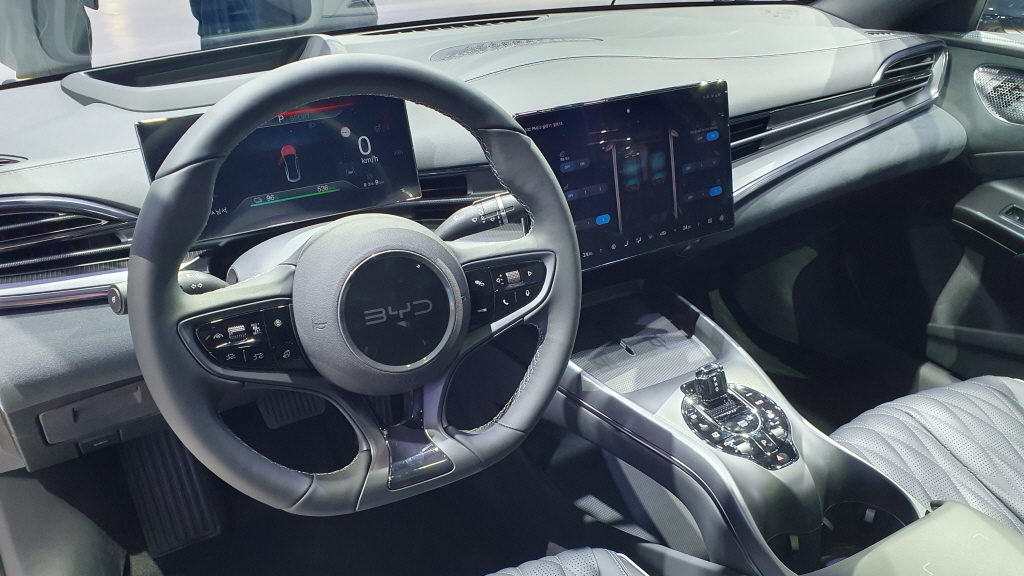
Electric vehicle energy consumption falls short of mandatory national standard PHEV criteria
The competitive landscape of the Chinese automotive industry is entering a new phase as BYD, considered China's largest electric vehicle company, has recently shown a distinct slowdown in the domestic market.
According to an industry analysis report released by the Korea Automotive Technology Institute (KATECH), BYD's passenger car sales in China stopped growing starting from the end of 2024, and both sales volume and market share declined significantly in January and February 2026.
During this period, the fact that Geely overtook BYD and took the lead is considered a symbolic change.
The report identifies two factors as the background for this sluggishness.
One is the excessive price competition known as "internal pricing" that has spread throughout the Chinese automobile market.
As the technology gap narrowed rapidly, cutthroat competition among companies intensified, which resulted in the weakening of BYD's price and technology advantages.
The other is the Chinese government's policy for the qualitative growth of the automotive industry. Analysis suggests that as energy efficiency and performance standards have been significantly strengthened, companies with lineups centered on small and low-cost cars have been put at a relative disadvantage, and BYD has also fallen under this influence.
In particular, the mandatory national standard (GB) for electric vehicle energy consumption, which has been in effect since 2026, has brought about significant changes to the market.
Unlike existing recommended standards, the new standards restrict production and sales themselves if they are not met.
With the addition of reduced acquisition tax exemptions for new energy vehicles and changes to the support system for replacing old vehicles, the policy attractiveness of low-cost models has significantly decreased.
The report points out that while BYD's BEV models are relatively responsive, the burden has increased as a significant number of its high-volume PHEV models fail to meet the strengthened standards.
Such environmental changes are expected to accelerate the restructuring of the entire Chinese automotive market.
By segment, a contraction of small and low-cost cars is expected, while mid-size, large, and premium vehicles are on the rise; furthermore, differentiation through smart and autonomous driving features is likely to become more important than competition over powertrains.
From an industrial perspective, it is highly likely that restructuring will accelerate, centered on companies lacking technological and financial capabilities, and that movements seeking brand redefinition and expansion into overseas markets will also increase.
The report warns that since Chinese automakers, including BYD, still rely heavily on the domestic market, they could suffer a significant blow if they fail to respond to regulations.
At the same time, it is emphasized that this process of responding to regulations can serve as a stepping stone for strengthening technological competitiveness and pioneering overseas markets.
In fact, BYD is seeking a turnaround by successively announcing large-scale investments to strengthen ultra-fast charging technology, next-generation blade batteries, and autonomous driving capabilities.
The Chinese automotive industry looks ahead to 2026It is facing another turning point as it shifts its center of gravity from quantitative growth to qualitative competition.

Comments
Related news
China's auto industry likely to remain 'domestic' for a long time.
According to the industry analysis report titled "(Industry Analysis Vol.156) The Paradox of China's Automotive Industry, Involution" released by the Korea Automotive Research Institute, despite China's automotive industry ranking first globally in production volume, the entire automotive industry ecosystem is facing difficulties amid excessive investment and cutthroat competition. Various factors surrounding the automotive industry suggest that this situation is expected to persist in the long term.
2025.11.10by 명세환 기자
Hanjayeon Secures Advanced Testing Infrastructure for Future Aviation Mobility
The Korea Automotive Research Institute (hereinafter referred to as KARI) has broken ground on the "Green UAM-AAV Core Component Testing and Evaluation Center," a key infrastructure for the eco-friendly future aviation mobility (AAM) industry, in the Seosan Bio-Wellbeing Special Zone in Galmari, Buseok-myeon, Seosan-si, Chungcheongnam-do, together with the Korea Aerospace Administration, Chungcheongnam-do, and Seosan-si.
2025.11.07by 배종인 기자
Global Automotive Industry in 2026, 'Test of Transformation'
The Korea Automotive Technology Institute (KATECH) recently forecasted through a special industrial analysis report that significant changes in the global automotive industry will enter a critical testing phase starting in 2026. The report presented five key issues for the automotive industry in 2026: △autonomous driving and robotics △powertrain electrification △software-defined vehicles (SDV) and user experience (UX) △complete vehicle market dynamics △and global core component supply.
2026.02.06by 배종인 기자
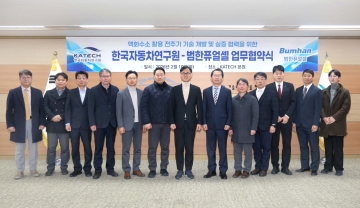
Korea Automotive Research Institute and Bumhan Fuel Cell Sign MOU for Full-Cycle Technology Development for Liquid Hydrogen Mobility
The Korea Automobile Research Institute and Bumhan Fuel Cell have signed a memorandum of understanding to strengthen competitiveness in the liquid hydrogen-based hydrogen mobility industry. The two organizations plan to promote full-cycle technology development and demonstration cooperation covering storage, charging, and utilization of liquid hydrogen, and to expand technology applications to both defense and civilian sectors. The agreement also includes infrastructure construction, testing and evaluation support, and identification of joint domestic and international research projects. Liquid hydrogen is a form created by cooling gaseous hydrogen to minus 253°C, reducing its volume to approximately 1/800th of the original, and is characterized by enabling large-capacity storage and transportation.
2026.02.12by 명세환 기자
.jpg)
2025–2029 project carried out through the Industrial Transition Joint Training Center
The Korea Automotive Research Institute is implementing job transition training for incumbent workers and providing corporate consulting support to the parts industry, which is in transition toward future vehicles, through the Industrial Transition Joint Training Center project of the Ministry of Employment and Labor. The Institute will operate the project for five years from 2025 to 2029, and concluded agreements with 161 companies last year. This year, the Institute plans to advance its training curriculum and expand consulting services, with full-scale operations to commence from next month.
2026.02.24by 명세환 기자











