


Gartner: “Corporate Burden Continues Even as AI Token Prices Drop”… Proliferation of Agents Changes Cost Structures
 Published2026.03.30 14:55
Despite falling inference unit costs, the challenge of managing total corporate AI costs persists.
In an analysis released on March 30, Gartner predicted that the cost of inference for massive language models with one trillion parameters would fall by more than 90% by 2030 compared to 2025. Tokens are the basic units used by generative AI to process sentences and data, and in this analysis, they were defined as data at the level of approximately 3.5 bytes.
Gartner cited improved semiconductor and infrastructure efficiency, changes in model design, enhanced chip utilization, the expansion of inference-specialized semiconductors, and the increased application of edge devices in certain areas as the background for this cost reduction. Accordingly, it projected that LLM in 2030 could demonstrate up to 100 times higher cost efficiency compared to an initial model of the same size in 2022.
However, Gartner noted that a drop in unit costs does not immediately lead to the "popularization of AI." In particular, since AI agents can use 5 to 30 times more tokens per task than traditional chatbots, the overall cost of inference could actually increase even if the price of individual tokens decreases. The explanation is that even if basic functions become cheaper, computing resources for processing complex reasoning remain limited.
This analysis compared costs based on a 'Frontier' scenario using state-of-the-art semiconductors and a 'Legacy Mix' scenario using a combination of various existing semiconductors. Gartner explained that the Mix scenario showed higher costs than the Frontier scenario due to relatively lower computational performance. Ultimately, this means that the type of semiconductor and infrastructure on which AI is operated has a direct impact on the cost structure.
Gartner predicted that going forward, corporate AI competitiveness will be determined not by adopting a single large-scale model, but by operational strategies for deploying and coordinating multiple models across different tasks. A more realistic alternative was suggested: assigning repetitive, high-frequency tasks to smaller or domain-specific models, while deploying costly, frontier-level models only for complex, high-value-added work. Ultimately, the ability to design which models to connect to which tasks is increasingly likely to determine corporate AI profitability, rather than the reduction in token prices itself.

Comments
Related news
Rockwell Automation Named to Gartner's Hype Cycle for 20 Categories
Rockwell Automation, Inc., the world's largest industrial automation and digital transformation specialist, has been featured across 20 different domains in Gartner®'s 'Hype Cycles' report, receiving recognition for global technology leadership in manufacturing, AI, cybersecurity, and energy sectors.
2025.12.17by 배종인 기자
.jpg)
Gartner: "AI Investment Success and Failure Depend on Human Capabilities and Organizational Maturity, Not Size"
Global research firm Gartner forecasts that worldwide AI spending will reach $252.78 billion (approximately 3,736 trillion won) by 2026, representing a 44% increase year-over-year.
2026.01.16by 명세환 기자
Gartner: “Global PC Shipments to Reach 270 Million Units in 2025, Up 9.1% Year-on-Year”
Global PC shipments in 2025 are expected to reach approximately 270 million units, representing a 9.1% increase compared to the previous year, indicating a clear recovery trend.
2026.01.21by 배종인 기자
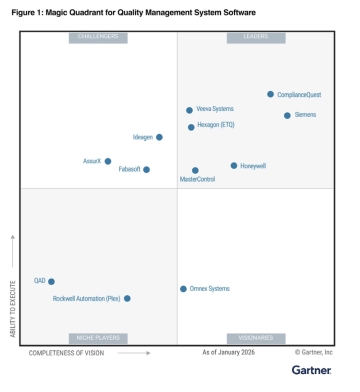
Siemens Named a Leader in Gartner's Magic Quadrant for Quality Management System (QMS) Software
Siemens has announced that it has been selected as a Leader in Gartner's Magic Quadrant for Quality Management System (QMS) Software. Gartner defines leaders as comprehensive QMS providers that support broad requirements including regulatory compliance, risk management, and process improvement. Siemens explained that it connects design, manufacturing, and operations based on Teamcenter X Quality and Opcenter X Quality, supporting enhanced traceability and workflow standardization. The company also emphasized its approach of integrating technologies such as generative AI, predictive analytics, XR, digital twins, and IoT into the quality lifecycle.
2026.02.04by 명세환 기자

Gartner: “Global IT spending to grow 10.8% by 2026… Continued expansion of AI infrastructure investment”
Gartner forecasted that global IT spending in 2026 will reach $6.15 trillion, representing a 10.8% increase from the previous year. Continued AI infrastructure investment is expected to sustain double-digit growth rates in data center systems and server spending. Software spending growth forecasts were slightly revised downward, but generative AI model spending is projected to maintain growth exceeding 80%. In contrast, device spending growth is expected to decelerate due to dampened demand resulting from rising memory prices.
2026.02.09by 배종인 기자











