


30 Years of CDMA Led by SKT, Standing at the Center of Korea's ICT Leap
 Published2026.04.09 13:33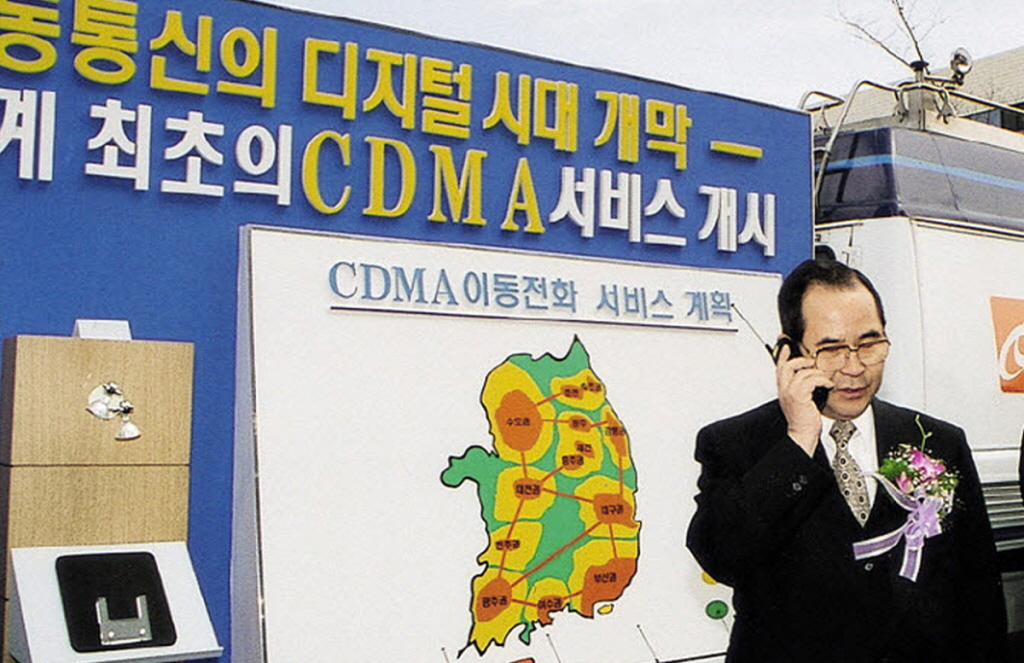
Former Prime Minister Lee Soo-sung making a test call at the CDMA mobile phone launch ceremony on April 1, 1996.
The history of the growth of South Korea's information and communications technology (ICT) industry has gone hand in hand with SK Telecom's challenges.
CDMA (Code Division Multiple Access), which was commercialized for the first time in the world in 1996, was a project led by the predecessor of SK Telecom, which was Korea Mobile Telecommunications at the time, and became a decisive turning point that changed the national industrial structure over the next 30 years.
CDMA is a digital mobile communication technology that allows multiple users to utilize a single frequency simultaneously; unlike TDMA, which was the global standard at the time, it was a method that had no commercial applications.
SK Telecom collaborated with the government, research institutions, and manufacturers to turn this unknown technology into reality, completing a nationwide network in just a few months, starting with Seoul and the metropolitan area.
With this, Korea became the world's first country to commercialize digital mobile communication.
The nationwide telecommunications infrastructure built by SK Telecom became the foundation for the growth of the ICT industry.
As mobile subscribers rapidly increased and replaced the landline-centric communication environment, the semiconductor, terminal, and network equipment industries grew alongside it.
The information and communications industry has significantly expanded its share of the gross domestic product and established itself as a key driving force for economic growth.
since SK Telecom led the generational evolution of mobile communication and drove the expansion of the industry.
3rd generation mobile communication opened up the mobile data and content industries, and the commercialization of 4th generation LTE triggered the popularization of smartphones and the growth of the platform economy.
SK Telecom also led the world's first commercial 5G service, launched in 2019, laying the foundation for digital transformation in industrial sites and the expansion of artificial intelligence services.
In particular, 5G served as a catalyst for SK Telecom to transform from a telecommunications company into an 'AI company'.
Through a strategy that combines networks, data centers, and AI technology, SK Telecom is expanding its business scope across AI services and infrastructure.
SK Telecom, which built a 'communications highway' with CDMA 30 years ago, is now setting out to build an 'AI highway' that connects data and artificial intelligence.
Ultra-high-speed, ultra-low-latency networks and AI infrastructure are considered key factors that will determine the competitiveness of all industries, including manufacturing, logistics, healthcare, and finance.
The 30-year history of CDMA demonstrates how SK Telecom’s technological choices and execution capabilities led the leap forward in South Korea’s ICT.
Over the next 30 years, SK Telecom is preparing for another industrial transformation centered on AI infrastructure.
.jpg)
▲ Success Built on a Bold Challenge: 30 Years of CDMA Infographic

Comments
Related news
SKT Pushes for 'One AI Agent Per Employee'... Full-Scale Transition to Field-Oriented AX
SK Telecom is implementing a "one person, one AI agent" system where all employees create and utilize AI agents tailored to their respective tasks. Beyond simple task automation, the initiative aims to expand AX (AI transformation) in a way that allows field employees to independently define problems and design AI tools. To this end, the company is opening an in-house platform and AX management system that can be used by non-developers, and will operate idea contests and step-by-step educational programs throughout the year. Based on existing application cases such as security coding verification automation and location analysis solutions, the company plans to pursue commercialization and company-wide expansion of key projects by the third quarter of this year.
2026.03.17by 배종인 기자
SKT Receives International Standard for AI Data Center Interconnection Structure… Establishes Operating System Standards
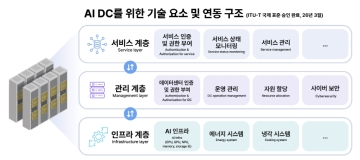
SK Telecom's proposed AI data center interworking architecture has received final approval as an international standard at the International Telecommunication Union Telecommunication Standardization Sector (ITU-T) conference. The core of this standard is the classification of AI data centers into three layers—service, management, and infrastructure—and the organization of signaling requirements between layers. As AI service proliferation increases the importance of interworking among various systems within data centers such as computation, power, cooling, storage, and security, this standard is significant in that it presents a common architecture for operations and service delivery. SK Telecom stated that it initiated the relevant standardization project in 2024 and achieved this approval following approximately two years of discussion.
2026.03.18by 명세환 기자
SKT and Ericsson Expand Joint Research on AI Networks… Preparing for 6G Beyond 5G Advancement
SK Telecom and Ericsson are expanding AI-based mobile network collaboration. On the 19th, the two companies signed a memorandum of understanding covering 5G advancement through 6G standardization, and agreed to undertake joint research and verification in the areas of AI-RAN, open and autonomous networks, security, and future communication technologies. This collaboration is interpreted as a move to enhance current 5G operational efficiency while preparing for a 6G environment where AI becomes embedded throughout the network. The scope also includes network operations automation, multi-vendor environment response, energy efficiency improvements, and review of communication-sensing fusion technology.
2026.03.19by 배종인 기자
.jpg)
SKT and NTT Docomo Jointly Publish AI-RAN White Paper… Presenting Conditions for Next-Generation Wireless Network Implementation
SK Telecom and Japan's NTT DOCOMO jointly published a white paper on the 31st outlining key technical requirements for implementing virtualized RAN (vRAN) and AI-based RAN (AI-RAN). In this white paper, both companies presented the separation of hardware and software, integrated operation of computing resources, and a simultaneous management system for AI and communication resources as major requirements. The direction encompasses converting base stations from dedicated communication equipment to software-centric architecture and subsequently expanding to an integrated platform that accommodates AI services. Both companies plan to continue cooperation in the areas of 5G optimization, 6G standardization, and technology verification.
2026.03.31by 명세환 기자
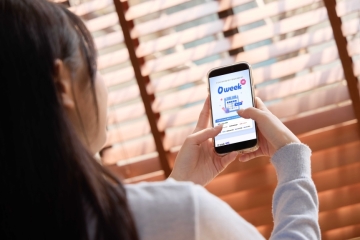
SKT Revamps T Membership… Introduces '0 Week' and Expands Customized Benefits for VIPs and Devices
SK Telecom (SKT) has reorganized its T Membership program, refining its benefit system by age group, tier, and device. The '0 day' program, which targeted ages 13-34, has been changed to '0 week,' allowing usage for 5 days during the first week of each month, and is now integrated with T day to improve accessibility. New benefits including 'VIP Chance' and 'VIP Only' have been introduced for VIP customers. The company also operates 'Club Galaxy S26' for customers who activate the Galaxy S26, providing personalized benefits including subscriptions, partner discounts, and prize drawings. The company explained that it focused on increasing the number of benefits while simplifying the structure to allow customers to check and select benefits on a single screen.
2026.04.01by 명세환 기자











