


KERI Develops Autonomous Manufacturing AI That Directs Processes by Voice
 Published2026.05.06 10:21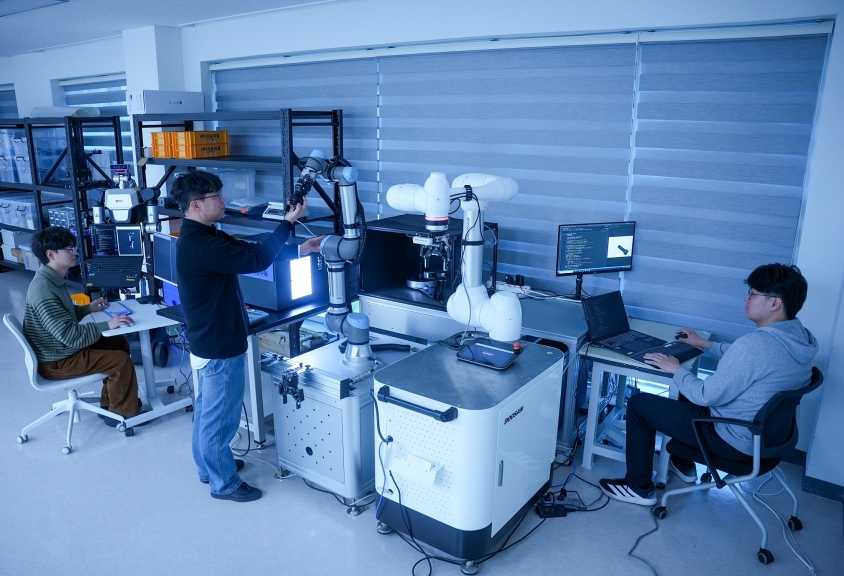
Implementation of Multi-Agent AI with Changwon National University Expected to Reduce Process Setup Time
The Korea Electrotechnology Research Institute (KERI) has developed autonomous manufacturing technology in which AI interprets manufacturing process instructions given via human voice and links them to robot movements. This technology aims to reduce the burden of existing automation methods, where engineers had to rewrite code every time the process changed.
The Korea Electrotechnology Research Institute (KERI) announced that a team led by Dr. Lee Ju-kyung at the Artificial Intelligence Research Center has developed "autonomous manufacturing multi-agent AI" technology in collaboration with Changwon National University. This research was conducted as part of the government's "Glocal University 30" project and KERI's own research project, "Development of Original AI-Robot Convergence Technologies for the Implementation of Agentic Self-driving Lab."
In manufacturing sites, robot operations and process conditions must be reset whenever a product or part changes. Since conventional automation robots operate according to pre-programmed rules and codes, specialized personnel had to intervene whenever the environment changed. For small and medium-sized manufacturing companies in regions lacking skilled labor, this process resulted in a burden of time and cost.
To solve this problem, the research team applied an agentic AI architecture based on Large Language Models (LLM) to the manufacturing process. When a user gives instructions in natural language, the language AI identifies the intent, and the vision AI analyzes the location and state of objects using a camera. Subsequently, the robot control AI converts this into an actual operation scenario and performs the process.
In particular, this technology focuses on connecting verbal instructions with actual workspace coordinates and object information. For instance, when a specific part is instructed, the AI identifies the target and its location based on camera data and converts it into a work procedure that the robot can perform.
KERI explained that utilizing this technology can reduce the process reset time, which previously took several days to a week, to within one hour. It is evaluated as having potential for use by small and medium-sized manufacturing companies engaged in multi-product, small-batch production, as it can also lower the burden of software modifications resulting from process changes.
Dr. Lee Ju-kyung of KERI stated, “Local small and medium-sized enterprises (SMEs) and middle-sized companies are struggling to adopt AI due to cost and manpower issues,” adding, “We will promote technology transfer by developing a technology that can intelligentize existing manufacturing lines without significant cost.” Moving forward, KERI and Changwon National University plan to cultivate the students who participated in this research into AI convergence talents capable of being deployed to local industrial sites.

Comments
Related news
.jpg)
Beyond 50 Years of Cooperation, Korea Electric Power Research Institute and Changwon City Present Industrial Vision for the Next 50 Years
The Korea Electrotechnology Research Institute (KERI) and Changwon Special City held a 'Future Industry Strategy Symposium' at Changwon Rivera Convention on the 29th, presenting a new 50-year blueprint for regional industry through collaboration among industry, academia, and government.
2026.01.29by 배종인 기자
KERI Launches Korean Testing and Certification System in North America
The Korea Electrotechnology Research Institute (KERI) has been selected as the implementing organization for the 'Charge Yard' project, worth $4 million (approximately 5.6 billion won), commissioned by the California Energy Commission (CEC) in the United States, thereby strengthening its presence in the global EV charging infrastructure market. This achievement is expected to directly benefit domestic electric vehicle and charger manufacturers in their market entry into North America.
2026.02.02by 배종인 기자
KERI Breaks Performance Limits of Eco-friendly Insulation Materials… Innovation Expected in High-Voltage Power Equipment
A research team led by Dr. Yu Seung-gun at the Insulation Materials Research Center of the Korea Electrotechnology Research Institute (KERI) has demonstrated a technology that overcomes the structural limitations of polypropylene, a conventional insulation material, and implements stable performance even in high-voltage environments.
2026.02.23by 배종인 기자
KERI Supports Data and GPU Infrastructure for Medical Device Companies in Changwon
The Korea Electrotechnology Research Institute (KERI) and the National Information Society Agency (NIA) have begun collaboration to foster the medical and healthcare industry in the Changwon region. The two organizations signed a memorandum of understanding on March 31st at KERI's Changwon Intelligent Medical Device Support Center, and agreed to provide companies with standardized medical and healthcare data and high-performance GPU computing environments based on a medical data trust zone. The initiative aims to broaden the foundation for medical device and diagnostic support tool development by supporting the securing of research conditions necessary for developing AI models for medical image analysis and disease prediction in the region.
2026.04.01by 명세환 기자
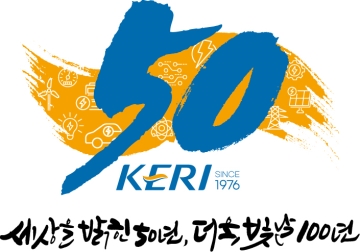
KERI Unveils 50th Anniversary Emblem… Slogan Selected via Public Vote
The Korea Electrical Engineering Research Institute (KERI) unveiled its 50th anniversary emblem and slogan ahead of 'Electricity Day' on April 10th. The symbols were selected based on the results of a public preference vote conducted through the institute's homepage and SNS during February and March, with a total of 10,000 participants. The emblem visualizes '50' using the institute's signature colors and incorporates elements symbolizing major research fields including power, renewable energy, mobility, and batteries. KERI plans to utilize these symbols to continue related events and content until the 50th anniversary main event scheduled for November.
2026.04.09by 명세환 기자











