



Synopsys Unveils Data Center Cable Management Robot Simulation Technology
 Published2026.05.07 10:33
In collaboration with NVIDIA and ADI, presenting a digital twin environment for physical AI training and verification
Synopsys, together with Analog Devices and NVIDIA, showcased physical AI simulation technology for the training and performance verification of industrial robots for data center cable management at NVIDIA GTC 2026, held in San Jose, California, from March 16 to 19.
Recently, hyperscale data centers consist of thousands of servers and kilometers of cables, increasing the need for automation in cable connection, replacement, and organization. While cable work may appear to be simple, repetitive tasks, it is a precision operation that requires robots to perform position alignment, force control, and obstacle handling.
To implement this, Synopsys utilized Ansys' simulation technology to build a physics-based virtual environment. This is a method that provides the conditions necessary for robot learning and verification by reflecting the physical characteristics of cables and connectors, such as elasticity, breaking force, and angle limits, in the NVIDIA Isaac Sim environment.
Physical parameters generated by Ansys Mechanical are packaged as OpenUSD assets and integrated into ADI’s Isaac Sim environment. This reduces the gap between the real and virtual environments and enables robots to learn precision tasks, such as cable connections, under more realistic conditions.
Sensor simulation is also utilized. Ansys AVxcelerate Sensors can be applied to verify the performance of ToF sensor-based 3D recognition systems, and based on this, ADI plans to advance the development of robotics solutions, including ToF sensors and tactile sensors.
ADI plans to summarize the results of this collaboration into a robotics benchmark and share it with the industry. The benchmark is focused on supporting companies in starting the development of AI solutions at NVIDIA Isaac Labs by utilizing their own robot platforms or ADI reference designs.
Simulation-based development has industrial significance in that it can reduce the burden of repetitive physical testing and prototype manufacturing. Particularly in fields where it is difficult to replicate large-scale environments, such as data centers, verification methods utilizing synthetic data and digital twins can be used to accelerate robot development.
At GTC 2026, Synopsys demonstrated a dual-arm robotic arm equipped with force, vision, and contact sensing capabilities, along with a corresponding digital twin. This technology has the potential to expand into industrial robot sectors requiring precision operation, such as manufacturing and logistics, as well as data centers.

Comments
Related news

Will UFS mobile memory rapidly expand beyond smartphones into various markets?
"In high-end mobile devices, UFS will replace eMMC's position." At the 'Mobile & IoT Forum 2017' held on the 28th at Elltower in Yangiae, hosted by the Korea Semiconductor Industry Association (KSIA) and JEDEC, representatives from Samsung Electronics, LG Electronics, Huawei, Micron, MediaTek, and SiTHOS forecasted that UFS will be the direction of next-generation mobile memory technology. UFS is a NAND flash memory solution developed for mobile devices, delivering approximately three times the read speed of eMMC 5.0 (embedded multimedia card), which is currently used in most smartphones, and is evaluated as highly efficient with power consumption at approximately half the level.
2017.08.01by 김지혜 기자

Elektrobit Launches Dedicated Software for Synopsys ARC FS IP
Elektrobit has released 'EB tresos Classic AUTOSAR software exclusively for Synopsys' 'DesignWare ARC EM/HS FS processor. This software provides a hardware-software platform that enables automotive semiconductor companies, automotive manufacturers, and automotive component suppliers to rapidly develop electronic control unit software applications based on the AUTOSAR standard.
2020.09.08by 명세환 기자
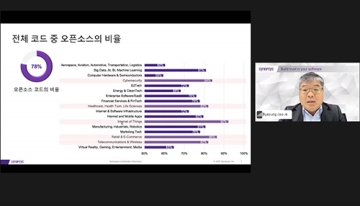
Synopsys: 81% of Open Source Projects Vulnerable to Security
Experts have emphasized the importance of establishing comprehensive understanding and continuous management strategies for open source software, which has become an essential element in development. Synopsys Korea, a global application security company, released the 'OSSRA (Open Source Security and Risk Analysis)' report on the 30th and held an online forum to discuss the open source ecosystem and explain business direction and strategy.
2022.06.30by 김예지 기자

Ansys, Synopsys, Samsung Electronics Foundry Productivity Improvement
Ansys has launched a new reference flow for radio frequency integrated circuit (RFIC) design developed in collaboration with Sihelix for Samsung Electronics' Foundry Business Division to support the 14LPU process technology.
2023.10.16by 배종인 기자
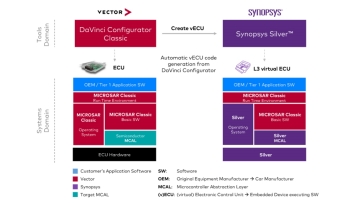
Vector and Synopsys Innovate in Virtual ECU-Based SDV Development
Vector Korea, a global company in the automotive network and embedded systems field (Branch Manager Jang Ji-hwan, Vector), has announced an integrated solution based on virtual ECU (vECU) for software-defined vehicle (SDV) development through collaboration with Synopsys. By providing integrated offerings of Vector's 'MICROSAR Classic' and Synopsys' 'Synopsys Silver', it has implemented an environment where ECUs can be generated and tested from the initial development stage without actual hardware.
2025.10.14by 배종인 기자











