



KIMM, “How AI is utilized determines manufacturing competitiveness”
 Published2026.05.14 13:18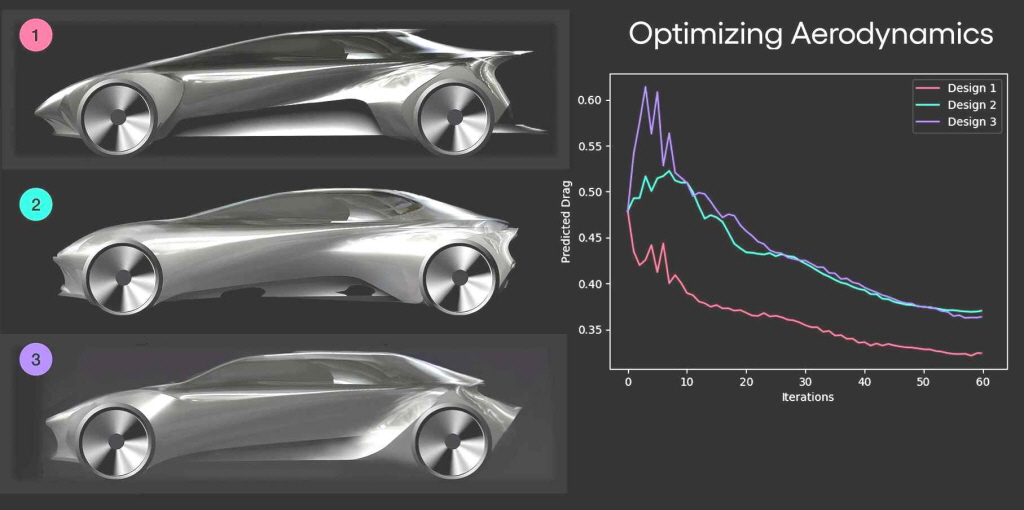
Image generation AI capable of automatically generating designs optimized for engineering requirements such as aerodynamics
Proposal for a Korean-style Hybrid Manufacturing AX Model
The Korea Institute of Machinery and Materials (KIMM) published the 123rd issue of *Machine Technology Policy* titled 'Current Status and Implications of Japanese Manufacturing AX – Focusing on the Automotive Industry,' presenting the AX (AI Transformation) and DX (Digital Transformation) strategies of the Japanese automotive industry and the response direction for the Korean manufacturing sector. The report also reflects the Japanese government's 'Mobility DX Strategy 2025,' announced on June 9, 2025, as a major policy trend.
According to the report, the Japanese automotive industry is utilizing AI not as a simple automation technology, but as 'Auxiliary Intelligence' that supports on-site experience and judgment. The key elements are Human-in-the-Loop, where humans participate in the decision-making process; Kaizen-driven DX, which combines on-site improvement activities with digital transformation; and Cultural Intelligence, which is the digitalization of organizational culture.
Toyota is reducing development time and enhancing field suitability through a citizen development system in which field workers directly develop applications and AI. In addition, it is expanding its collaborative decision-making culture, 'O-Beya,' into a multi-agent AI system to support the transfer of skilled knowledge and design decision-making.
Honda is expanding AX by visualizing data and improving decision-making structures through on-site DX. In particular, it is developing a "discussion-type AI" in which multiple AI agents collaborate based on "Waigaya," an evidence-based discussion culture, thereby implementing a collective intelligence-type decision-making structure for solving complex problems.
The scope of application for generative AI is also expanding beyond the production process to the early stages of design and development. Honda is utilizing natural language-based 3D design generation technology for design review, while Toyota is pursuing the reduction of design lead times through AI-based computer engineering and shape optimization technology.
The Korea Institute of Machinery and Materials suggested that the Japanese case has implications for the Korean manufacturing industry for field-oriented AI internalization, AX integration throughout the design, production, and quality lifecycle, the introduction of collaborative AI based on organizational culture, and the expansion of the industrial ecosystem. In particular, it was analyzed that a 'hybrid manufacturing AX model' combining Korea's physical AI strategy and Japan's human-centered DX is needed.
Kim Cheol-hoo, a senior researcher at the Machinery Policy Center of the Korea Institute of Machinery and Materials (KIMM), stated, “Japan is not merely adopting AI, but is redesigning its organization around AI,” adding, “In the future, manufacturing competitiveness will be determined by how organizations utilize AI, rather than by the technology itself.”

Comments
Related news
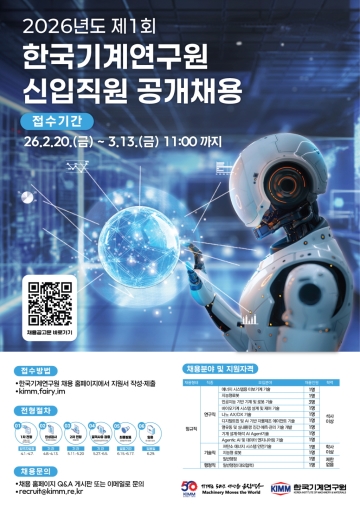
Korea Institute of Machinery and Materials is recruiting key talent to lead AX, AI, and carbon neutrality.
The Korea Institute of Machinery and Materials (KIMM) under the Ministry of Science and ICT, led by President Ryu Seok-hyun, will recruit 15 personnel across 13 fields in 3 job categories—research, technical, and administrative positions—through the "First Open Recruitment of New Employees for 2026."
2026.02.20by 배종인 기자
.jpg)
Robots that learn daily routines liberate people from repetitive labor
The Korea Institute of Machinery and Materials under the National Research Council of Science and Technology has developed a robot task AI that learns from human task demonstrations and performs various everyday operations. By enabling robots to flexibly handle simple yet labor-intensive tasks such as item organization and table arrangement, the application scope is expected to expand widely from homes and office spaces to retail and logistics sites.
2026.03.12by 배종인 기자
.jpg)
AI Humanoids Deployed on Automotive Production Lines… The Era of 'Physical AI' Begins in Domestic Manufacturing Sites
Korea Institute of Machinery and Materials (KIMM), Electronics and Telecommunications Research Institute (ETRI), and KG Mobility have concluded a tripartite memorandum of understanding for the development and demonstration of AI humanoid robots customized for manufacturing sites. According to the agreement, the humanoid robot being developed will be directly deployed in KG Mobility's vehicle production process.
2026.03.20by 배종인 기자
KIMM, First Government-funded Research Institute to Release Machinery Research Data Externally
Korea Institute of Machinery and Materials (KIMM) has become the first among government-funded research institutes to publicly disclose mechanical research data and has begun operating a "Mechanical Data Platform." The platform is designed to systematically provide data types, generation conditions, producer information, and other details, enabling industries and researchers to locate necessary data and examine collaboration possibilities. In certain fields, raw data and guidebooks applicable to AI training are also provided together. KIMM plans to expand the scope of disclosure centered on eight priority areas including hydrogen society, AI robotics, and mobility, while establishing a mechanical data ecosystem that can be utilized in research and development as well as industrial applications.
2026.03.25by 명세환 기자
Humanoid Robots Move Beyond Demonstration to Adoption Stage… KIMM: “The Next Five Years Will Be a Watershed”
The Korea Institute of Machinery and Materials has indicated 2026 as a turning point for the commercialization of humanoid robots. In a policy report released on the 8th, the institute stated that as the United States and China are engaged in a competition for leadership, Korea has a window of around five years to develop and concrete its response strategy. In the market, price reductions and production expansion are proceeding simultaneously, and while Korea possesses strengths in manufacturing infrastructure, it identified a need for supplementation in general-purpose AI and dedicated component supply chains. The Korea Institute of Machinery and Materials proposed that both localization of core components and global technology cooperation should be pursued in tandem.
2026.04.08by 명세환 기자











