



L&F Completes Daegu LFP Plant… Competition to Expand Non-China Supply Chains Intensifies
 Published2026.05.18 11:43
.jpg)
Mass production in Q3, 60,000-ton annual system targeting ESS and entry-level EVs
L&F has completed the construction of its LFP (lithium iron phosphate) cathode material production plant, 'L&F Plus,' and has begun establishing a mass production system. This move is interpreted as aligning with the trend of supply chain restructuring, as it marks the securing of a production base by a domestic battery materials company within a global LFP supply chain structure dominated by Chinese firms.
L&F announced on the 18th that it has completed the construction of the L&F Plus plant within the Daegu National Industrial Complex. The company plans to begin mass production with an annual capacity of 30,000 tons by the end of the third quarter of this year and gradually establish a total production system of 60,000 tons by the first half of 2027. A total of 338.2 billion won is scheduled to be invested in the plant.
LFP batteries have rapidly expanded, primarily in the Chinese electric vehicle market and ESS sectors, based on their price competitiveness and stability. Recently, as the demand for supply chain diversification grows in North America and Europe, there is a strengthening trend toward sourcing materials from non-Chinese sources. The domestic battery industry is also expanding its entry into the LFP business to respond to the growth of the mid-to-low-priced electric vehicle and energy storage system markets.
L&F plans to begin mass production of high-density 3rd generation LFP products on this production line. The company is focusing on improving the driving range and power output issues, which were pointed out as limitations of existing LFPs, through products with higher energy density compared to standard LFPs. It explains that this is closer to a strategy for the high-value market rather than simply focusing on low-cost products.
The scope of application is also expanding. The company announced that it is currently in supply discussions with clients, focusing on ESS for power grids, ESS for AI data centers, and the entry-level electric vehicle market. The increasing demand for long-duration and stability-oriented ESS, driven by the recent expansion of global data centers and AI infrastructure, is also cited as a factor behind the expansion of the LFP market.
The company is also pursuing the internalization of its raw material supply chain. L&F announced that it is developing an iron oxide-based precursor-free process while securing FP (iron phosphate) precursor technology, which currently has a high dependence on China. This is interpreted as a strategy to simultaneously secure material costs and supply stability.
L&F plans to establish a so-called 'two-track' structure that runs its existing high-nickel-centered business alongside its LFP business. The company recorded sales of 739.6 billion won and an operating profit of 117.3 billion won in the first quarter of this year, continuing its streak of profitability for three consecutive quarters.
Comments
Related news
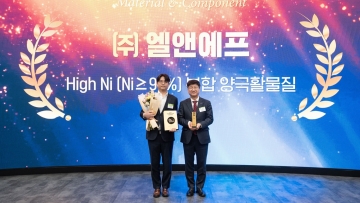
L&F, 'High-Nickel Composite Cathode Active Material' Wins Interbattery Awards
Global secondary battery materials company L&F received the honor of an award in the materials and components category at the InterBattery Awards 2025 held at COEX on the 24th for its high-nickel composite cathode active material.
2025.02.25by 명세환 기자
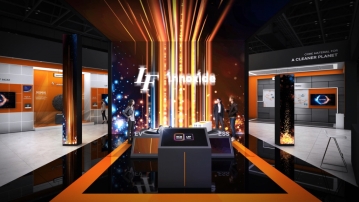
LNF Participates in 'Interbattery 2025'… Proves Leadership in LFP Cathode Material Technology
L&F will participate in 'InterBattery 2025' held at COEX from March 5-7 and showcase next-generation battery material technology and global production systems.
2025.02.27by 배종인 기자
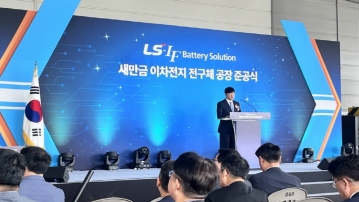
L&F and LS complete construction of Saemangeum precursor plant, strengthening the K-battery value chain.
L&F, a global secondary battery materials specialist, and LLBS, a joint venture between L&F and LS Group, have completed construction of a precursor plant in Saemangeum, marking the beginning of full-scale localization of the K-battery value chain and strengthening of global competitiveness. The company plans to establish an annual production capacity of 120,000 tons by 2029 to stably supply cathode material raw materials needed for 1.3 million electric vehicles.
2025.10.02by 명세환 기자
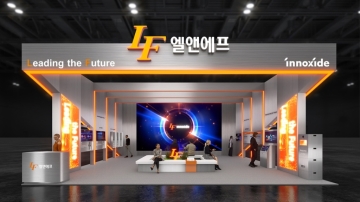
L&F Targets Global Battery Market with Two-Track Cathode Material Strategy
L&F will participate in 'DIFA 2025' and unveil its dual-track strategy centered on NCM and LFP cathode materials. Along with a 2026 domestic-first LFP mass production roadmap, the company will showcase next-generation battery material technologies and present its vision for a circular economy ecosystem.
2025.10.16by 명세환 기자
.jpg)
L&F Unveils LFP Cathode Material Strategy at InterBattery 2026… Accelerating Establishment of Non-China Supply Chain
L&F unveiled next-generation cathode material technology and LFP (lithium iron phosphate) cathode material mass production plans at the domestic battery exhibition 'InterBattery 2026'. The company introduced its development status of ultra-high-density products with a target of commercializing third-generation LFP cathode materials in 2026, and presented a strategy for establishing a domestic supply chain based on precursor technology localization and recycling. This is interpreted as a move to expand the LFP portfolio alongside high-nickel cathode materials as a countermeasure to reduce the supply structure's high dependency on China in battery material supply.
2026.03.16by 배종인 기자











