



KT Applyes Quantum-Resistant Cryptography to Defense Communication Infrastructure
 Published2026.05.19 13:50
KT announced on the 19th that it will participate in the '2026 Quantum-Resistant Cryptography Pilot Transition Support Project' promoted by the Ministry of Science and ICT and the Korea Internet & Security Agency (KISA) and apply PQC-based security technology to key national defense systems. This demonstration will be conducted for the Ministry of National Defense and the Army Information and Communications School, and KT has formed a consortium with Daeyoung S-Tech and ESE.
Quantum-resistant cryptography is an encryption technology based on difficult mathematical problems that are hard to decipher even with quantum computers. As concerns grow that existing public-key cryptography systems could become vulnerable in quantum computing environments, major countries and the security industry are preparing to transition their encryption systems, focusing on critical national infrastructure.
In this project, KT will apply PQC modules to key military infrastructure sections, including the smart unit platform and user PC sections, CCTV and NVR systems, drones and ground control systems (GCS), 5G routers, and core networks. It also plans to verify performance and applicability in actual operating environments.
The smart troop platform has a structure that combines equipment from different manufacturers with multiple layers of networks. For this reason, the transition is more difficult than applying security based on a single device or a closed network. KT plans to verify the effectiveness of the national defense data protection system by applying PQC to the entire process from data generation to transmission, storage, and utilization.
KT has previously carried out projects such as the interoperability of heterogeneous quantum cryptography communication between Seoul and Busan, Shinhan Bank's hybrid quantum security network, and the National Cancer Center's AI medical data quantum encryption project. This defense demonstration marks an expansion of existing experience in the public, financial, and medical sectors into the defense domain.
Based on the verification results and operational experience secured through the project, KT plans to expand the application of PQC in the public and private sectors and continue developing security service models that meet global security standards.
Jeon Myeong-jun, Senior Vice President and Head of KT Enterprise Service Division, said, “Quantum-resistant cryptography is a core technology for national cyber security in preparation for the era of quantum computing,” adding, “Through pilot projects in the defense sector, we will enhance the reliability of communication and security technologies and contribute to building a safe AX environment.”

Comments
Related news
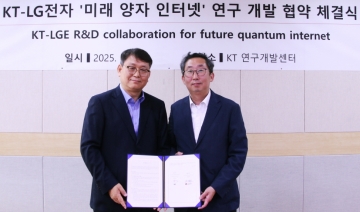
LG Electronics and KT Partner on Quantum Internet Communications
LG Electronics and KT have launched joint development of quantum internet communication technology. With the goal of building an ultra-secure network based on quantum direct communication, the two companies are collaborating to secure core technologies that will address future services such as 6G, AI, and autonomous vehicles.
2025.10.30by 명세환 기자

KT and Samsung Electronics Successfully Verify AI-RAN Commercial Network
KT and Samsung Electronics have successfully validated AI-RAN (Artificial Intelligence Radio Access Network), a next-generation communication technology, in a real commercial network, accelerating their acquisition of core technologies to expedite the arrival of the 6G era.
2025.12.11by 명세환 기자
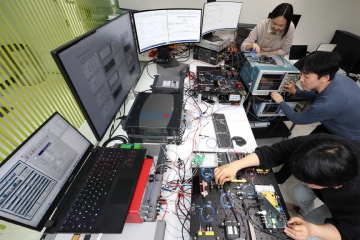
KT Develops Quantum Cryptography Key Distribution Equipment Capable of Distributing 300,000 Quantum Keys Per Second
I don't see any Korean text to translate in your message. Could you please provide the Korean electronics/semiconductor industry content that you'd like me to translate into English?
2026.02.03by 명세환 기자
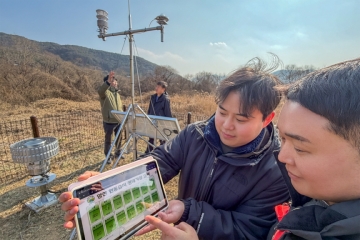
KT installs automatic weather observation equipment at Wondong Wetland, supporting research by the National Institute of Ecology.
KT has installed automatic weather observation equipment at Wondong Wetland in Yangsan, Gyeongnam Province to support environmental research at the National Institute of Ecology on the occasion of World Wetlands Day. This equipment marks the first application of KT's Internet of Things (IoT) communication technology in a wetland field setting and operates on solar-based renewable energy. It continuously monitors key meteorological elements such as temperature, precipitation, and humidity, transmitting data in real time, and the collected information will be utilized for analyzing wetland ecosystem changes and biodiversity research. KT plans to progressively expand ecosystem conservation activities in cooperation with the National Institute of Ecology and Yangsan City.
2026.02.04by 명세환 기자
.jpg)
KT to intensively monitor network operations at approximately 1,200 locations nationwide ahead of the Lunar New Year holiday.
KT is entering a concentrated network management system centered on major transit hubs and commercial districts nationwide ahead of the Lunar New Year holiday. In preparation for increased returning home traffic and surging data usage, approximately 1,200 locations including airports, KTX stations, and areas near expressways have been included in 24-hour management targets. In response to increased wireless traffic from customer reward programs, the company will flexibly operate network resources between regions, and will strengthen international communications control considering increased overseas travelers and international event periods. Additionally, in preparation for fire risks due to dry weather conditions, the company will conduct emergency recovery drills for forest fire and telecommunications facility fire response.
2026.02.09by 배종인 기자











