


KIMS and KERI Develop PTFE-Free Dry Cathode Manufacturing Technology
 Published2026.06.09 13:17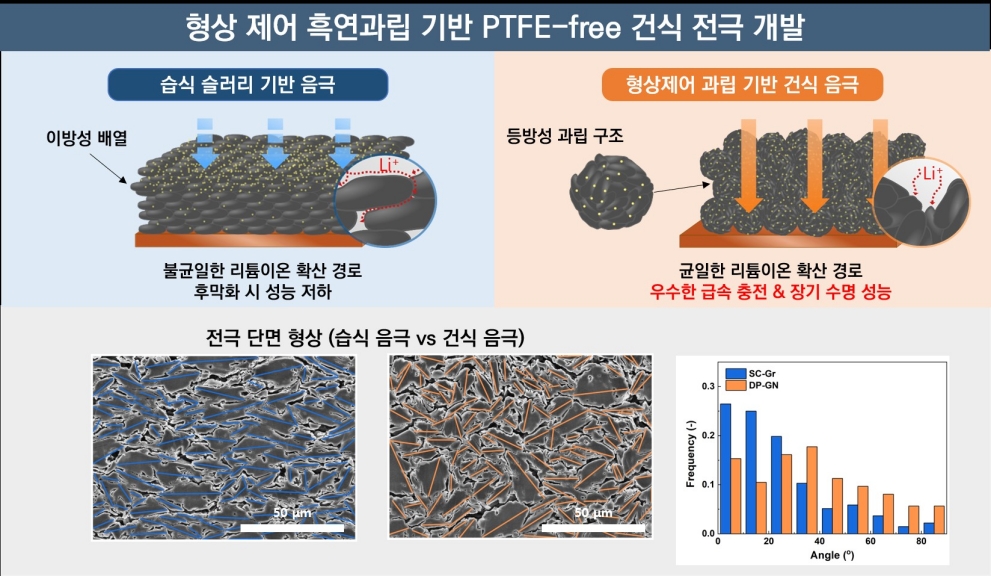
Improvement of lithium-ion diffusion through graphite granule structure control
The Korea Institute of Materials Science announced on the 9th that a research team led by Dr. Ji-Hee Yoon of the Convergence and Composite Materials Research Division, in collaboration with a research team led by Dr. In-Sung Hwang of the Korea Electrotechnology Research Institute, has developed a "shape-controlled graphite granule-based dry electrode manufacturing technology." The research results were published online on April 21, 2026, in the energy journal *Energy Storage Materials*.
Dry electrodes are a manufacturing technology that reduces the use of organic solvents and drying processes during battery electrode production. As they can lower manufacturing costs and carbon emissions, they are being researched as a next-generation battery process for electric vehicles and energy storage systems (ESS).
Conventional dry electrode processes have often relied on PTFE as a binder to bond electrode materials. While PTFE is used to ensure bonding strength in dry processes, the need for alternative technologies has been raised due to potential performance degradation in the cathode environment and issues related to regulations on fluorine-based materials.
The research team applied the CMC-SBR binder used in commercial wet cathode processes to a dry process. A slurry mixed with graphite, a conductive material, and a binder was granulated using a spray drying process to redesign the existing plate-shaped graphite particles into a spherical structure.
This structure focused on ensuring an even pathway for lithium ion movement within the electrode. Through this, the research team mitigated the problem of degraded charge and discharge performance seen in thick electrodes.
Experimental results showed that the developed dry cathode exhibited improved rapid charging performance and long-term cycle characteristics compared to conventional slurry-based cathodes. Even under high energy density conditions, lithium-ion diffusion characteristics were improved, confirming the possibility of realizing high-capacity batteries based on thick electrodes.
Yoon Ji-hee, a senior researcher at the Korea Institute of Materials Science, explained that this technology is an approach that reduces the limitations of PTFE-based dry electrode processes and can be utilized in the electric vehicle battery sector, which requires high energy density and rapid charging performance.
This technology can utilize the CMC-SBR binder system currently used in the industry, making it applicable to mass production processes. The research team anticipates that this will contribute to the commercialization of eco-friendly dry electrode processes in the fields of electric vehicles, ESS, and next-generation high-energy-density batteries.

Comments
Related news
KERI Supports Data and GPU Infrastructure for Medical Device Companies in Changwon
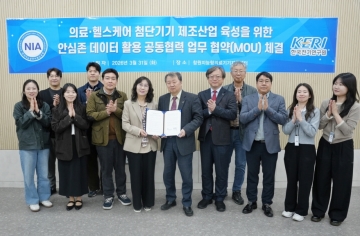
The Korea Electrotechnology Research Institute (KERI) and the National Information Society Agency (NIA) have begun collaboration to foster the medical and healthcare industry in the Changwon region. The two organizations signed a memorandum of understanding on March 31st at KERI's Changwon Intelligent Medical Device Support Center, and agreed to provide companies with standardized medical and healthcare data and high-performance GPU computing environments based on a medical data trust zone. The initiative aims to broaden the foundation for medical device and diagnostic support tool development by supporting the securing of research conditions necessary for developing AI models for medical image analysis and disease prediction in the region.
2026.04.01by 명세환 기자
KERI Unveils 50th Anniversary Emblem… Slogan Selected via Public Vote
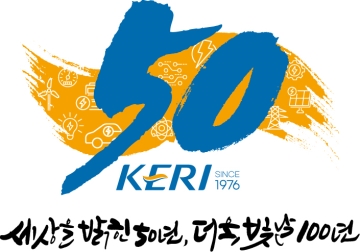
The Korea Electrical Engineering Research Institute (KERI) unveiled its 50th anniversary emblem and slogan ahead of 'Electricity Day' on April 10th. The symbols were selected based on the results of a public preference vote conducted through the institute's homepage and SNS during February and March, with a total of 10,000 participants. The emblem visualizes '50' using the institute's signature colors and incorporates elements symbolizing major research fields including power, renewable energy, mobility, and batteries. KERI plans to utilize these symbols to continue related events and content until the 50th anniversary main event scheduled for November.
2026.04.09by 명세환 기자
KERI and Changwon City Begin Full-Scale Construction of 'Open Second Campus'
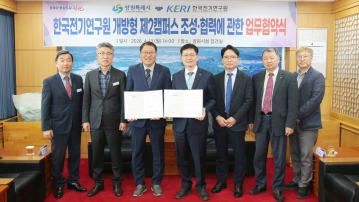
The Korea Electrotechnology Research Institute (KERI) signed a business agreement with Changwon Special City on the 13th to establish an "open second campus" to strengthen competitiveness in future power and AI industries, and agreed to jointly promote the construction of national strategic technology demonstration infrastructure.
2026.04.13by 배종인 기자
Improvement of carbon dioxide adsorption performance without chemical processes
The Korea Institute of Materials Science (KIMS) announced on the 17th that a research team involving senior researcher Lee Hee-jeong has jointly developed with research groups from Kyungpook National University and Yeungnam University a technology to control the internal pore structure of MOFs using laser.
2026.04.17by 배종인 기자
.jpg)
KERI Develops Intermediate Layer Technology to Reduce Anode Contact Instability in All-Solid State Batteries
Researchers at the Korea Electrotechnology Research Institute (KERI) have developed an interlayer technology that reduces contact instability issues occurring between the lithium metal anode and solid electrolyte in all-solid-state batteries. The research team applied an interlayer utilizing nano tin to the anode surface through a transfer process, and confirmed capacity retention of 81% or higher after 500 charge-discharge cycles even under low pressure conditions of 2 MPa in large-area pouch cell experiments. This research was selected as a cover paper for the international academic journal 'Advanced Energy Materials'.
2026.04.27by 명세환 기자











