



ams OSRAM Targets AI Data Center Optical Interconnects with Automotive MicroLED Technology
 Published2026.06.10 12:01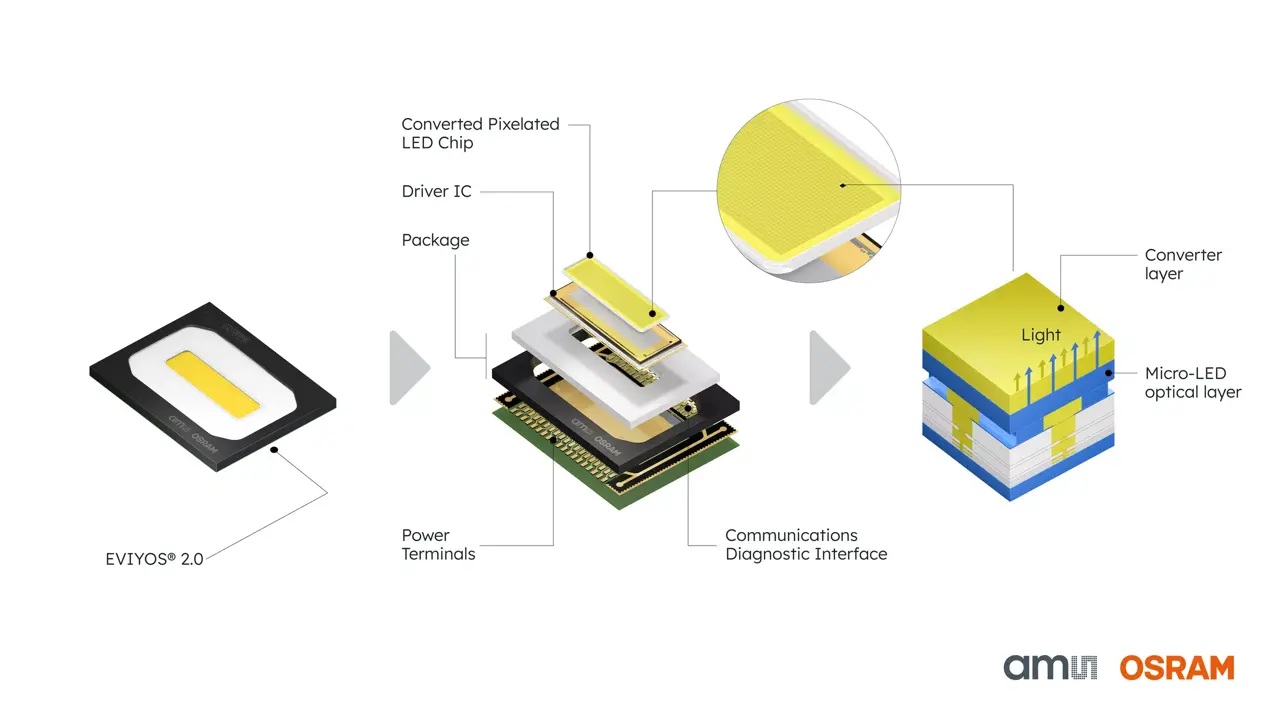
Proposal of a 'Slow-and-Wide' Structure Based on EVIYOS Mass Production Experience
ams OSRAM announced on the 10th that it is expanding its automotive microLED technology portfolio into the field of next-generation AI data center optical interconnects. The key is a 'Slow-and-Wide' structure that utilizes multiple microLED-based parallel optical channels, rather than the existing high-speed single-channel-centered 'Fast-and-Narrow' method.
This structure secures the full bandwidth by configuring hundreds to thousands of optical channels in parallel. The company believes that this approach can reduce power consumption and heat generation, while enhancing system reliability through multi-channel-based redundancy. It is also explained that system design complexity can be reduced through low switching frequency and a simplified serialization and deserialization structure.
ams OSRAM stated that in internal research, its microLED-based optical transmitter achieved a maximum transmission speed of 3.0 Gbits/s per lane based on a 10m link and an energy efficiency of less than 2 pJ/bit. This positions it as an alternative to address the power consumption, heat generation, and electromagnetic interference issues of copper-based interconnects in a situation where the volume of data movement between AI servers and accelerators is rapidly increasing.
The foundation of this technology expansion is the automotive EVIYOS adaptive headlamp platform. EVIYOS is a solution that integrates 25,600 individually controlled microLED pixels and a CMOS driver into a single package, and it has secured experience in precision lighting control and mass production applications in the automotive sector. ams OSRAM is transferring this large-scale microLED integration and control capability to the realm of digital photonics for data centers.
In the AI data center market, competition in optical-based data transmission technologies, such as silicon photonics and CPO, is already intensifying. This is because, as GPU and NPU performance improves, the efficiency of data transfer between chips, boards, and racks determines overall system performance and power costs. ams OSRAM's microLED approach is differentiated from the competition in high-speed single-channel systems by offering a parallel optical channel-based alternative.
ams OSRAM is currently collaborating with data center ecosystem partners in the fields of high-speed driver integration, advanced packaging, optical connectors, and fiber optic integration. As the company possesses both microLED and photodiode technologies, it appears poised to pursue the development of integrated transmit-receive optical data transmission systems in the future. As AI infrastructure continues to expand, the commercialization of low-power optical interconnect technology is also expected to accelerate.

Comments
Related news

ams OSRAM Becomes All-in-One Supplier for Projection Applications
Global optoelectronic solutions company ams OSRAM (Korea Representative Kang Seok-won) is launching the first product in its high-power multi-die laser package 'Vegalas™ Power' series, supplying all essential optoelectronic components required for projection, and is now moving into earnest action to reshape the global projection market landscape.
2025.09.30by 배종인 기자
ams OSRAM Provides Reliable, Flexible Solutions for Capacitive Sensing
ams OSRAM (Korea Representative: Kang Seok-won), a global leader in intelligent sensors and emitters, has launched the capacitive sensing sensor 'AS8580' that operates reliably even in demanding automotive environments, reducing the complexity of automotive electrical system design and enhancing user experience.
2025.11.28by 배종인 기자
.jpg)
ams OSRAM Unveils 'OSLON™ Compact RM,' Next-Generation LED for Ultra-Slim Headlamps
ams OSRAM has unveiled the next-generation automotive LED 'OSLON™ Compact RM'. It meets ultra-slim headlamp requirements with a ceramic package and compact architecture based on rectangular chips.
2025.12.08by 명세환 기자
ams OSRAM Targets Advanced Autonomous Driving Sensor Market with Innovative LiDAR Laser
Global sensor and emitter industry leader ams OSRAM (Korea Representative: Kang Seok-won) has officially launched a 5-junction edge-emitting laser, targeting the next-generation autonomous vehicle advanced sensor market.
2025.12.15by 배종인 기자

Infineon Acquires Ams OSRAM Sensor Business for €570 Million
Infineon Technologies strengthens its position in the global sensor market by acquiring the non-optical analog and mixed-signal sensor portfolio of ams OSRAM for a value of 570 million euros.
2026.02.04by 명세환 기자











