



Korea Radio Promotion Association and KT Expand Scope of Terminal Specification Verification (SAT) from 5G to LTE
 Published2026.08.03 09:00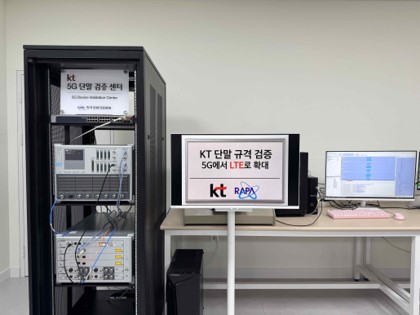
Support for LTE Cat-1, Cat-1 bis, and Cat-4 devices; expected to reduce verification waiting times for small and medium-sized manufacturers
Utilizing existing 5G terminal verification facilities to expand verification targets without separate investment
The Korea Radio Promotion Association (Chairman Hong Beom-sik, hereinafter 'RAPA') and KT (CEO Park Yoon-young) announced on August 3 that they will expand the scope of support for the 5G terminal specification verification (SAT) environment, which they have been jointly operating since 2024, to include LTE terminals.
Accordingly, small and medium-sized manufacturers intending to supply LTE modules, modems, and routers to the KT network can now perform KT specification verification at the AIoT Technology Support Center of the RAPA Institute of Radio and Telecommunications Technology in Songdo, Incheon, and receive test result reports. The issued reports are used in KT's internal verification procedures when adopting terminals from these manufacturers. This offers an advantage to manufacturers in that they can verify compliance with specifications during the development phase without having to wait for the carrier's verification schedule.
This expansion is driven by the steady increase in demand for LTE-based Internet of Things (IoT) terminal verification. As IoT businesses centered on Cat.1 bis and Cat.4 expanded, the number of terminals subject to verification increased; furthermore, in large-scale projects, verification periods were often prolonged because multiple products had to be verified simultaneously to select the optimal module. With limited verification channels, this has led to increased waiting times and development schedule delays for small and medium-sized manufacturers.
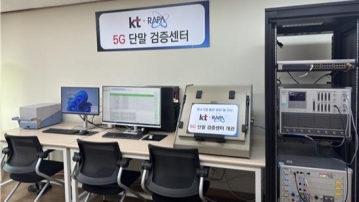
RAPA and KT resolved this by utilizing the existing 5G terminal verification environment without new facility investment. KT completed the development of test cases (TCs) for LTE MTM IoT terminal verification based on its operational 5G terminal verification equipment, and these test cases can be utilized in the Anritsu 5G terminal verification environment (MT8000A, etc.) built by RAPA. In addition, since RAPA already possesses verification infrastructure including an LTE base station simulator, it was able to expand the scope of verification simply by expanding the test cases.
The verification targets are Cat.1, Cat.1 bis, and Cat.4-based communication modules, modems, and routers installed in remote metering devices, control equipment, and payment terminals widely used in industrial settings. The verification confirms whether the terminals successfully connect to the KT network to exchange data, and whether they operate according to specifications even in exceptional situations, such as communication interruptions or network connection refusals. In addition, critical features for IoT terminals, such as connection control to handle traffic surges and power-saving functions to reduce battery consumption, are also checked. Through this process, manufacturers can confirm specification compliance during the development phase, thereby shortening the verification period leading up to commercialization.
Son Jeong-yeop, Head of KT’s Device Business Division, said, “KT and RAPA have been cooperating to develop the domestic terminal industry by jointly operating a 5G terminal specification verification environment since 2024,” adding, “We hope that this expansion of LTE specification verification items will help shorten the development and commercialization period for small and medium-sized manufacturers.” "We will continue to expand the scope of verification based on close cooperation with RAPA to support the improvement of terminal quality competitiveness," they added.
"The biggest burden for small and medium-sized manufacturers is not the technology development itself, but the time and cost involved in verification right before commercialization," said Jeong Heung-bo, Executive Vice President of RAPA. "As we have expanded the scope of verification to include LTE following 5G, we will continue to broaden the environment that allows domestic IoT terminal companies to focus on product development."

Comments
Related news
.jpg)
RAPA, Emco, and Konkuk University cooperate to foster professionals in radio and ICT convergence
As the advancement of cutting-edge industries accelerates, a global shortage of technical talent is emerging as a critical issue. In response, various industries are making intensive efforts in their own workforce development, and domestically, the radio frequency utilization sector is also focusing on training specialized personnel through mutual cooperation.
2023.02.16by 명세환 기자
RAPA·Busan TP to train autonomous vehicle professionals
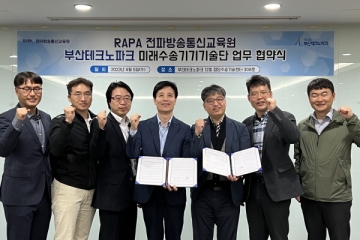
RAPA Radio and Broadcasting Communications Training Institute and Busan TP Future Transportation Equipment Technology Group signed a Memorandum of Understanding on December 5th at Busan Technopark to collaborate on developing specialized workforce in the autonomous vehicle industry for incumbent workers.
2023.04.05by 성유창 기자
RAPA·ICT Polytechnic University, ICT Talent Training Business Agreement Signed
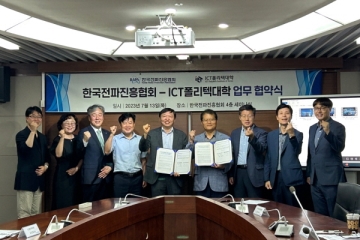
The Korea Radio Promotion Association (RAPA) and ICT Polytechnic University are pursuing the development of professional workforce in the radio and ICT convergence industry sector through a business agreement that encompasses educational training program development and in-service worker training collaboration projects.
2023.07.13by 성유창 기자
Cast.era, Korea Radio Promotion Association, and Sinclair Broadcasting Join Hands to Activate ATSC 3.0 Services
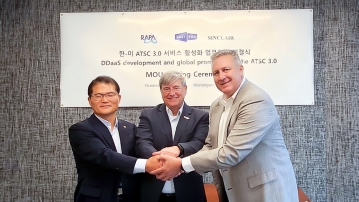
CastDotEra has signed a memorandum of understanding with the Korea Radio Promotion Association (RAPA) and Sinclair, North America's largest terrestrial broadcasting group, to activate ATSC 3.0 services and expand global business operations.
2023.10.30by 배종인 기자
Korea Radio Promotion Association Opens 5G Terminal Verification Center... Supports 5G Verification for Small and Medium-sized Companies
The Korea Radio Promotion Association (RAPA) announced the opening of a '5G Terminal Verification Center' located in Yongsan-gu, Seoul on the 2nd.
2024.01.03by 명세환 기자











