


ETRI and Busan City Launch Demonstration of AI and Digital Twin-Based Urban Flooding Prediction Platform
 Published2026.08.19 09:29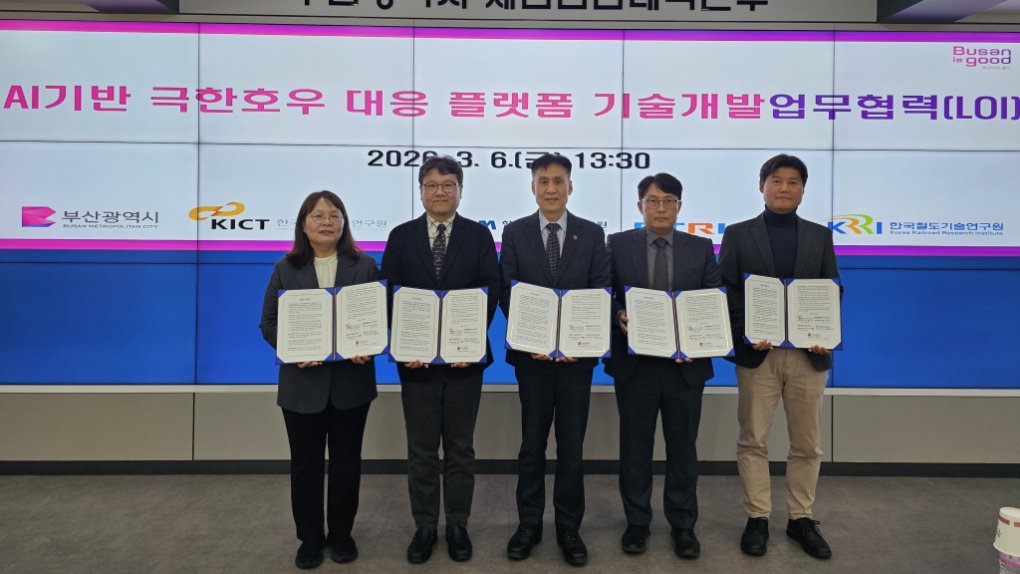
5년간 338억 규모, 하이브리드 침수예측 모델 개발 주도

KICT는 도시 인프라 연계 홍수 예측·제어 기술을, KIGAM은 4D 도시 지질환경 기반 지질재해 대응 플랫폼을 각각 담당한다.

Comments
Related news
ETRI Expands Government-funded Research Institute Open Source Council into Pan-Government-funded Research Institute System
The government-funded research institute open source consortium led by ETRI will expand from eight institutions at its launch in 2022 to encompass all government-funded research institutes starting this year. This is a measure to jointly address complex risks including license disputes, security vulnerabilities, and AI training data copyright issues as open source expands into national strategic sectors such as AI, semiconductors, and defense. ETRI plans to serve as a central hub for open source management in the public sector based on its own governance system and R&D expertise.
2026.07.07by 배종인 기자
.jpg)
ETRI's Machine Learning-Based Frequency Prediction Methodology Receives ITU-R International Standard Approval
The machine learning-based spectrum availability assessment and prediction methodology developed by the Electronics and Telecommunications Research Institute (ETRI) has been officially approved as a new report by the International Telecommunication Union Radiocommunication Sector (ITU-R). This result comes from leading international discussions for seven years since the proposal in 2019, and incorporates technology that predicts frequency availability by region and time zone using AI. Going forward, it is expected to be utilized as a reference technology for intelligent spectrum management and the establishment of efficient frequency supply strategies in the 6G era.
2026.07.15by 명세환 기자
ETRI Localizes Core Components for Aerial Holograms… Implements Non-Contact Touch Interface
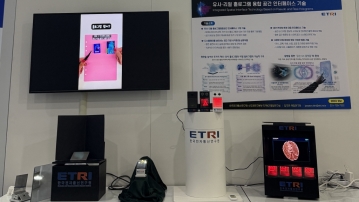
The Electronics and Telecommunications Research Institute (ETRI) has achieved domestic localization of a mirror-reflective sheet, a key component for aerial holograms previously supplied exclusively by Japanese companies, and completed a prototype of a non-contact interface technology that enables direct manipulation of aerial images with fingertips. High-resolution mirror-reflective sheets were manufactured using a proprietary production method combining polymer materials with photolithography and imprinting processes, and application as a next-generation UI without infection concerns in operating rooms, medical facilities, and public institutions is anticipated.
2026.07.21by 배종인 기자
ETRI Unveils Digital Archive of ICT History to Mark 50th Anniversary
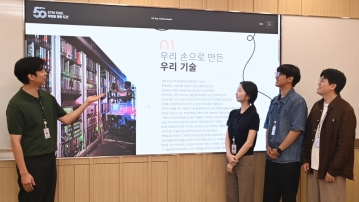
The Electronics and Telecommunications Research Institute (ETRI) has unveiled an online archive documenting half a century of domestic ICT research and development achievements on the occasion of its 50th founding anniversary. The archive is organized into 5 sections comprised of photographs, videos, and interactive content showcasing major technological development outcomes including TDX, DRAM, CDMA, 5G, and AI. The industrial ripple effects over the past 50 years are estimated at 494 trillion won. The archive is accessible online to all citizens without restrictions on time or location.
2026.07.23by 배종인 기자
ETRI Adopts ITU-T and MPEG International Standards for Biosignal Compression Technology
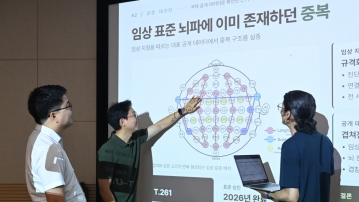
The lossless biosignal compression technology developed by the Electronics and Telecommunications Research Institute (ETRI) has been officially adopted in the international standard H.BWC by the International Telecommunication Union (ITU-T) and MPEG. Two core technologies—predictive encoding and electrode arrangement-based channel coding—have been incorporated, and two international standard patents have been secured. As the first international standard for biosignal compression including electroencephalography, electrocardiography, and electromyography, it is expected to be utilized in telemedicine, wearable healthcare, and AI-based precision medical diagnosis.
2026.07.29by 배종인 기자











