


Intel, "60% Have Robotics Investment Intent, But Only 40% Possess Actual Strategy"
 Published2026.08.21 12:41
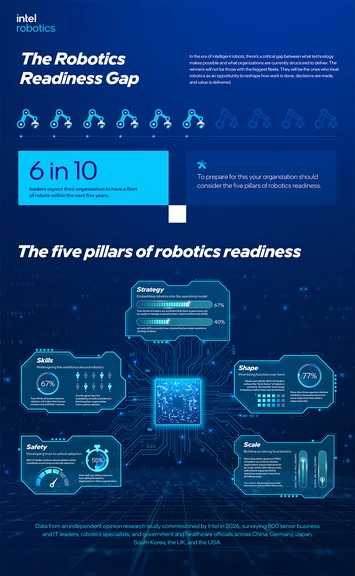 기업 리더 10명 중 6명이 향후 5년 내 로봇 운영 체제를 갖출 것으로 예상하지만, 실제 공식 전략을 보유한 조직은 40%에 그치는 것으로 나타났다. 로보틱스 도입 의지와 운영 준비 수준 사이의 격차가 확인된 것이다.
이번 조사는 맨 바이츠 도그(Man Bites Dog), 콜맨 파크스 리서치(Coleman Parkes Research)와 공동으로 진행됐으며, 한국·미국·영국·독일·일본·중국 등 주요 시장의 기업 임원·로봇 전문가·정부·의료 관계자 800여 명을 대상으로 했다.
조사 대상은 연 매출 5억 달러 이상 규모 조직이다.

안전과 관련해서는 55%가 안전 문제로 도입이 지연된 경험이 있다고 답했으며, 68%는 명확한 글로벌 표준이 도입 속도를 높일 것으로 봤다.
규모 측면에서는 응답자의 75% 이상이 주요 로봇 애플리케이션에 100밀리초 이내 의사결정이 필요하다고 응답했다.
인텔은 엣지 AI 반도체, 인텔 로보틱스 AI 스위트(Intel Robotics AI Suite), 오픈비노 피지컬 AI(OpenVINO Physical AI) 툴 등을 통해 기업의 로봇 기술 도입 기반을 지원한다고 전했다.

Comments
Related news

Sky Intelligence Valued at 100 Billion Won... Secures Additional Investment
Sky Intelligence has attracted additional investment from the Oracle-Vector Regional Innovation Venture Fund and has been valued at 1 billion won in corporate value. The company is responding to manufacturing industry demand for Physical AI transformation by building digital twins based on NVIDIA Omniverse and creating synthetic data infrastructure for AI training. Sky Intelligence is pursuing joint research in robot vision with the Seoul National University AI Research Institute and strategic cooperation with ABB Robotics, while planning to expand its business scope into manufacturing, robotics, and smart factories.
2026.07.13by 명세환 기자

Sky Worldwide Proposes Data Sovereignty Policy at National Assembly Forum
Shin Jae-hyuk, CEO of SkyWorldwide, emphasized the necessity of securing data sovereignty and fostering domestic synthetic data infrastructure to ensure national competitiveness in the era of Physical AI at a parliamentary forum. He explained that for robots to recognize actual environments and operate autonomously, real-world data must be managed and utilized with domestic technology, and that synthetic data serves as both a "textbook" and "error note" for AI learning. SkyIntelligence is currently advancing physical AI technology demonstrations in the manufacturing sector in collaboration with NVIDIA and ABB Robotics.
2026.07.16by 명세환 기자
Sky Intelligence Participates in ABB and NVIDIA Physical AI White Paper
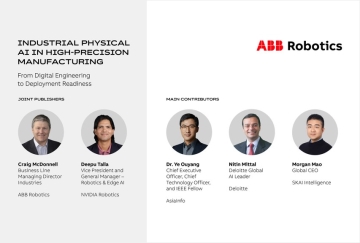
ABB Robotics and NVIDIA have published a white paper on Physical AI for high-precision manufacturing, with domestic company Sky Intelligence participating as a key contributing organization. The paper presents a system engineering pathway that enhances robot system deployment readiness through synthetic data, digital twins, and Real2Sim2Real engineering loop technology. Sky Intelligence focused its technological capabilities on building a synthetic data pipeline that validates low-frequency, high-risk failure conditions at the digital stage.
2026.07.20by 명세환 기자

Intel Hosts Korea Representative Selection for AI Global Impact Festival
Intel Korea will officially hold the Korean representative selection preliminary for the AI Global Impact Festival on July 21st. This is a competition for youth and university students proposing ideas that solve social issues in the education, healthcare, and environment sectors using AI, with the Korean representative team advancing to the global finals after domestic preliminaries. The winning teams will be provided with opportunities to participate in global events and visit Intel's overseas campuses.
2026.07.21by 배종인 기자
Sky Intelligence Officially Announces Physical AI Collaboration with ABB Robotics at WAIC 2026
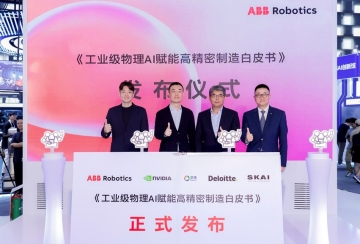
Sky Intelligence has formalized collaboration on Physical AI with ABB Robotics at Shanghai WAIC 2026. Sky Intelligence, which participated as a key contributing organization in the Physical AI whitepaper for precision manufacturing issued by ABB and NVIDIA, has agreed to cooperate by supporting industrial robot simulation, robot vision AI learning, and deployment readiness through a precise synthetic data pipeline and integration with ABB RobotStudio.
2026.07.22by 명세환 기자











