



A single misaligned light means 'defect'… Vehicle interior lighting now guarded by semiconductors and software
 Published2026.08.28 11:28
LED 비닝·온도 편차로 흔들리는 색, MCU 내장 드라이버가 실시간 보정
인피니언 LITIX 'TLD4020-3ET', ECU-less로 소형차까지…"5년 내 30% 성장"
자동차 실내조명이 '보조 조명'의 자리를 벗어나고 있다. 색상과 애니메이션으로 브랜드 아이덴티티를 드러내고 운전자 취향을 담아내는 사용자 경험(UX)의 핵심 요소로 올라서면서, LED 실내 앰비언트 시장도 빠르게 커지는 중이다. 이에 관하여 '미래 자동차를 밝히는 지능형 LED 실내 조명 솔루션' 이라는 내용으로 기술 웨비나 세션을 발표하는 최영재 다보코퍼레이션 연구위원을 앞서 만나, 시장의 온도와 설계 요구의 변화를 들었다.
이동수단에서 '경험 공간'으로…RGB, 소형차까지 내려온다
최 위원은 성장 동력으로 자동차의 성격 변화를 첫손에 꼽았다. 바로 "자동차가 이동수단을 넘어 사용자 경험을 제공하는 공간으로 바뀌고 있다"는 것이다. 완성차 업체는 조명의 색과 움직임으로 브랜드 고유의 인상을 만들고, 운전자는 색을 바꾸거나 주행모드·경고·공조 상태를 빛으로 확인하며 개인화한다. 여기에 반도체·LED 원가 하락이 확산에 불을 붙였다. 과거 고급차 전유물이던 RGB 조명이 이제 중저가·소형차까지 내려오고 있다는 설명이다. 그는 "고급차는 대부분, 중가 브랜드도 절반 이상이 RGB LED를 쓴다"며, 원가 절감이 이어지면, 이러한 트렌드가 대다수 차종으로 번져 "5년 안에 30% 이상 시장이 성장할 것"으로 내다봤다. 다만 화려함의 수준이나 컨셉은 국가·브랜드별로 갈릴 것으로 봤다.
"불빛 하나 어긋나면 고장으로 오인"…색을 지키는 게 곧 기술
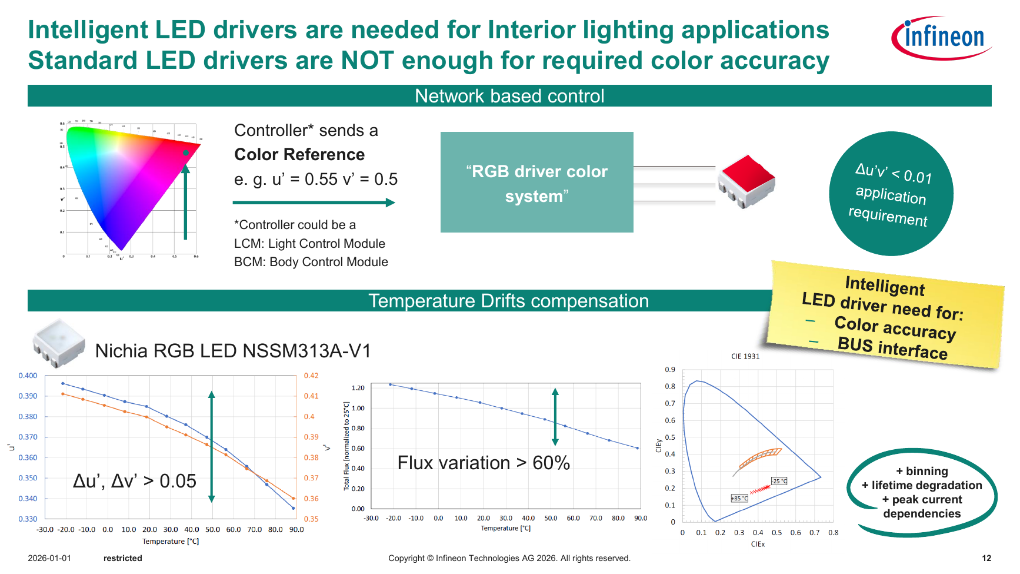
화려함 뒤에는 까다로운 공학이 숨어 있다. LED는 비닝(소자 편차)과 온도, 열화 탓에 색이 미세하게 틀어진다. 최 위원은 "대시보드처럼 여러 LED가 모인 곳은 하나만 색이 바뀌어도 눈에 확 띄어 차량 불량으로 오인될 수 있다"고 말했다. 여기서 지켜야 하는 '색온도'는 실제 온도가 아니라 색좌표를 뜻한다. 문제는 단순 전류 제어만으로는 이 색좌표를 잡을 수 없다는 점이다. 온도·편차·열화에 따른 드리프트를 소프트웨어 알고리즘으로 보정해야 하고, 그러려면 고분해능 PWM과 이를 돌릴 MCU가 필수가 된다. 슬림해진 인테리어 디자인으로 PCB 공간마저 좁아지면서, MCU를 별도로 두는 대신 드라이버에 통합하는 흐름이 굳어졌다. 그는 "실내조명은 이제 광학·반도체·소프트웨어를 유기적으로 묶는 통합 솔루션"이라고 정리했다.
MCU·LIN 통합한 '지능형 드라이버'…원칩으로 존 전체 제어
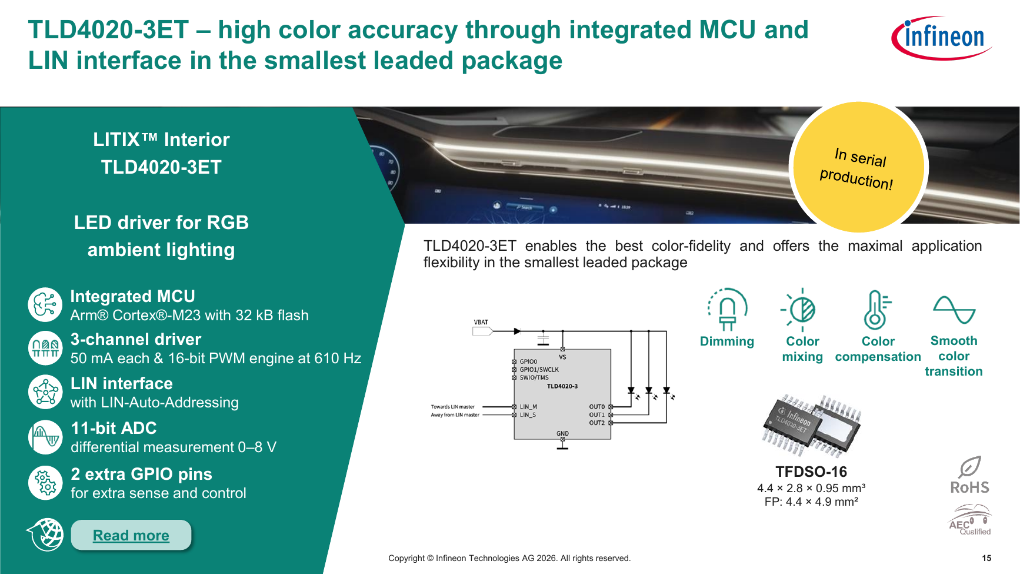
이 요구에 대한 인피니언의 답이 자동차 LED 드라이버 브랜드 'LITIX(리틱스)'다. 웨비나에서 소개하는 'TLD4020-3ET'은 Arm 코어 MCU와 LIN 통신, 16비트 PWM 엔진, 플래시 메모리 32kB를 한 칩에 담은 '지능형 LED 드라이버'다. 오토 어드레스 기능으로 도어존·센터페시아·풋웰 같은 넓은 영역까지 한 번에 다이내믹을 구현한다. 이름에 붙은 'ECU-less'는 조명을 제어하지 않는다는 뜻이 아니다. LED 전용 컨트롤러를 따로 두지 않고, BCM이나 존 컨트롤이 LIN으로 지령을 내리면 TLD4020이 말단에서 실제 LED를 제어하는 구조라는 의미다.
하드웨어 그대로, 소프트웨어만 바꿔…"4채널·12채널로 확장"
기존 베이직·멀티채널 드라이버가 정전류 구동과 PWM 디밍, 보호·진단에 집중했다면, TLD4020-3ET은 MCU·LIN을 통합해 색상 제어와 소프트웨어 기능까지 아우른다. 최 위원은 "하드웨어는 그대로 두고 소프트웨어만 바꿔 여러 파생 제품을 만들 수 있다는 게 가장 큰 장점"이라며 이를 '전용 RGB 로컬 LED 드라이버'로 규정했다. 앞으로의 경쟁력은 "LED를 균일하게 제어하는 능력과 소프트웨어 유연성에서 갈릴 것"이라는 진단이다. 로드맵도 그 방향이다. 현재 3채널(RGB) 제품을 시작으로 화이트까지 제어하는 RGBW 4채널, 나아가 12채널 제품까지 준비되고 있다. 종국에는 존(zonal) 집중식 통신 프로토콜로 실내 전체 LED를 제어하는 단계로 나아갈 것이라고 그는 전망했다.

Comments
Related news

[e4ds Tech Day 2026 ⑨] Sim Sang-gyu, Autocrypt CTO: "In the Physical AI Era, Automotive Security Must Extend Beyond the Vehicle"
At e4ds Tech Day 2026, Sim Sang-gyu, CTO of Autocrypt, explained automotive cybersecurity strategies in the era of Physical AI and SDV (Software-Defined Vehicle). Automobiles are evolving as part of an ecosystem connected to AI, cloud, chargers, IoT, and robots, and he emphasized that the scope of security must expand beyond the vehicle interior to the entire connected environment. In particular, AI model tampering, adversarial attacks, OTA updates, and EV charger hacking were identified as major threats. He explained that response measures require zero trust, AI model integrity protection, intrusion detection, Security by Design and Default, and full lifecycle security management, and that proactive security system establishment beyond regulatory compliance is critical for securing future mobility competitiveness.
2026.10.12by 배종인 기자

Practical HIL Construction Strategy for Automotive and Off-Highway Controller Validation
As vehicle E/E architecture transitions to zonal structures and shifts to software-defined vehicles (SDV), the number of controllers (ECUs) requiring validation and software complexity are surging dramatically. Meanwhile, real vehicle testing cannot provide repeated verification under identical conditions and entails lead time and safety concerns. This white paper explains the principles of HIL (Hardware-in-the-Loop) validation and the structure of the NI platform composed of PXI, SLSC, and VeriStand, and through two actual implementation cases—Camera Record & Replay HIL for In-Cabin Monitoring Controller (ICMU) and Forklift Controller (VCU) HILS—describes how controller-level regression testing becomes possible. Additionally, it explicitly states application boundaries and limitations, such as lack of A2B support.
2026.10.12by 편집부
DDR/LPDDR Protocol Analyzer Technical Whitepaper: Non-Invasive Observation of Live Memory Links
This whitepaper addresses the live memory link observation solution composed of Introspect Technology's DDR/LPDDR protocol analyzer (M7030), remote sampling head (RSH, multi-channel active probe), and integrated tip interposer. Based on maximum 36-channel aligned capture and 80 Gsps asynchronous sampling, automatic command and timing verification based on JEDEC specifications, and field measurements of probing in non-terminated mode LPDDR5X 8533 MT/s systems, this document describes the causality and trade-offs of each design decision and their application boundaries. All figures are based on webinar presentation slides and technical Q&A; items that were not cross-verified have been excluded from the main text and separately organized as review items.
2026.10.12by 편집부
War on Noise: Piercing Through SI/PI/EMI in the Frequency Domain
In high-speed digital design, SI, PI, and EMI are not separate issues but a single physical phenomenon sharing Vias, PDN, coupling, and return paths. Based on WaveInSense webinar materials, this white paper organizes the causal chain of frequency domain analysis—from transmission line theory through Via Stub resonance, PDN anti-resonance, to a three-element model of system-level EMI. Finally, through an ultrasonic equipment EMC certification case study, it demonstrates how minimal changes targeting root cause structures led to certification acquisition and cost reduction (external chamber monthly usage reduced to 1/18 compared to the highest user).
2026.10.12by 편집부

Infineon Launches 27kW 3-Phase PSU Solution for AI Servers
Infineon has launched a reference design for a 27kW 3-phase power supply unit for AI servers. By integrating its own components including CoolSiC MOSFET and PSOC microcontroller, the solution simultaneously achieves a power density of 116W/in³ and peak efficiency exceeding 98%. It meets the OCP Open Rack V3 specification and addresses the increasing power requirements of data centers driven by the proliferation of AI workloads.
2026.10.12by 배종인 기자











