



Microchip and Navitas Jointly Develop 800V DC Reference Design for AI Data Centers
 Published2026.10.06 09:20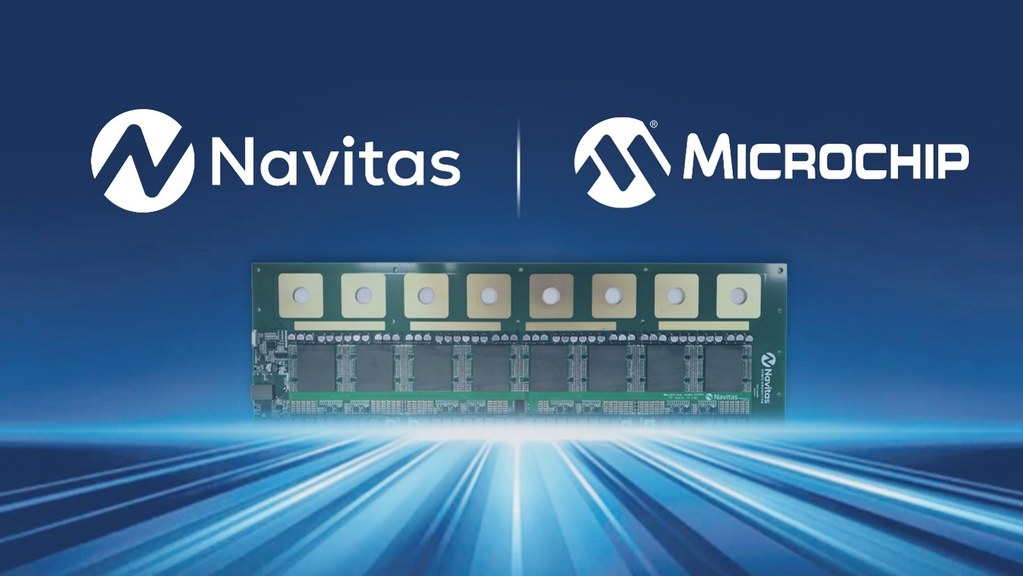
The platform combines Microchip's digital power control and security technology with Navitas' GaNFast™ gallium nitride (GaN) power devices to support power conversion implementation compliant with the OCP (Open Compute Project) 800V DC standard.
By providing reference hardware, software, and design documentation together, design risk can be reduced and development cycles shortened.
The dsPIC33AK256MPS306 product family features a 200MHz 32-bit core, 78ps high-resolution pulse width modulator (PWM), and 12-bit ADC operating at up to 40MSPS, and provides post-quantum cryptography algorithm library support and hardware-accelerated encryption capabilities.
The TA100 supports establishing a hardware root of trust through secure boot, authentication, and protected firmware updates.
The PDB is designed to achieve maximum peak efficiency of 96% and power density of 2,100W/in³ under full-load conditions at 1MHz switching frequency.
The two companies explain that integrating the conventional two-stage conversion of 800V DC-to-50V DC and 50V DC-to-6V DC into a single converter improves overall conversion efficiency.
Improvements in total cost of ownership (TCO) are also expected.

Comments
Related news
Microchip Launches 3.3kV SiC Power Module for AI Data Center SST
Microchip has launched a 3.3kV-class SiC power module applicable to solid-state transformers (SST) for AI data centers. The module is focused on simplifying the power supply architecture from medium-voltage power grids to server racks and reducing the burden of series connection in conventional low-voltage SiC-based designs.
2026.05.27by 명세환 기자
Microchip Launches PCIe 6.0 and CXL 3.1 Retimers… Targeting AI Server Connectivity
As AI data centers expand toward GPU-centric high-density server architectures, the importance of server internal interconnection technologies is growing. Microchip has launched PCIe 6.0 and CXL 3.1-based XpressConnect retimers, addressing latency and signal integrity issues that arise in high-speed interconnect environments.
2026.06.04by 배종인 기자

Microchip Obtains 'QML Class Y' Certification for Nantes Plant, France… Expanding Aerospace Semiconductor Production
Microchip Technology has expanded its Nantes, France production facility's QML (MIL-PRF-38535) certification, which is the quality standard for military and aerospace semiconductors, to include 'Class Y', and the company expects its role as a European production hub to be strengthened.
2026.06.17by 배종인 기자
.jpg)
Mouser to Supply Over 5,000 Additional New Products in Q2
Mouser Electronics will supply over 5,000 new products during the second quarter of 2026, including Renesas MCUs, Microchip evaluation kits, DFRobot sensors, and Phoenix Contact connectors. The Renesas RX14T is an MCU for motor control applications, the DFRobot SEN0691 is a sensor that detects minute movements using 24GHz mmWave technology, and the Phoenix Contact connector is an integrated interface solution for energy storage systems.
2026.07.24by 명세환 기자

Mouser Unveils Online Resource Center for Transportation Technology
Mouser Electronics has opened a transportation technology online resource center that supports next-generation mobility development including urban air mobility (UAM), hydrogen fuel cells, and autonomous driving. It provides design phase-specific technical information such as power management, functional safety, and AI-based decision-making, as well as MCU and connector products from major manufacturers including NXP and Microchip.
2026.07.28by 명세환 기자











