


Kaspersky: 87% of SMBs in APAC Experience Cybersecurity Incidents
 Published2026.10.07 09:27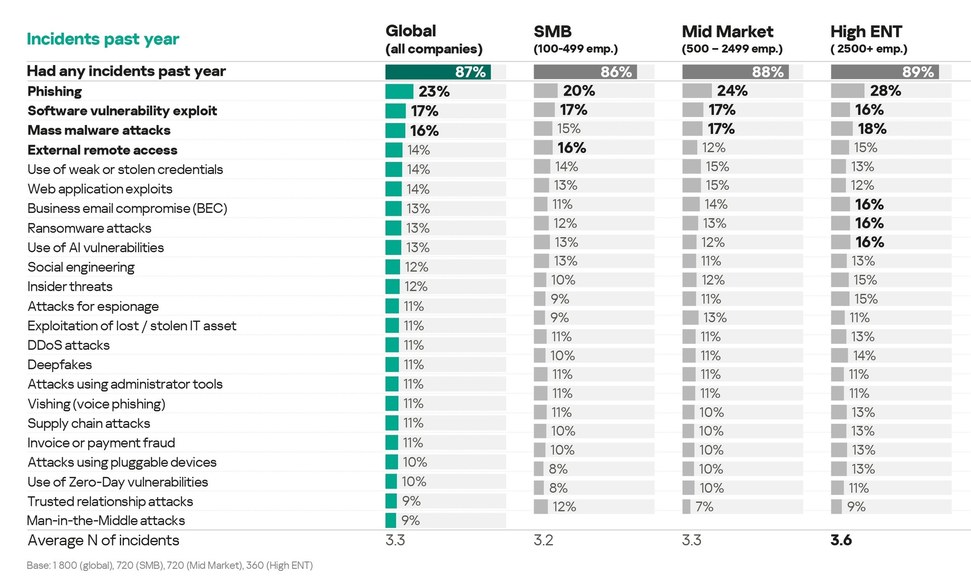
According to a survey conducted by Kaspersky's Internal Research Center targeting a total of 1,800 IT security professionals across 18 countries, in the APAC region only 13% of companies with fewer than 500 employees had not experienced cybersecurity incidents over the past year.
By country, Vietnam had the highest incident experience rate at 97%, followed by Malaysia at 95%, Indonesia at 92%, and India at 87%.
Thailand and China fell below the APAC average at 82% and 67%, respectively.
The most frequently occurring incident types among SMBs were △software vulnerability exploitation (20%), △phishing (19%), and △large-scale malware attacks (18%).
Zero-day attacks occurred at a low frequency of 6%, but companies exposed to this type of threat reportedly suffered severe damage.
This was followed by lack of expertise among IT security personnel (24%), outdated software or hardware (23%), insufficient regular risk assessments (22%), and lack of necessary security solutions (22%).
78% of SMBs have already increased their cybersecurity budgets this year.
The allocation of additional budgets ranked as follows: △IT and security personnel expansion (48%), △adoption of advanced security solutions such as XDR, NDR, and SIEM (32%).
For product offerings, Kaspersky presented Kaspersky Small Office Security Premium for small companies with fewer than 50 employees, Kaspersky Next Optimum with advanced detection and response capabilities, and Kaspersky Security for Mail Server for email threat response.

Comments
Related news

Kaspersky KCS, DevSecOps Optimization·GitHub Actions Error Detection Enhanced
Kaspersky has released a new version of its container security solution KCS. The update adds features including GitHub Actions configuration error detection, custom security policies, control plane deep audit, and SBOM export to streamline DevSecOps workflows and strengthen software supply chain security. Node agent performance has improved 2.5 times, and dynamic admission control processing speed has improved 10 times, enabling protection of the entire lifecycle of container applications in on-premises and isolated network environments.
2026.08.05by 명세환 기자

Kaspersky Shares Cybersecurity Cooperation Plans at WSIS Forum 2026
Kaspersky participated in the UN-affiliated WSIS Forum 2026 and shared insights on strengthening cyber resilience for SMEs and AI governance. The company collaborated with national agencies including Nigeria and Indonesia to discuss methods for securing cybersecurity capabilities for SMEs with limited security investment capacity, and presented the necessity of cross-border incident response cooperation to build trust in the Agentic AI environment.
2026.08.13by 명세환 기자

Kaspersky Launches Malware Detection for AI Agents, Models, and Skills
Kaspersky has launched malware and backdoor inspection capabilities targeting AI agents, models, and skills. The move responds to a surge in supply chain security threats, with over 15,000 AI-disguised malware samples identified this year alone. The capability enables employees to proactively identify security risks before deploying AI components, and can also inspect for bias.
2026.08.18by 명세환 기자
Kaspersky Unveils 'Partnerverse' Connecting 18,000 Global Partners
Kaspersky has unveiled the 'Partnerverse' platform, which connects 18,000 partners worldwide. In the form of an interactive digital universe, it enables partner search by region, tier, and specialty, as well as inquiry of success cases and award history, helping enterprises easily find security partners suited to their environment.
2026.08.24by 명세환 기자

Kaspersky announces manufacturing cyber resilience report
According to the manufacturing cyber resilience report jointly announced by Kaspersky and VDC Strategy, 60% of current manufacturers aim to achieve complete digitalization within 2 years, but cyber incidents are causing damages exceeding 1 million dollars per incident and an average of 15.3 hours of operational downtime. The report noted that IT departments' security policies do not sufficiently reflect OT security at production sites, and that establishing an integrated IT and OT security system is urgent. In response, Kaspersky presented a Kaspersky Industrial Cybersecurity (KICS) solution based on a native XDR platform.
2026.08.31by 명세환 기자











