


Someone can control your car at will.
 Published2015.09.22 18:30
Automotive semiconductor companies such as Infineon focus on enhanced security solutions
#Scene 1. Mr. A was startled when the air conditioner suddenly started working while he was driving. The speedometer also moved on its own. Driving was no different than usual, and he had not operated any other devices. The car became uncontrollable against his will, and eventually, the engine even stalled.
#Scene 2. When Mr. B stepped out to leave for work in the morning, he discovered that his car was gone. It had been only a short while since he had purchased a luxury car known for its excellent security features. It turned out that he was not the only one whose car had been stolen. Even more surprising was the fact that all the stolen vehicles were equipped with smart keys.
The first scene actually shows American internet security experts hacking a Fiat-Chrysler Jeep Cherokee, a sports utility vehicle (SUV). They demonstrated hacking a vehicle located 15 kilometers away from their home using a laptop. Due to this incident(?), the company hurriedly carried out a recall of approximately 7,800 vehicles. The company stated that the total number of vehicles subject to recall, including the hacked vehicles this time, amounts to 1.4 million across seven models.
 Car hacking incidents follow one after another
The second scene involves a recent car theft incident that occurred in two small towns near Frankfurt, Germany. Over a six-month period, a total of 80 luxury cars were stolen in this region. The thieves divided their roles, taking charge of the driver with the smart key and the driver's vehicle.
A thief, maintaining a distance of about 5 to 7 meters from the moving driver, used an amplifier to amplify the frequency used by the smart key and the car. An accomplice, who was staying near the vehicle, pressed the start button of the car—which had its security and locking mechanisms unlocked by the amplified frequency—as if it were his own car and fled.
Ultimately, what was feared has happened. Car hacking has become a reality. With electronic devices accounting for as much as 50% of a vehicle's performance, the car is no longer a mechanical device but has become an electronic one. Although there have been countless warnings for years about the security risks of "mobile appliances" like the automobile, everyone was shocked by the fact that hacking is actually possible at will.
Connected cars, capable of continuous wireless connectivity, have brought about a revolution in the automotive industry. They guarantee vehicle convenience and safety, and enable remote software updates instead of costly maintenance. However, this very connectivity has ended up becoming a liability. As external access to automobiles has become possible, the possibility of car hacking has also increased.
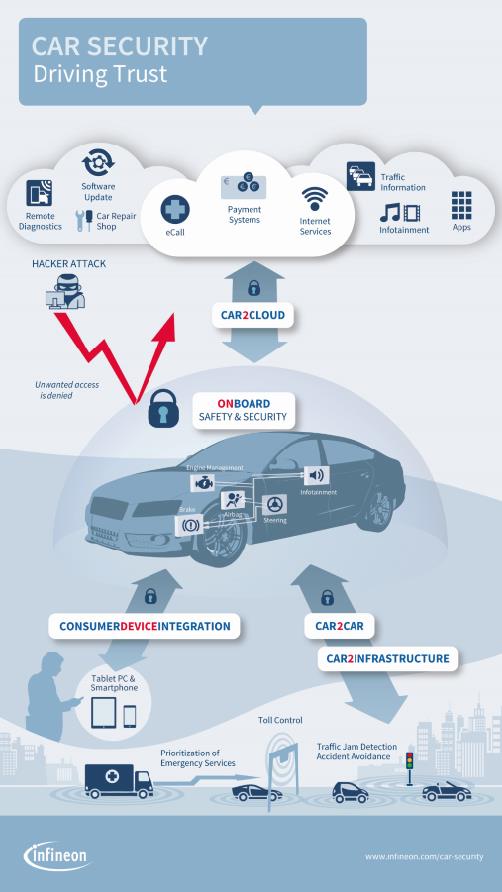
The problem is that communication systems such as C2C (car-to-car) and C2I (car-to-infrastructure communication), which are intended to improve safety and efficiency on the road, can conversely expose data such as the vehicle's location and speed. The reality has arrived where software updates, remote diagnostics, emergency calls, payment systems, internet services, and infotainment services—all of which have become computer networks—can directly become targets for car hacking.
"The key to electronic driver assistance systems is that communication between vehicles or between vehicles and infrastructure must be secure," said Professor Christof Paar, Chairman of the Embedded Security Department at Rhein-Ruhr University Bochum in Germany. "For example, if someone on the road sends a false accident warning message, it could cause fatal danger to other drivers who are driving at 180 kilometers per hour on the highway and have to make a sudden stop."
The automotive industry is in a state of emergency as automotive security issues come to the forefront. Since this is not a problem that can be resolved through voluntary recalls, the government is also stepping in to take active measures.
▲ Infineon Car Security Infographic
Infineon Technologies, a leader in automotive semiconductors, offers a solution for automotive security through its security solutions. The company has long emphasized the importance of automotive security by applying the Trusted Platform Module (TPM) standard to its chips. For example, using a TPM as a communication control unit connected to an infotainment system can enhance the reliability of that unit.
Strong security supported by both software and hardware is needed
Infineon Technologies’ AURIX™ family of 32-bit multicore microcontrollers, designed to meet the demands of automotive powertrain and safety applications, is a leading automotive security solution. By employing up to three independent 32-bit TriCore processor cores, it not only meets the highest safety standards but also provides security features. Furthermore, all AURIX products are equipped with a Hardware Security Module (HSM) to meet future security requirements and better protect vehicles from theft, forgery, and unauthorized modification.
Professor Christof Paar explained, “Automotive electronics require robust security supported by both software and hardware to reduce the risk of damage from cyber attacks. These hardware-based security elements are a prerequisite for building consumer trust.”
As such, automotive security has now become a nationwide issue. Using enhanced security solutions has become a necessity, not a choice. This is because the inability to control one's vehicle as one pleases is a matter directly related to one's life.

Comments
Related news

Infineon Launches Embedded Security Chip for Advanced Mobile Communications
2015.03.20by 명세환 기자


[e4ds Tech Day 2026 ⑨] Sim Sang-gyu, Autocrypt CTO: "In the Physical AI Era, Automotive Security Must Extend Beyond the Vehicle"
At e4ds Tech Day 2026, Sim Sang-gyu, CTO of Autocrypt, explained automotive cybersecurity strategies in the era of Physical AI and SDV (Software-Defined Vehicle). Automobiles are evolving as part of an ecosystem connected to AI, cloud, chargers, IoT, and robots, and he emphasized that the scope of security must expand beyond the vehicle interior to the entire connected environment. In particular, AI model tampering, adversarial attacks, OTA updates, and EV charger hacking were identified as major threats. He explained that response measures require zero trust, AI model integrity protection, intrusion detection, Security by Design and Default, and full lifecycle security management, and that proactive security system establishment beyond regulatory compliance is critical for securing future mobility competitiveness.
2026.10.12by 배종인 기자

Practical HIL Construction Strategy for Automotive and Off-Highway Controller Validation
As vehicle E/E architecture transitions to zonal structures and shifts to software-defined vehicles (SDV), the number of controllers (ECUs) requiring validation and software complexity are surging dramatically. Meanwhile, real vehicle testing cannot provide repeated verification under identical conditions and entails lead time and safety concerns. This white paper explains the principles of HIL (Hardware-in-the-Loop) validation and the structure of the NI platform composed of PXI, SLSC, and VeriStand, and through two actual implementation cases—Camera Record & Replay HIL for In-Cabin Monitoring Controller (ICMU) and Forklift Controller (VCU) HILS—describes how controller-level regression testing becomes possible. Additionally, it explicitly states application boundaries and limitations, such as lack of A2B support.
2026.10.12by 편집부











