



KT Demonstrates Technology to Simultaneously Transmit HD Video to Multiple Users
 Published2015.11.02 10:57
KT (Chairman Hwang Chang-kyu, www.kt.com) announced on the 2nd that, together with Nokia, it has succeeded in developing and demonstrating the world's first 'ultra-low latency eMBMS' technology capable of simultaneously transmitting HD video to multiple users with a latency of less than one second.
'Ultra-low latency eMBMS,' successfully developed and demonstrated by KT and Nokia, is a technology that drastically reduces latency compared to the existing 'LTE eMBMS.' It is an innovative technology that simultaneously transmits multi-channel services, providing HD-quality video and various information to a large number of subscribers gathered in specific areas such as large concert halls and sports stadiums, with a latency of less than one second.
In particular, 'ultra-low latency eMBMS' holds great significance as the first successful achievement in development and demonstration following the agreement between the CEOs of both companies regarding development cooperation on a next-generation 5G network structure for early 5G commercialization during KT Chairman Hwang Chang-kyu's visit to Nokia headquarters last May.
Accelerated the era of real-time video transmission
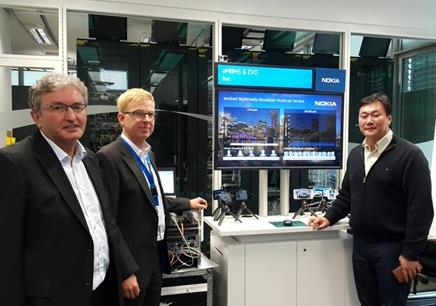
The technology demonstration was conducted at the Nokia Research Lab in Munich, Germany, by transmitting HD camera video to a smartphone and checking the time required for playback. The demonstration was successful as it took less than 1 second from camera video input to smartphone playback.
Also,'Ultra-low latency eMBMS' has laid the foundation to provide ultra-high-definition content more quickly in the upcoming 5G era by applying Mobile Edge Computing technology, which places local cloud servers at base stations to reduce the latency of requesting and receiving services, thereby providing customers with seamless and optimized services.
'Ultra-low latency eMBMS' can be utilized in various fields, such as rapid video transmission in spaces where many users gather, like the PyeongChang Winter Olympics and performance venues, and remote video transmission in disaster situations. It is also expected to be used in future 5G services that require fast response speeds, such as autonomous vehicles and intelligent transportation networks.
KT, which has opened a 5G R&D center and led the development of 5G technologies such as millimeter wave, Massive MIMO, D2D, and dual connectivity, as well as next-generation LTE technologies, has laid the foundation to gain an advantage in LTE quality competition and the development of next-generation 5G wireless technologies to be introduced in the future by successfully demonstrating 'ultra-low latency eMBMS' for the first time in the world.
Lee Dong-myeon, President of KT Convergence Technology Institute, said, “Through the successful demonstration of this ‘ultra-low latency eMBMS,’ we have laid the foundation for providing ultra-low latency services, a key element of the 5G era.” He added, “Going forward, we will strive to accelerate the 5G era and lead 5G technology development by applying this technology across various fields.”
Comments
Related news
LG Uplus applies virtualization technology to VoLTE
LG U+ (Executive Vice President Lee Sang-chul / www.uplus.co.kr) announced on the 2nd that it has successfully demonstrated the application of NFV (Network Function Virtualization) technology to VoLTE commercial networks for the first time in Korea to enable rapid adoption of new VoLTE services. The commercialization test involves NFV-based vCSCF (virtualization Call Session Control Function) and vSPGW (virtualization Serving and PDN Gateway) technologies operating in conjunction with existing commercial network equipment, through which services previously provided by existing networks such as VoLTE and HD video calling are delivered in a virtualized environment.
2015.08.07by 명세환 기자
[Reporter's Notebook] Why Did KT Chairman Hwang Chang-kyu Take Two Devices Out of His Pocket?
Chairman Hwang revealed a plan to build an 'Intelligent GiGA Infra' based on differentiated technological capabilities to respond to revolutionary changes that will occur in industry and daily life based on ICT. The Intelligent GiGA Infra aims to provide greater value to users by combining with cutting-edge control systems, cloud, and big data, and made a surprise announcement of investing 13 trillion won by 2020 in the Intelligent GiGA Infra and future growth businesses.
2015.09.25by 신윤오 기자

KT, LG Electronics' Ambitious 'LG V10' Launches on the 8th!
KT announced that it will launch LG Electronics' flagship model 'LG V10' starting from the 8th. The 'LG V10', first unveiled on the 1st, features a high-performance dual selfie camera, secondary screen functionality, and enhanced durability.
2015.10.07by 명세환 기자
ESP32 Development Environment Selection and GPS Application Implementation
The ESP32 is a microcontroller that integrates Wi-Fi, Bluetooth, 12-bit ADC, capacitive touch, PWM, DAC, and UART in a single SoC. However, the abundance of features does not by itself solve the designer's problems. The real challenges lie in selecting the appropriate development environment, determining which pins can be used and which must be avoided, and converting raw data from modules into usable information. This document addresses ESP32 peripheral constraints (ADC2 and Wi-Fi coexistence limitation, UART1 occupancy, ADC non-linear regions), the trade-offs between Arduino IDE and ESP-IDF, and the process from connecting NEO-6M/NEO-M8N GPS modules to UART2, parsing NMEA sentences, and visualizing routes in Google Earth, all organized based on documented references.
2026.10.12by 편집부
MIPI CSI-2, DSI-2, C-PHY, D-PHY Test Solution Technical White Paper
The MIPI interface adopts a burst mode that transitions between low-power (LP) and high-speed (HS) states for low-power consumption, and in return, strict timing rules are imposed on state transitions. Additionally, the high-speed section operates as a packet-based protocol with headers, ECC, and CRC, so verification engineers must handle waveforms and protocols simultaneously. Traditional configurations combining general-purpose oscilloscopes and AWGs reveal limitations in setup complexity, measurement uncertainty, and lack of reproducibility when faced with these requirements. This white paper, based on webinar materials, organizes the structure of this problem and describes how the SV5C-DPTXCPTX generator for receiver testing and SV5C-DPRXCPRX analyzer for transmitter testing integrate state transition testing, stressed eye testing, and protocol analysis into a single bench, along with their application boundaries.
2026.10.12by 편집부











