



[Planning] The Brain of Electronic Devices, Visiting MCU Companies ① Freescale, Automotive MCU Security ‘We Take Responsibility’
 Published2015.11.30 11:56
E4ds News visits major semiconductor companies that focus on MCU (Micro Controller Unit), which is called the brain of various electronic products. As MCUs are being used in a wider range of applications from simple electronic devices to automobiles and robots in the IoT era, their high performance and low power performance are being strengthened. Accordingly, we will intensively introduce the functions and features of various MCU products and, through interviews with these major MCU companies, examine the technologies and trends that each company focuses on to help readers choose products. <Editor's Note>
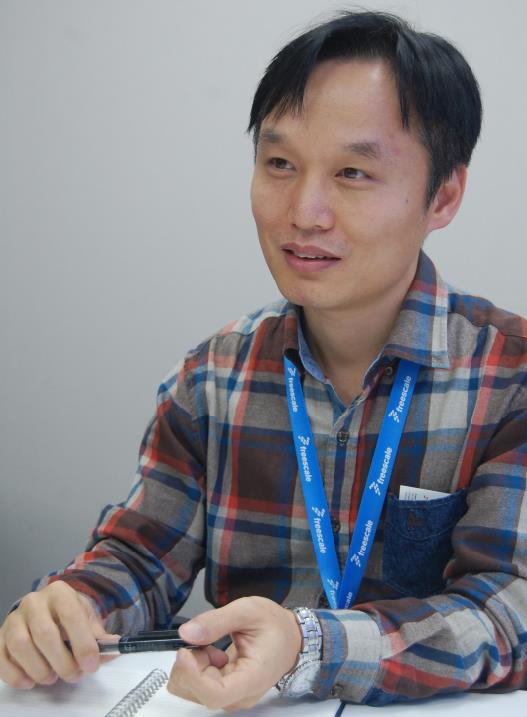
[Interview / Reporter Shin Yun-oh, Reporter Kim Su-jin] The first company in 'Going to MCU Companies' is Freescale Semiconductor, famous for its automotive MCUs. We introduce Freescale products that especially emphasize automotive security, which is directly related to life. The interview was conducted with Lee Jin-woo (pictured), a manager in charge of automotive MCUs at Freescale Semiconductor. (※Notice: Since the interview took place before the final merger announcement with NXP, we would like to inform you in advance that the company name is written as Freescale Semiconductor.)
 -Freescale is famous for its automotive MCU products. First, let me introduce Freescale’s main MCU products used in automobiles.
Freescale's areas of focus include car-to-car or car-to-thing networks, collecting the surrounding environment using radar image sensors, audio amplifiers, infotainment, clusters, and powertrains.
I.MX processors and MPC5748G are widely used in infotainment, audio amplifiers, and V2V, V2I. The MPC5748G provides a wide range of peripherals for networking communications with a high level of integration for low power, safety support, and security features.
Additionally, I.MX is a Freescale series that integrates one, two or four ARM Cortex-A9 cores, providing solutions that combine performance, optimized power consumption and scalability. Powertrain and radar applications include the MPC57xxK product, which is specifically designed for automotive radar systems and boasts high-performance analog integration and performance for next-generation ADAS.
Applied to Front Vision ADAS to implement around view, S32V meets the security hardware extension regulations presented by various automobile manufacturers with secure boot, network-grade encryption engine, and security key function.
“Freescale is looking into the future of driverless cars with the keyword Automovie-IoT. At the same time, we are consistently working to respond to the high-bandwidth networks, improved data security, functional safety implementation, and reduced energy consumption that the automotive industry is facing,” said Vice President Lee. We asked him in detail about Freescale’s consistent efforts and the differentiation of Freescale MCUs.
Vision ADAS, from images to safety
-As functional elements for safety, such as ADAS, are emphasized, safety elements are also added to MCUs.
Freescale aims to reduce uncertainty risk through 'Functional safety'. This is because random faults and fixed faults must be eliminated to create a safe system. This is also something that OEMs continue to emphasize. In the case of Vision ADAS, we focus on not only showing images but also increasing safety. Currently, the entire system is built using one processor for vision and another MCU for 'functional safety'. The next generation product will combine the two.
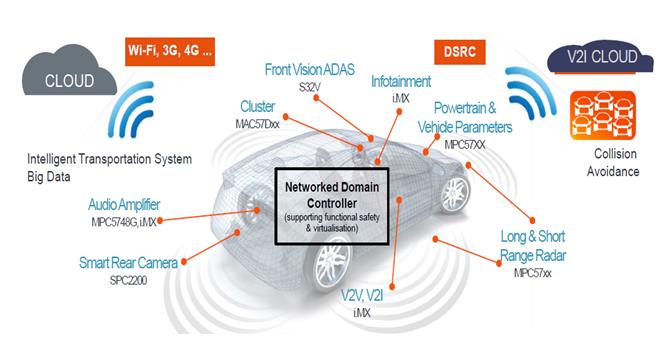
▲Major automotive sectors where Freescale MCUs are applied.
-It seems that MCUs are ultimately focused on self-driving cars. How is Freescale responding to this?
Safety is the top priority in self-driving cars, but basic technologies are also needed. This is the network inside the vehicle and the network outside the vehicle. It is necessary to route data from the external environment collected by the image sensor and analyze how to match the speed. However, since data from the user's vehicle alone is not enough, it is necessary to communicate with an external DB to find the optimized value. To do this, V2C, or communication between the vehicle and the cloud, is important. This is where safety issues come into play. If the security of collected or transmitted data is breached or hacked, it is obvious that it will lead to a serious accident that threatens life. Accordingly, Freescale has been focusing on security and supporting appropriate technologies.
-So what is the core of Freescale’s security solution technology?
Secure wireless connections can be implemented over Ethernet vehicle networks with the I.MAX processor and the 'MPC5748G' MCU for gateways. Conceptually, VPN is supposed to be able to securely communicate point-to-point, but in reality, the Transport Layer, which is the middle layer, has the weakest security. That's why it must be used through Transport Layer security protocols such as TLS, DTLS, or SSH.
Hardware module security that protects important data
-How is strong security applied to the transport layer?
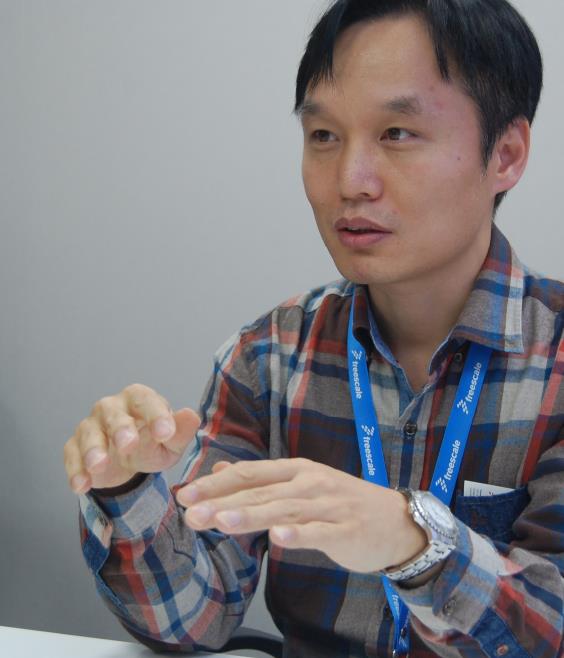
In communication between vehicles and clouds, security must be implemented at the transport layer, and inside the vehicle, security must be implemented at the network layer. Therefore, domains must be divided and distinguished within the vehicle (the gateway divides into external and internal domains, and inside the vehicle, it divides into secure and normal domains).
The secure domain is responsible for storing keys and encryption, while the normal domain is responsible for connectivity applications and routing to protect important data. Freescale supports both forms, with the 'Trust Zone' portion having CSE/HSM hardware module security.
" Freescale's strengths in the automotive sector are its diverse portfolio and its status as a global company. In the future, Freescale Semiconductor will continue to develop technologies that are important in the autonomous vehicle sector, such as high-end gateways, audio amplifiers, radar, and vision."
-Can you explain specifically about Freescale's CSE module?
There are currently two international security standards. There is SHE and EVITA under the HIS organization, and CSE is the world's first security structure that standardizes SHE and has been incorporated into MCU.
In other words, the CSE module is embedded in the MCU. It is mainly embedded in high-performance 32-bit MCUs, which indicates that security is becoming important in general aspects. The two functions are encryption (AES) and random number generation (RNG). Standards can vary depending on OEM choice, with SHE already standardized by several German companies, but the EU still has two competing standards (SHE and EVITA).
- What are the differences between Freescale’s security characteristics and those of other companies?
When we make MCUs, we don't make them because we think, 'This is what we need.' We make MCUs through discussions with global Tier 1s or OEMs to create devices that meet customer needs. In the case of other companies, there are limits to how much they can lower the price because they add security to existing devices. However, only Freescale has security products for low-end products. Freescale has been consistently developing technology in the security sector, so it has been able to make products without raising costs.
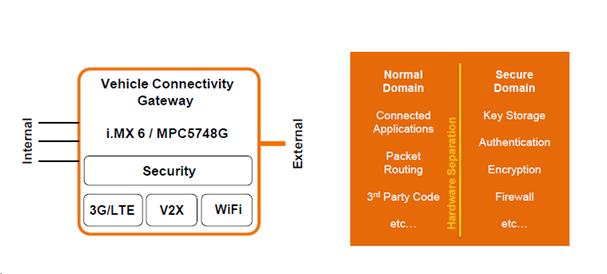
▲Security has been enhanced by dividing the gateway into external and internal domains, and supporting secure and normal domains inside the vehicle.
Applying security even to low-end gateways
- How does Freescale plan to strengthen security features in the future?
Security is absent from the automotive chassis sector, but MCUs are being applied to gateways, powertrains, and low-end bodies. While other companies focus on security only on high-end gateways, Freescale focuses on the low end as well as the high end. Therefore, Freescale’s solution is suitable for each internal issue between gateways and infrastructure.
- Lastly, what is Freescale’s development direction in the automotive field?
Freescale's strengths are its diverse portfolio in the automotive space and its global presence. Going forward, Freescale Semiconductor will continue to develop high-end gateways, audio amplifiers, radar, vision and other technologies important for autonomous vehicles.
[Freescale's main MCU related products]
1. S32V vision processor boasting sensor fusion function
Implementing collision avoidance vehicles presents a new framework for safety systems
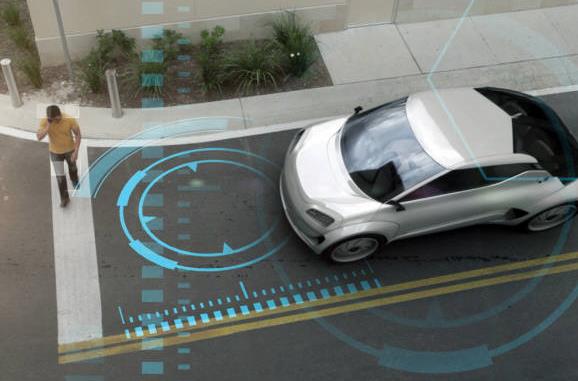
Freescale’s automotive vision system-on-chip (SoC), the S32V vision microprocessor, delivers the reliability, safety and security features needed to automate self-aware vehicles and make “co-driving” a reality.
The S32V breaks away from the current “assistive” technology mold that focuses on driver convenience, and leverages technology that complies with a variety of automotive standards to enable cars to collect and process data and actually take control of the vehicle alongside the driver when faced with a hazardous situation. This is a necessary intermediate step to progress from today's "assisted" technology to the fully autonomous vehicles of the future.
The S32V microprocessor is built with Freescale’s SafeAssure functional safety program in mind and is structurally designed to meet rigorous ISO 26262 functional safety standards, while also being engineered to automotive quality standards measured in parts per billion (ppb). This reliability is backed by the superior performance-to-power ratio of second-generation CogniVue APEX image recognition processing technology and the ability to combine the vision data captured by the S32V device with multiple other data streams, including radar, LiDAR and ultrasonic information, to achieve optimal resolution and image recognition accuracy.
2. Tire pressure monitoring system for trucks
Advanced data analytics for safe vehicle management and IoT applications
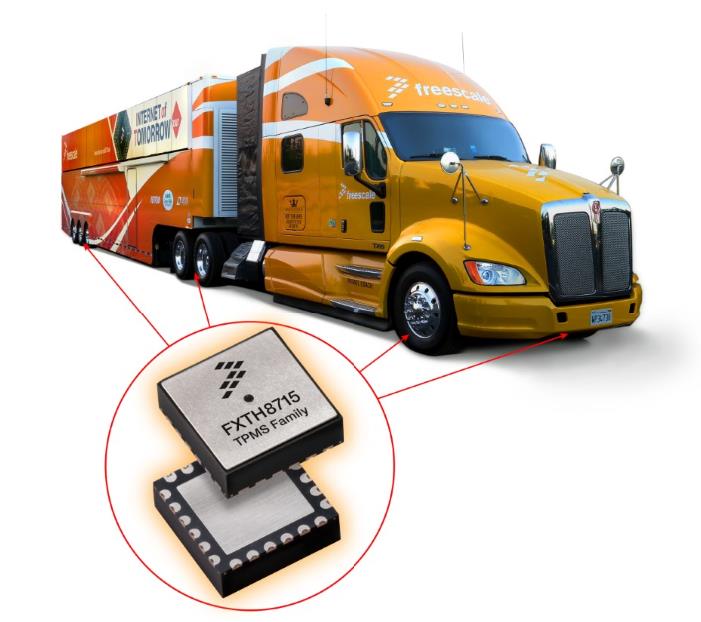
Freescale Semiconductor has successfully completed its tire pressure monitoring system (TPMS) portfolio with the announcement of the FXTH8715 family of products for trucks and heavy vehicles, which is the industry’s smallest integrated package and highest accuracy.
This ultra-compact solution consists of a dual-axis accelerometer, motion sensor, RF transmitter, LF receiver, pressure and temperature sensor, and microcontroller, all housed in a 7 x 7 mm package. In addition to excellent accuracy, the solution can collect and transmit pressure, temperature, and acceleration values. This enables sophisticated analytics that can improve safe vehicle management and turn tire pressure sensing systems into end nodes that add future value.
“Freescale’s new FXTH8715 family of products takes tire pressure monitoring to a new level by capturing and transmitting actionable sensor data that helps transportation managers monitor tire pressure, track driver behavior, and optimize predictive maintenance,” said Babak Taheri, general manager of Freescale’s sensor solutions business unit. “Combining these capabilities allows transportation companies to optimize vehicle utilization and reduce downtime.”
The FXTH8715 system's integrated MCU and dedicated firmware support up to 8KB of flash memory, expanding application flexibility, accelerating time to market, and supporting rolling encryption for a more secure solution.
Comments
Related news
[Planning] MCU Company Tour ② Infineon: Will it Power Self-Driving Cars with High-Performance MCUs?
E4ds News seeks out major semiconductor companies specializing in MCUs (Micro Controller Units), known as the brains of various electronic products. As the scope of MCU applications expands from simple electronic devices to automobiles and robots in the IoT era, high-performance and low-power capabilities are increasingly being strengthened. Accordingly, we aim to intensively introduce the functions and features of various MCU products and, through coverage of major MCU manufacturers, examine the technologies and trends each company prioritizes to assist readers in their product selection. <Editor's Note>
2015.12.07by 신윤오 기자

Freescale's ultra-thin Kinetis MCUs take device form factor to another level
December 4, 2015, Seoul, Korea - Freescale Semiconductor (www.freescale.co.kr, CEO Yeon-ho Hwang) announced the ultra-thin Kinetis K22 microcontroller (MCU) that integrates 120MHz performance, extensive memory, and interfaces in a package with a height of 0.34mm. This device is well-suited for applications such as chip-and-PIN credit cards, wearable devices, and consumer electronics where security and compact form factor are essential.
2015.12.07by
[Planning] Visiting MCU Companies ③ TI, If you need an MCU that is strong in low power and real-time operations…
The third company in 'Visiting MCU Enterprises' is Texas Instruments, or TI, which has begun to distinguish itself in the automotive sector. Above all, readers must have been curious about what synergy effects TI, known as a powerhouse in DSP chips, creates with MCUs. Through Director Ryu Seung-yun (photo), who oversees MCU technical support at TI, this will be an opportunity to learn everything about TI MCUs and the development kits available for developers.
2015.12.14by 신윤오 기자

[e4ds Tech Day 2026 ⑨] Sim Sang-gyu, Autocrypt CTO: "In the Physical AI Era, Automotive Security Must Extend Beyond the Vehicle"
At e4ds Tech Day 2026, Sim Sang-gyu, CTO of Autocrypt, explained automotive cybersecurity strategies in the era of Physical AI and SDV (Software-Defined Vehicle). Automobiles are evolving as part of an ecosystem connected to AI, cloud, chargers, IoT, and robots, and he emphasized that the scope of security must expand beyond the vehicle interior to the entire connected environment. In particular, AI model tampering, adversarial attacks, OTA updates, and EV charger hacking were identified as major threats. He explained that response measures require zero trust, AI model integrity protection, intrusion detection, Security by Design and Default, and full lifecycle security management, and that proactive security system establishment beyond regulatory compliance is critical for securing future mobility competitiveness.
2026.10.12by 배종인 기자

Practical HIL Construction Strategy for Automotive and Off-Highway Controller Validation
As vehicle E/E architecture transitions to zonal structures and shifts to software-defined vehicles (SDV), the number of controllers (ECUs) requiring validation and software complexity are surging dramatically. Meanwhile, real vehicle testing cannot provide repeated verification under identical conditions and entails lead time and safety concerns. This white paper explains the principles of HIL (Hardware-in-the-Loop) validation and the structure of the NI platform composed of PXI, SLSC, and VeriStand, and through two actual implementation cases—Camera Record & Replay HIL for In-Cabin Monitoring Controller (ICMU) and Forklift Controller (VCU) HILS—describes how controller-level regression testing becomes possible. Additionally, it explicitly states application boundaries and limitations, such as lack of A2B support.
2026.10.12by 편집부











