


10 selected, including fintech and the Internet of Things, as part of the 4th Industrial Revolution based on ICT convergence.
 Published2015.12.08 11:23
KT (Chairman Hwang Chang-gyu) announced that it will publish '10 Key ICT Trends Changing Korea in 2016', which examines the key keywords of the 4th Industrial Revolution that will transform the future.
The 10 ICT trend topics selected by the KT Economic and Management Research Institute are the latest global trends and evolutionary directions in representative fields of ICT convergence, including fintech, smart healthcare, smart energy, self-driving cars, smart media, the Internet of Things (IoT), big data, smart privacy, and the direction of manufacturing and network evolution in the convergence era.
Following the 1st, 2nd, and 3rd industrial revolutions triggered by steam engines, electricity, and computers, the 4th industrial revolution is emerging based on the convergence of ICT. As a representative example, the theme of the 2016 Davos Forum, attended by major political, economic, and cultural leaders, was selected as ‘Mastering the Fourth Industrial Revolution.’
Amidst this trend, the KT Economic and Management Research Institute presented market analysis and outlook for each ICT convergence field, along with a wealth of case studies, to enhance understanding of related industries and emphasize the role of ICT convergence in economic and social development.
Focus on the transformation of the financial market through fintech and the emergence of smart healthcare.
Specifically, in the 'Fintech' field, new financial market changes combined with ICT technologies were introduced, such as the big data-based loan screening evaluation introduced by the British fintech company 'Visual DNA'.
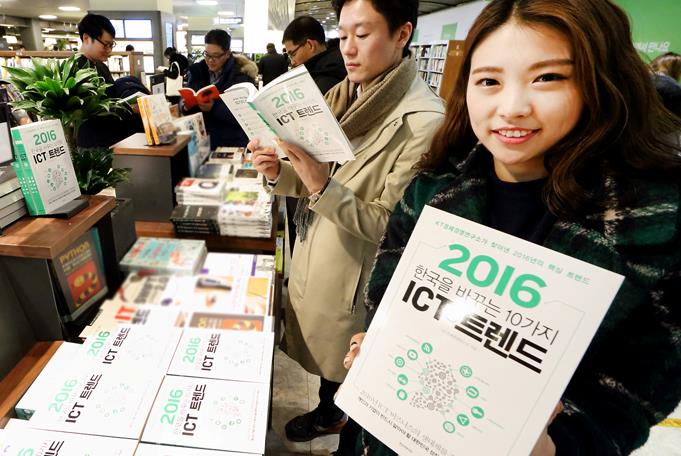
We also analyzed market changes that have led to competition for new financial business models, including the fintech market entry strategies of global ICT companies such as Google, Apple, and Samsung. 'Smart Healthcare' focuses on the shift in the medical paradigm from treatment to prevention through smart health in a time of increasing aging and chronic diseases.
We introduced recent trends, including the fierce competition for smart healthcare platforms and the emergence of various wearable devices, and predicted the future direction of industry evolution.
Presenting implications for ICT changes, including overseas examples of smart energy and big data.
"Smart Media" covered the global market competition and future evolution of OTT, a highly anticipated segment. It also presented the future prospects for VR, which makes virtual spaces feel real; AR, which integrates virtual environments into the real world; and digital signage, which is emerging as a digital target marketing terminal. Finally, in the "Internet of Things (IoT)," a field attracting significant attention across various industries, the report analyzed the competitiveness strategies of global companies and countries and highlighted the changing lifestyles they are driving.
Big data is recognized as a key convergence technology that enhances quality of life through personalized services and improves efficiency in businesses and the public sector. We analyzed the impact of big data across diverse industries, including services, manufacturing, healthcare, and sports. Furthermore, to further expand the benefits of big data, we analyzed social issues such as privacy violations and proposed measures to create a "smart privacy" environment.
In the case of 'manufacturing,' a revolution in production methods is taking place through convergence with ICT, establishing itself as a new growth engine. Accordingly, we analyzed the direction of ICT and manufacturing convergence initiatives being pursued in major countries, including Germany's "Industry 4.0," and derived implications. Finally, we proposed the need for a balanced network policy driven by the mutually beneficial development of ICT, which serves as the foundation for expanding ICT convergence and building future networks.
Park Dae-soo, director of the KT Economic and Management Research Institute, said, “I hope that the 10 ICT trends that will change Korea in 2016 will serve as a foundation for promoting ICT convergence in the 5G era.” He added, “If all citizens become more interested in the changing trends in ICT convergence, I expect that our country will be able to leap from a global ICT powerhouse to ‘ICT Convergence Korea’ and lead the 4th Industrial Revolution.”
10 Key ICT Trends Transforming Korea in 2016
-Fintech
-Smart healthcare
-Smart Energy
-Driverless cars
-Smart Media
-Internet of Things (IoT)
-Big data
-Smart Privacy
-Manufacturing in the age of convergence
-ICT convergence toward network evolution

Comments
Related news

ICT exports in June increased for the second consecutive month driven by strong performance in mobile phones and semiconductors.
The Ministry of Trade, Industry and Energy announced that exports of key products such as mobile phones and system semiconductors increased despite difficult conditions including global ICT market contraction and worsening trade conditions. ICT exports increased slightly for two consecutive months (May 2.0%, June 0.2%). By product category, mobile phones (2.25 billion dollars, ↑19.4%), semiconductors (5.31 billion dollars, ↑3.0%), and computers and peripherals (580 million dollars, ↑6.9%) increased, while display panels (2.06 billion dollars, ↓12.7%) and digital televisions (hereafter 'D-TV' / 360 million dollars, ↓36.0%) decreased. Mobile phones recorded double-digit growth for two consecutive months (↑19.4%) due to increased exports of strategic smartphones from domestic companies (Galaxy S6, G4) and components such as mobile processors (AP). By product category, smartphones increased 31.9% to 960 million dollars, and components increased 12.3% to 1.27 billion dollars.
2015.07.20by 명세환 기자

In 2019, ICT spending in manufacturing, energy, and public sectors reached 206.51 billion euros.
As information and communication technology (ICT) is being implemented in the manufacturing industry, it has recently limited sporadic use of M2M communications and cloud solutions. However, cloud adoption is important for developing fully automated factories, particularly for critical processes, cybersecurity efforts, and implementing advanced robotics and artificial intelligence. Accordingly, strong long-term possibilities in the industrial automation sector are emerging from IT service providers, telecommunications equipment suppliers, fixed network providers, and wireless network providers.
2015.09.04by 명세환 기자

The Future Can Be Seen by Looking at the Top 10 Issues in the ICT Industry of 2016
According to a report released by the Information and Communications Technology Promotion Center (IITP), the top 10 ICT industry issues in 2016 were identified as IoT (Internet of Things), automobiles, mobile, drones, artificial intelligence, robotics, China, batteries, and healthcare.
2015.10.06by 신윤오 기자
Nvidia invests $5 billion in Intel
NVIDIA and Intel, leaders in global AI computing technology, are now forging ahead in providing cutting-edge solutions through NVLink-based architecture integration. NVIDIA and Intel have officially announced a strategic partnership and stated that they will jointly develop customized data center and personal computing products to accelerate diverse applications and workloads ranging from hyperscale to enterprise and consumer markets, thereby laying the foundation for the next generation computing era.
2025.09.22by 배종인 기자
.jpg)
Applied Materials Launches Environmental Protection Campaign to Mark World Cleanup Day
Applied Materials Korea (CEO Park Kwang-seon) is carrying out environmental cleanup activities with employees and their families around the Dongtan Sinricheon area on the occasion of World Cleanup Day, evolving into a company that engages with the local community beyond technological innovation.
2025.09.22by 명세환 기자











