



[Planning] Going to MCU Companies ④ Renesas (1), “The Secret to Being No. 1 in the World MCU Market is Low-Power, High-Performance Proprietary Technology”
 Published2015.12.21 17:51
[Interview / Reporter Shin Yun-oh, Reporter Kim Su-jin] 'Going to MCU Companies' introduces Renesas, the absolute powerhouse that is number one in the global MCU market (according to 2014 Gartner statistics). Renesas, which accounts for nearly 40% of the global automotive MCU market, supplies MCU products specialized for applications to the extent that it divides its business headquarters by sector. Since its product line is largely divided into its first business, Automotive, and its second business, GP (General Purpose), and it has a diverse product lineup, Renesas MCUs will be introduced separately by ①GP and ②Automotive. Accordingly, in order to learn about Renesas GP, which aims to be a leader in IoT development, for the first Renesas MCU, we met with Manager Min Hyun-jin (pictured), who is in charge of GP MCUs.
■Please briefly introduce Renesas' consumer (GP) MCU.
Renesas MCU conducts business in two major areas. Due to the nature of MCU, there are parts where product technology is shared, but it is divided into Automotive and GP (General Purpose). What I will introduce is GP, which is called General Purpose, and refers to consumer MCUs that are widely used in home appliances that we commonly use in our daily lives.
■The main fields of consumer MCUs are.
The main market is the general consumer sector, such as home appliances. There are some products that are supplied to the industrial sector, but the Korean market is dominated by large corporations, so it is not a main sector. Representative GP product lines include the low-end 'RL78' and the mid-high-end 'RX' product lines.
■First, please explain the low-end 'RL78' MCU. What competitive edge does it have compared to other companies?
The competitiveness of Renesas MCU 'RL78' is threefold. First is 'ultra-low power consumption'. 'RL' in 'RL78' stands for 'Renesas low power'. In a past demonstration, two lemons were inserted and the MCU was powered without power supply only by the acidity of the lemons, which is an advantage of low power consumption.
The second is that the product is diverse and has a wide lineup. In the existing 8-bit market, there was no flash memory larger than 128KB, so we had to review other series of products. However, now, with 16-bit flash memory up to 512KB pin-to-pin, we can cover a wide range of fields. We have made it possible to expand by developing only one product. Lastly, it has high price competitiveness compared to its performance.
In Run, Halt and Stop modes
Lowest power consumption compared to other companies

Min showed a graph of power consumption by mode compared to other companies and said, “Run mode is performed with the lowest power. In the case of the Halt mode, while other companies are able to use more than 1 micro-amp, Renesas can use 0.58 micro-amp.”
He also explained, “Even though the safety function is activated in the stop mode when the CPU is stopped, it was measured to be the lowest among other companies at 0.49 microamperes.”
■What is the difference between Holt mode and Standby mode?
Halt mode is a state where the device wakes up immediately from standby mode. If you want to reduce power consumption when the clock is alive and the MCU is not operating, it becomes stop mode. Previously, it started normal operation in standby mode, but it has implemented low power consumption by adding a 'Snooze Mode' before standby mode.
■What exactly is the ‘SNOOZE MODE’ technology?
For products that use batteries, wake-up is required in stop mode and standby mode. However, if external noise or inaccurate data is used, unnecessary wake-ups consume power. To reduce this power consumption, the snooze mode was developed. When data comes in during stop mode through A/D conversion or UART while the CPU is stopped, it first determines whether the data is necessary. Then, it decides whether to operate or not, thereby reducing unnecessary power consumption.
Determines whether the CPU is operating by judging data reception errors
Even a small amount of power waste is not tolerated through snooze mode.
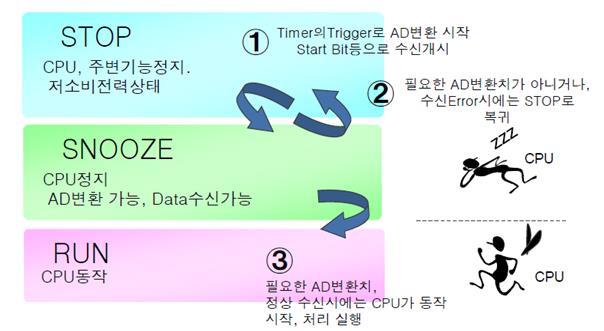
▲SOOZE MODE, A/D conversion and data reception are possible while the CPU is stopped, so it determines whether the CPU is operating.
■It sounds like Renesas's unique low-power technology, like snooze mode, is its strength.
Yes, we can say that there are two ways to implement low power in Renesas. First of all, the Renesas CPU itself is 'low power' and as an additional feature, the snooze mode has been independently developed. Even low-end MCUs usually consume a lot of power without knowing it if they do not have this special feature. In the case of remote controls that operate on batteries, if the CPU operates due to external noise in standby mode, the power consumption increases accordingly. In particular, the snooze mode technology was developed to prevent power consumption due to noise from lighting.
■Low power performance does not guarantee MCU performance.
'Low power' can be thought of as lower performance if you think about it the other way around. However, Renesas has achieved both low power and high performance. When using a battery, the battery's normal voltage is around 1.8V. 1.8V is the voltage at which A/D is converted, but Renesas has made it possible to maintain high performance even at 1.6V.
■Safety is also an important factor in MCU, how does 'RL78' deal with it?
Recently, the home appliance and industrial fields also demand 'ICE 60730', which verifies hardware functions and enhances the safety of MCUs. Renesas has improved the stability of hardware-based MCUs. By checking the Flash ROM with the CRC function, you can confirm whether the contents are normal, and by measuring the 15KHz built-in oscillator from the main clock, you can confirm whether the frequency is operating correctly.

“I think Renesas chip performance is competitive with low power and high performance differentiation. The next task to be solved is to provide developers with a convenient development environment to shorten the development time.”
High performance and low power consumption through development of our own CPU, ‘RXv2 Core’
The 'FPU' built into the CPU also contributes to improved performance.
■ Please introduce the 'RX' product line.
RX is a 32-bit MCU that provides products from low-end to high-end. As with the 'RL78' explained above, we pursued high performance of the CPU to implement low power consumption and wide operating range. This is because MCUs have become more high performance due to the high added value of devices and system complexity, and the demand for low power consumption to extend battery operating time has increased.
The RX CPU previously had the RXv1 Core, but recently its performance has been improved to the RXv2 Core. Before changing to V2, it only outputted 165 MIPS at 100MHz, but now it measures about twice as many MIPS. In other words, this means that the performance of third-party products using 200MHz and Renesas products using 100MHz are similar.
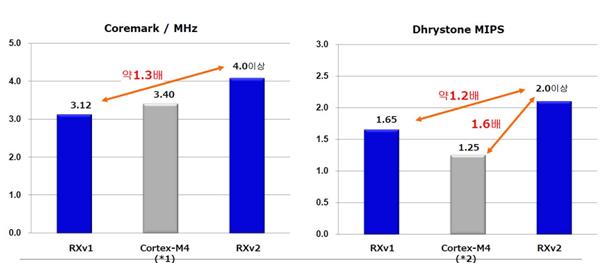
▲Performance comparison between Renesas’ RXv2 core and Cortex M4.
■Third party products mainly use ARM cores, so is there a reason why Renesas insists on its own core?
Renesas has a core technology with proven reliability, performance, and power consumption through its long-standing know-how in the MCU field, and based on this, it maintains its No. 1 position in the MCU field.
■It is said that the 'FPU' built into the CPU greatly contributes to improving performance, but what design benefits does it actually have?
'FPU' refers to a floating operation built into the CPU separately so that DSP functions can be used efficiently on motors. Using FPU contributes to improved performance by reducing clock cycles by approximately 84% and PI control by approximately 78%. It can also reduce code size by approximately 30%.
■I understand that you are also very interested in the u-health field. Please tell me about the progress.
Solutions in the health field were mainly showcased at exhibitions. Demonstrations were held, such as transmitting information through gateways. Introducing solutions that link with Bluetooth, energy devices, and PCs.
■Recently, there has been an increase in customers demanding a diverse and convenient development environment. What are the characteristics of Renesas’ development environment?
Usually, when developing a motor based on a kit, there is a disadvantage that the tuning work takes too long. However, by using the Renesas motor solution, you can obtain the tuning value at once by connecting it to the board, reducing the development time by about 70%. In the future, we will strengthen the development environment such as Realboard so that even customers with little development experience can easily access it. Another development environment is the touch IP solution. When developing a touch product, tuning is easily completed with a few clicks without having to configure the firmware as before. Since this solution can also be automated in the production line, anyone can easily develop and make good products.
■I am curious about GP’s future development direction and roadmap.
I think Renesas chip performance has some level of competitiveness due to its differentiation in low power and high performance. The next task to be addressed is to focus on shortening development time by providing developers with a convenient development environment.
※What kind of company is Renesas?
Born in 2010 through the integration of Renesas and NEC Electronics
Boasting a wide product lineup in addition to the world's top-class MCU
Renesas Electronics Corporation (English: Renesas Electronics Corporation) is the largest integrated semiconductor manufacturer in Japan, headquartered in Japan. It was established in April 2010 as a result of the management integration of Renesas Technologies, spun off from Mitsubishi and Hitachi, and NEC Electronics, spun off from NEC.
The company name 'Renesas' is an abbreviation for " Renaissance Semiconductor for Advanced Solutions ", which realizes the advancement of semiconductors applied to all systems worldwide, and includes the meaning of revitalizing the semiconductor industry from Japan to the world. Renesas Electronics Corporation has a wide product lineup centered around microcontrollers that boast the world's top-class market share. Its main fields are automotive, industrial/home appliance, and OA/ICT, and it provides optimal services with increased added value through three types of semiconductor solutions: devices, kits, and platforms.
Comments
Related news
[Planning] The Brain of Electronic Devices, Visiting MCU Companies ① Freescale, Automotive MCU Security ‘We Take Responsibility’
As the first company in 'Visiting MCU Enterprises,' we introduce Freescale Semiconductor, renowned for its automotive MCUs. We present Freescale products that feature MCUs with particular emphasis on automotive security, which is directly linked to human safety. The interview was conducted with Director Lee Jin-woo, who oversees automotive MCUs at Freescale Semiconductor.
2015.11.30by 신윤오 기자
[Planning] MCU Company Tour ② Infineon: Will it Power Self-Driving Cars with High-Performance MCUs?
E4ds News seeks out major semiconductor companies specializing in MCUs (Micro Controller Units), known as the brains of various electronic products. As the scope of MCU applications expands from simple electronic devices to automobiles and robots in the IoT era, high-performance and low-power capabilities are increasingly being strengthened. Accordingly, we aim to intensively introduce the functions and features of various MCU products and, through coverage of major MCU manufacturers, examine the technologies and trends each company prioritizes to assist readers in their product selection. <Editor's Note>
2015.12.07by 신윤오 기자
[Planning] Visiting MCU Companies ③ TI, If you need an MCU that is strong in low power and real-time operations…
The third company in 'Visiting MCU Enterprises' is Texas Instruments, or TI, which has begun to distinguish itself in the automotive sector. Above all, readers must have been curious about what synergy effects TI, known as a powerhouse in DSP chips, creates with MCUs. Through Director Ryu Seung-yun (photo), who oversees MCU technical support at TI, this will be an opportunity to learn everything about TI MCUs and the development kits available for developers.
2015.12.14by 신윤오 기자

[e4ds Tech Day 2026 ⑨] Sim Sang-gyu, Autocrypt CTO: "In the Physical AI Era, Automotive Security Must Extend Beyond the Vehicle"
At e4ds Tech Day 2026, Sim Sang-gyu, CTO of Autocrypt, explained automotive cybersecurity strategies in the era of Physical AI and SDV (Software-Defined Vehicle). Automobiles are evolving as part of an ecosystem connected to AI, cloud, chargers, IoT, and robots, and he emphasized that the scope of security must expand beyond the vehicle interior to the entire connected environment. In particular, AI model tampering, adversarial attacks, OTA updates, and EV charger hacking were identified as major threats. He explained that response measures require zero trust, AI model integrity protection, intrusion detection, Security by Design and Default, and full lifecycle security management, and that proactive security system establishment beyond regulatory compliance is critical for securing future mobility competitiveness.
2026.10.12by 배종인 기자

Practical HIL Construction Strategy for Automotive and Off-Highway Controller Validation
As vehicle E/E architecture transitions to zonal structures and shifts to software-defined vehicles (SDV), the number of controllers (ECUs) requiring validation and software complexity are surging dramatically. Meanwhile, real vehicle testing cannot provide repeated verification under identical conditions and entails lead time and safety concerns. This white paper explains the principles of HIL (Hardware-in-the-Loop) validation and the structure of the NI platform composed of PXI, SLSC, and VeriStand, and through two actual implementation cases—Camera Record & Replay HIL for In-Cabin Monitoring Controller (ICMU) and Forklift Controller (VCU) HILS—describes how controller-level regression testing becomes possible. Additionally, it explicitly states application boundaries and limitations, such as lack of A2B support.
2026.10.12by 편집부











