


[Feature] Visiting MCU Companies ⑥ Microchip: “Development Boards Will Be an Excellent Starting Point for IoT Design”
 Published2016.01.25 14:11
Supports PIC MCUs with built-in Core Independent Peripherals (CIP).
E4ds News visits major semiconductor companies specializing in Micro Controller Units (MCUs), often referred to as the "brains" of various electronic products. As the applications of MCUs expand from simple electronic devices to automobiles and robots in the IoT era, their high-performance and low-power capabilities are becoming increasingly enhanced. Accordingly, we aim to assist readers in their product selection by focusing on the functions and features of various MCU products and examining the technologies and trends emphasized by these leading companies through interviews. <Editor's Note>
This edition of 'Visiting MCU Companies' introduces Microchip Technology Inc., a traditional powerhouse in the MCU market. Microchip is a global specialist in microcontroller, mixed-signal, analog, and flash IP solutions, providing a wide range of customer applications that enable lower product development risk, lower overall system costs, and faster time-to-market. We will learn more about this through an interview with Wayne Freeman , Product Marketing Manager of Microchip's MCU8 division.
 Recently, the availability of development boards has become an important factor in customers' MCU selection. What differentiating features do Microchip MCU development boards have compared to competitor products?
The Curiosity development board, PICDEM™ Lab II, and Explorer 8 development board are all designed to meet the needs of engineers developing with Microchip's 8-bit PIC microcontroller (MCU) family.
Above all, these three boards were developed to support Microchip's latest PIC MCU family with embedded Core Independent Peripherals (CIP). These development boards are focused on enhancing the experience of designing embedded systems using CIP.
Each PCB was designed to clearly demonstrate the distinct characteristics of Microchip's MCU and operating environment. This includes everything from Microchip's low-power performance and extensive connectivity options to support for Microchip and third-party module expansion boards for easy wired, wireless, and sensor connections.
It includes everything from Microchip’s low-power performance and extensive connectivity options to support for Microchip and third-party module expansion boards for easy wired, wireless, and sensor connectivity.
You mentioned Core-Independent Peripherals (CIP); please explain this in detail.
Core-Independent Peripherals (CIPs) possess a unique function in that they allow general-purpose embedded processes to be handled by the MCU's built-in hardware peripherals rather than within the MCU's core processor, offering significant advantages to engineers. This can improve the performance and overall efficiency of embedded systems while simultaneously reducing total power consumption. CIPs are configurable on-chip hardware engines that are easy to configure and require almost no code for task execution. It also significantly reduces the time required for the operation, authentication, and production preparation of embedded systems.
CIP improves embedded system performance and efficiency
Reduce overall power consumption at the same time
■ What are the technical reasons why Core Independent Peripherals (CIP) can improve efficiency and reduce power consumption?
CIPs (Core-Independent Peripherals) can be used independently or combined to form a type of hardware state machine, allowing various system tasks to be executed while the CPU is in sleep mode. Examples of these tasks are very diverse, ranging from turning on a light source to automatically respond to analog sensor inputs (such as motion sensors) to operating a switching power supply in a steady state.
Since these peripherals consume less power than the MCU core processor, the overall system power consumption can be reduced. In addition, for some applications, processor overhead can be reduced by up to 90%, which can shorten the execution time of these applications.
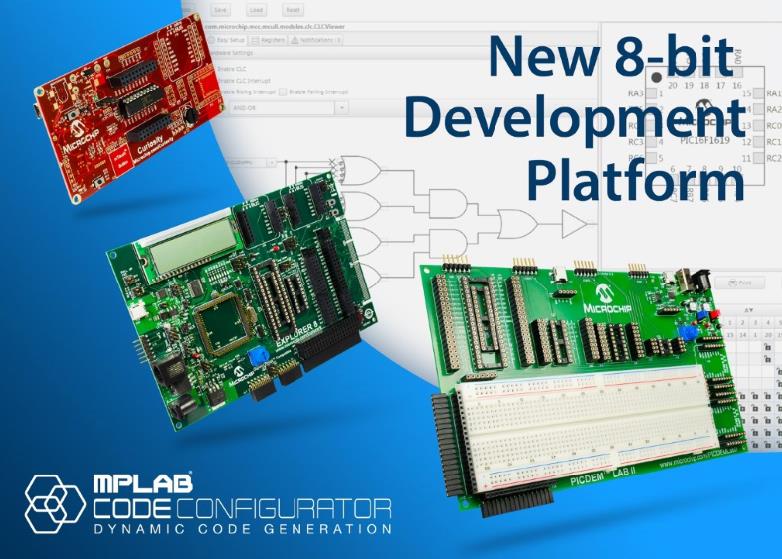
Microchip has expanded its development platform for an innovative portfolio of 8-bit PIC microcontrollers with built-in core-independent peripherals.
■ Does support for Microchip and third-party module expansion boards for easy wired, wireless, and sensor connections apply to all MCU development boards?
The previously mentioned development boards are the Curiosity development board, PICDEM Lab II, and Explorer 8, and can be used with expansion boards from MikroElectronika and Digilent, as well as the three boards mentioned above and other boards from MikroElectronika and Digilent.
■ What benefits does the Curiosity development board provided by Microchip offer to developers?
Microchip designed the Curiosity board as a complete all-in-one development solution supporting Microchip's most popular low-pin-count 8-bit PIC MCUs. Designers can start development immediately (with built-in on-board programmer/debugger) and purchase expandable boards as needed at a very low price ($20).
Users can develop by adding third-party modules everywhere, from sensors to GPS and Wi-Fi connections. Based on these capabilities, the Curiosity board is the optimal tool for developing various “connected” sensor node applications. The Curiosity board supports 8, 14, and 20-pin PIC MCUs.
Smartphones, laptops, via Curiosity Board
for internet router access
Add wireless connectivity features very easily
■ It was stated that the Curiosity board is the optimal tool for developing diverse “connected” sensor node applications, which suggests it is also suitable for IoT applications. What characteristics does it possess for IoT applications, which are a recent trend?
The Curiosity board will be an excellent starting point for IoT design. This is because it allows you to very easily add wireless connectivity features for smartphones, laptops, and internet router access (via Microchip's RN4020 or MikroElecktronica's Wifi Click board). Microchip plans to showcase hands-on and technical resources highlighting the connectivity aspects of Curiosity on its website.
■ You mentioned that the PICDEM Lab II development board is relatively easy for even beginners to use.
PICDEM Lab II was developed for analog designers and hobbyists. It features a large breadboard and various options for connecting PIC MCUs to various sensors, motor drivers, and other external hardware. This board offers great flexibility to designers who want to add intelligence to analog circuits.
Since 8-bit PIC MCUs include intelligent analog modules (comparators, operational amplifiers, DACs, ADCs, slope compensation), this product was developed to provide an easy platform for testing various switching power supply configurations and complex motor control schemes. While providing these functions, PICDEM Lab II also supports third-party MikroElektronika click boards such as the Curiosity board. It supports 6, 8, 14, 18, 20, 28, and 40-pin PIC MCUs.
Focusing on showcasing practical training and technical materials
■ Then, who is the primary target audience for the Explorer 8 development board?
The Explorer 8 development board supports the widest and most diverse range of 8-bit PIC MCUs. For developers using PIC MCUs across a wide range of pin counts, the Explorer 8 is the wisest choice. Several external hardware devices widely used with PIC MCUs, such as a USB-serial interface and a 2x16 LCD display, have been added.
Add-on boards are also supported most extensively, including connections to MikroElektronika's Click, Digilent's PMOD, PICtail™ daughterboards, and on-board user interfaces. Explorer 8 will be the perfect choice for industrial control system designers who wish to develop entire systems on standardized hardware prior to the production phase. All pin counts from 6-pin to 100-pin are supported.
■ I would like to hear the roadmap for the future development board. What areas do you plan to focus on developing going forward?
Microchip is currently focusing on showcasing practical exercises and technical resources that highlight the capabilities of these three new development boards. These boards are versatile and will serve as excellent guides for developing most 8-bit applications.
Microchip's latest MCU products
1. New low-cost, low-power PIC MCU,
Extended battery life and external memory savings with 1 MB dual-partition flash
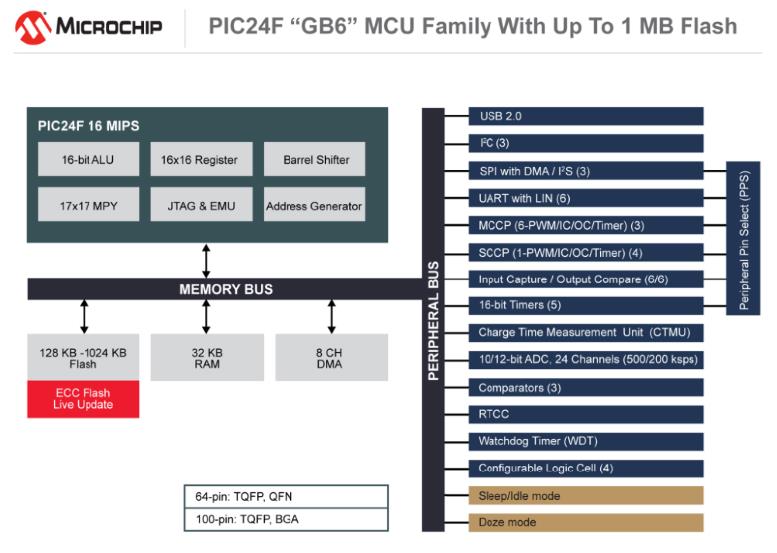
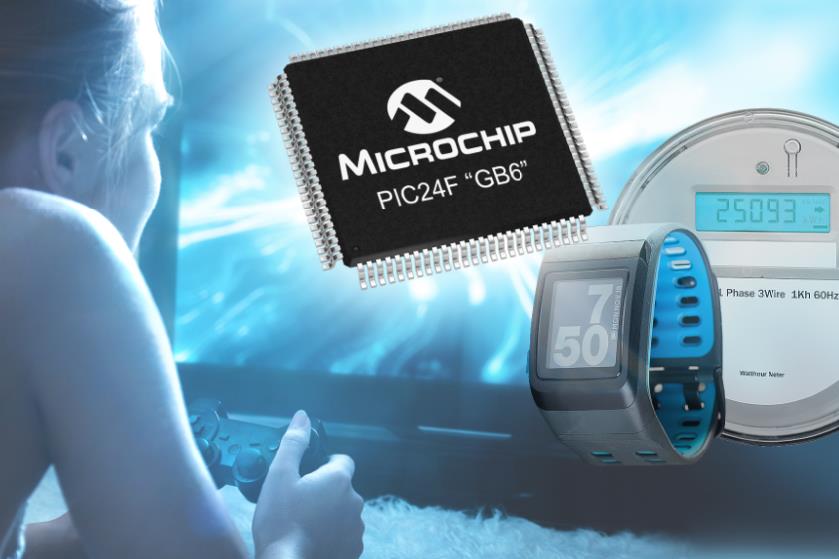
Microchip Technology announced that it is expanding the portfolio of its low-power PIC® microcontroller (MCU) family. The new PIC24F 'GB6' family is the first 16-bit MCU in the Microchip family to feature large memory, and it includes up to 1MB of flash memory with ECC (Error Correction Code) functionality and 32KB of RAM.
In addition, this device, equipped with dual-partition flash that provides live update capabilities, can run two independent software applications and allows for the simultaneous execution of application code on one partition while programming the other. With this powerful combination, the PIC24F 'GB6' family is ideal for industrial, computer, medical/fitness, and portable applications that require data transfer and storage without external memory, along with long battery life. These applications include power metering, HVAC control, fingerprint scanners, and gaming.
2. Expansion of the high-performance 32-bit MCU family equipped with floating-point processing units
Provides superior performance and minimal latency in intensive single-precision and double-precision math applications
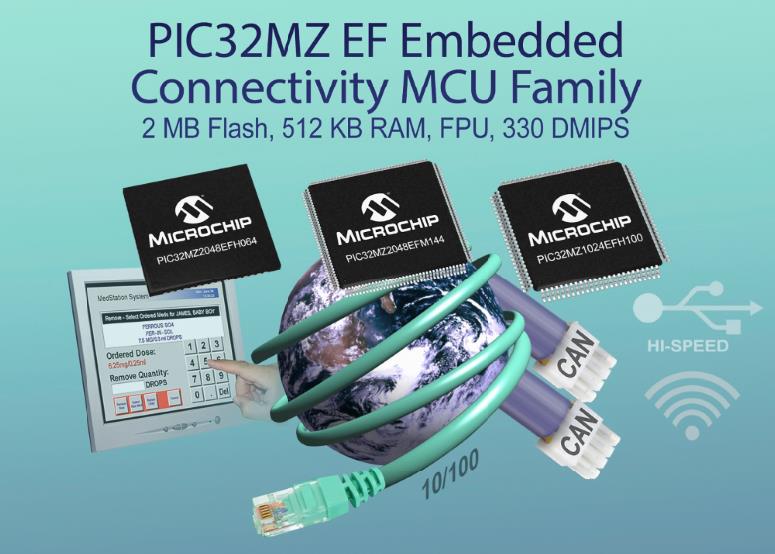
Microchip Technology announced that it is adding a new product series with a built-in hardware floating-point unit (FPU) to its high-performance PIC32MZ 32-bit microcontroller (MCU) family. This new product series provides excellent performance and minimal latency in intensive single-precision and double-precision mathematical applications.
Comprising 48 products, this new PIC32MZ EF series features a 12-bit 18 MSPS analog-to-digital converter (ADC), making it suitable for various types of high-speed, wide-bandwidth applications. Additionally, the PIC32MZ EF series provides a comprehensive DSP instruction set. By offering DSP instructions, a double-precision FPU, and a high-speed ADC, it improves code density, reduces latency, and accelerates performance in process-intensive applications.
3. PIC32MX1/2 32-bit Microcontroller Series Expansion
Equipped with cost-optimized 256KB flash and up to 83 DMIPS performance
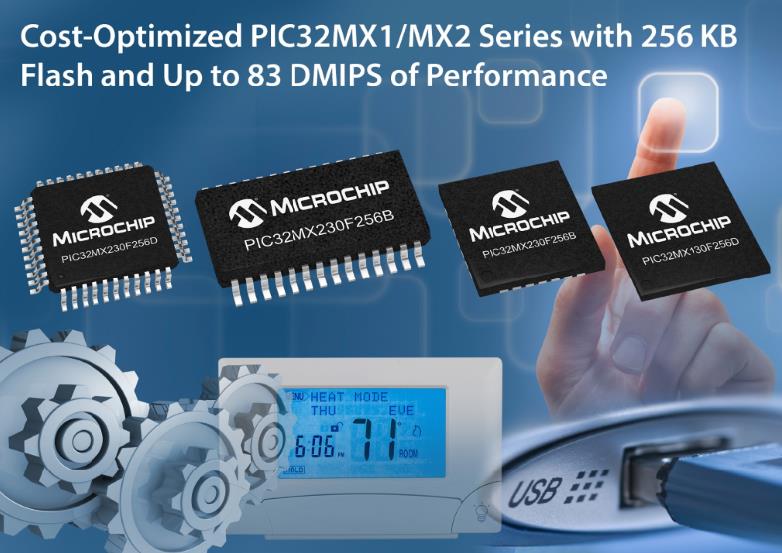
Microchip Technology announced a new series of its PIC32MX1/2 32-bit microcontroller (MCU) family, featuring a large 256KB flash configuration and 16KB RAM, available in a small footprint package. This latest addition to the general-purpose MCU family provides flexibility for low-cost applications requiring complex algorithms and application code, and can be used with Microchip's extensive software and tools for graphics, touch sensing, and general-purpose embedded control design.
The new PIC32MX1/2 MCU series features a wide range of rich capabilities, including performance of up to 50 MHz/83 DMIPS for advanced control applications and mTouch® capacitive touch sensing. In addition, it provides an enhanced 8-bit Parallel Master Port (PMP) for graphics or external memory, a 10-bit, 1 Msps, 13-channel Analog-to-Digital Converter (ADC), support for SPI and I2S serial communication interfaces, and USB Device/Host/OTG (On-the-Go) functions.
Comments
Related news

[Cafe E-People] Visiting the MCU Community ② Oroka, Reborn as a System Engineer through Robots
E4ds News meets with community operators who share information related to MCU (Micro Controller Unit). The second community in 'In Search of MCU Community' is the 'Open Robotics Community Oroca'. Robots, which are called the comprehensive art of science, require MCUs that implement various sensor detection and motion control. This community currently has 30,000 members and actively conducts practical information exchange through offline meetings based on projects. Park Hyung-il (photo), a sub-operator of this café who speaks with a smile about "sticking one's nose in," expressed, "It would be good if our café could play a more progressive role in this field," and also conveyed that "the true value of a community lies in sharing." In listening to the stories of Oroca's past and future told with laughter and sometimes complaints, it was a time where one could sense both affection and ambivalence toward the café.
2015.12.07by 명세환 기자

[Planning] Going to MCU Companies ④ Renesas (2), “Providing ‘A to Z’ of Automotive MCUs with Reliability Built Up Over a Long Time”
"Visiting MCU Companies" introduces automotive MCUs from Renesas, the absolute leader holding the number one position in the global MCU market (based on 2014 Gartner statistics). Renesas, commanding nearly 40% of the global automotive MCU market, supplies application-specialized MCU products to the extent that it has organized its business divisions by field. We met with Kim Se-yong, Director at Renesas Korea (photo), who is pursuing Renesas's vision of a high-performance, safety-oriented automotive single-chip solution.
2015.12.28by 신윤오 기자

[MCU Q&A] 1. What criteria should I apply when selecting an MCU?
MCU Q&A ① Microcontrollers (MCUs) are essential components with diverse applications, ranging from rice cookers in our everyday lives to cutting-edge automobiles. But how much do we really know about MCUs? Do we simply select products based on the basic specifications that match the system we want to use? Or are you curious about how to connect an EEPROM to an MCU, what the differences are between MCUs and DSPs, or what the criteria are for selecting MCU peripherals? Starting today, e4ds News will run a four-part MCU Q&A series. We hope that information you have been curious about or may have overlooked will help you in selecting the right products.
2016.01.18by 신윤오 기자
Intel Unveils Next-Generation 'Core Ultra Series 3' and vPro Platform for Enterprise PCs
Intel has officially unveiled the "Intel Core Ultra Series 3" for next-generation enterprise PCs and the latest vPro platform, addressing a wide range of demands from enterprise notebooks to high-performance workstations.
2026.03.26by 배종인 기자
ROHM Launches ESD Protection Diode Compatible with High-Speed Interfaces of 10Gbps or Higher
Semiconductor specialist ROHM has developed the 'RESDxVx series' of ESD (electrostatic discharge) protection diodes capable of responding to next-generation high-speed data communication environments exceeding 10Gbps, simultaneously enhancing both signal quality maintenance required in high-speed interfaces and IC protection performance.
2026.03.26by 배종인 기자











